
The UP Vidhan Sabha introduced facilities allowing speeches in regional dialects with interpretation services – a first in Indian legislature.
Official Language Policy (Legal & Constitutional Framework)
- Hindi is the official language of Uttar Pradesh, adopted under the Uttar Pradesh Official Language Act, 1951, in alignment with Article 345 of the Indian Constitution, which empowers states to select their official languages.
- The Devanagari script is used for all official purposes.
- Urdu was granted the status of second official language through the Uttar Pradesh Official Language (Amendment) Act, 1989, ensuring its use in administrative, judicial, and educational domains where applicable.
- English functions as a associate/working language, particularly in higher judiciary, administration, and academia, though not a state official language per se.
Regional Languages and Dialects
Uttar Pradesh is linguistically rich. Apart from Hindi (and Urdu), the state is home to multiple Indo-Aryan languages/dialects, many of which have distinct literary and cultural identities. These varieties form a dialect continuum that is blends of cultural history, geography, and social ethos.
-
Khari Boli / Kauravi
-
-
- Considered the prestige dialect of Hindustani and the basis of Standard Hindi and Urdu.
- Spoken mainly in Western Uttar Pradesh, surrounding Delhi and southern Uttarakhand.
-
-
Awadhi
-
-
- Indigenous to the Awadh region (Lucknow, Ayodhya, Sultanpur, Raebareli).
- Rich literary tradition, e.g., Tulsidas’s Ramcharitmanas.
- Awadhi has millions of speakers and historically significant folk literature.
-
-
Braj Bhasha
-
-
- Spoken in Braj region, eg., Mathura, Agra, Aligarh and surroundings.
- Deeply linked with Krishna Bhakti tradition, with abundant folk and devotional literature.
-
-
Bhojpuri
-
-
- Dominant in Eastern UP (Purvanchal) – Varanasi, Gorakhpur, Azamgarh, Ballia.
- Also spreads beyond UP to Bihar and globally via diaspora communities (Mauritius, Fiji, Caribbean).
- It has strong folk, song, and theatrical traditions.
-
-
Bundeli
-
-
- Spoken in Bundelkhand region (Jhansi, Lalitpur, Banda).
- Part of the Western Hindi subgroup and historically linked to regional oral and folk traditions.
-
-
Kannauji
-
-
- Found in parts of Doab region of Kannauj, Kanpur, Farrukhabad, Etawah.
- Shares features with both Awadhi and Braj and sometimes considered transitional to Western Hindi.
-
-
Bagheli
-
- Spoken around Baghelkhand in southeastern UP.
- An Indo-Aryan language with links to Eastern Hindi groups.
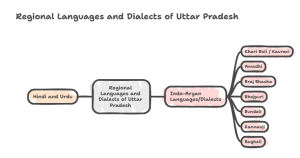
Source: ForumIAS
| Read more about Music and Dance of UP |
Language Continuum & Sociolinguistic Reality
- Rather than sharp boundaries, these “languages/dialects” often form a continuum, blending into one another across regions.
- Standard Hindi and Urdu dominate in urban centers, while regional varieties thrive in rural and cultural milieus.
Cultural & Administrative Significance
-
Cultural Role
-
-
- Regional languages are carriers of folk lore, music traditions, festivals, and historical literature (e.g., Ramcharitmanas in Awadhi, Braj devotional poetry).
- Many local linguistic communities maintain oral and performance traditions that preserve cultural ethos.
-
-
Administrative Role
-
- Hindi as the official language ensures uniformity in administration and governance.
- Urdu’s official status caters to linguistic minorities and enriches the cultural-literary fabric (especially in Lucknow and Aligarh).
Government Initiatives & Policy Measures
Uttar Pradesh has taken several initiatives to support language inclusion and preservation:
-
Multilingual Legislative Proceedings
-
-
- The UP Vidhan Sabha introduced facilities allowing speeches in regional dialects with interpretation services — a first in Indian legislature.
-
-
Language Expansion in Education
-
-
- The state has introduced South Indian and Bengali languages into vocational education, allowing students to learn additional languages and fostering cultural unity.
-
-
Preservation of Dialects
-
-
- Efforts like the development of dialect dictionaries and translation resources (e.g., bilingual teaching materials) help preserve regional linguistic heritage and make learning accessible.
-
-
Promotion of Classical and Traditional Languages
-
-
- Training programs like Sanskrit Sambhashan Yojana aim to revive and popularize Sanskrit through conversational training and workshops.
-
-
Cultural Organizations
-
- Institutions like the Uttar Pradesh Hindi Sansthan actively promote Hindi literature, organise events, and honour litterateurs under state patronage
Challenges and Contemporary Issues
While UP’s linguistic fabric is rich, several challenges persist:
-
Dialect vs Language Classification
-
-
- Most regional varieties are treated as “dialects” under administrative records, often lumped under Hindi in censuses, leading to under-representation and policy neglect.
-
-
Educational Integration
-
-
- Regional languages often lack formal curriculum support and educational material in schools, which constrains intergenerational transmission and literacy.
-
-
Technological & Digital Divide
-
-
- Limited digital content and computational resources for many regional languages restrict their use in modern platforms, media, and e-governance.
-
-
Urban-Rural Divide
-
-
- Urban dominance of Standard Hindi marginalises local varieties, especially in official communication and media, potentially leading to erosion of local linguistic identity.
-
-
Resource Constraints
-
- Insufficient documentation, scholarly research, and lexicographical resources for dialects hamper the creation of standardized educational tools which is a challenge for long-term preservation.
Way Forward
- Institutional Recognition: Provide formal policy support and documentation for major regional languages instead of subsuming them under Hindi.
- Educational Integration: Introduce regional languages as optional subjects and develop localized textbooks and trained teachers.
- Digital Promotion: Enable regional languages in e-governance, translation tools, and digital platforms to enhance accessibility.
- Cultural Preservation: Support folk literature, theatre, and oral traditions through grants, festivals, and language academies.
- Administrative Inclusion: Expand multilingual practices in legislature and local governance for inclusive public service delivery.
Conclusion
Uttar Pradesh reflects deep linguistic layering from its official language policy centered on Hindi and Urdu to a rich spectrum of regional languages and dialects like Awadhi, Braj Bhasha, Bhojpuri, Bundeli, Kannauji, Bagheli, and Khari Boli. These varieties not only enhance the cultural richness and regional identity of India’s most populous state but also pose policy challenges in language preservation, representation, and educational integration.