
What do you understand by the notion of Statecraft? Discuss the theory of statecraft as given by Kautilya.
How the answer moves
The flow snapshot — the routes in, the body, the counter-view and the routes out.
Route 1 statecraft = skilful management of state affairs (administration, law, finance, diplomacy, war, welfare) → Kautilya gives its first systematic theory
Route 2 Bulpitt’s lens: governing challenges + strategic choices of leadership → Arthashastra as practical governance
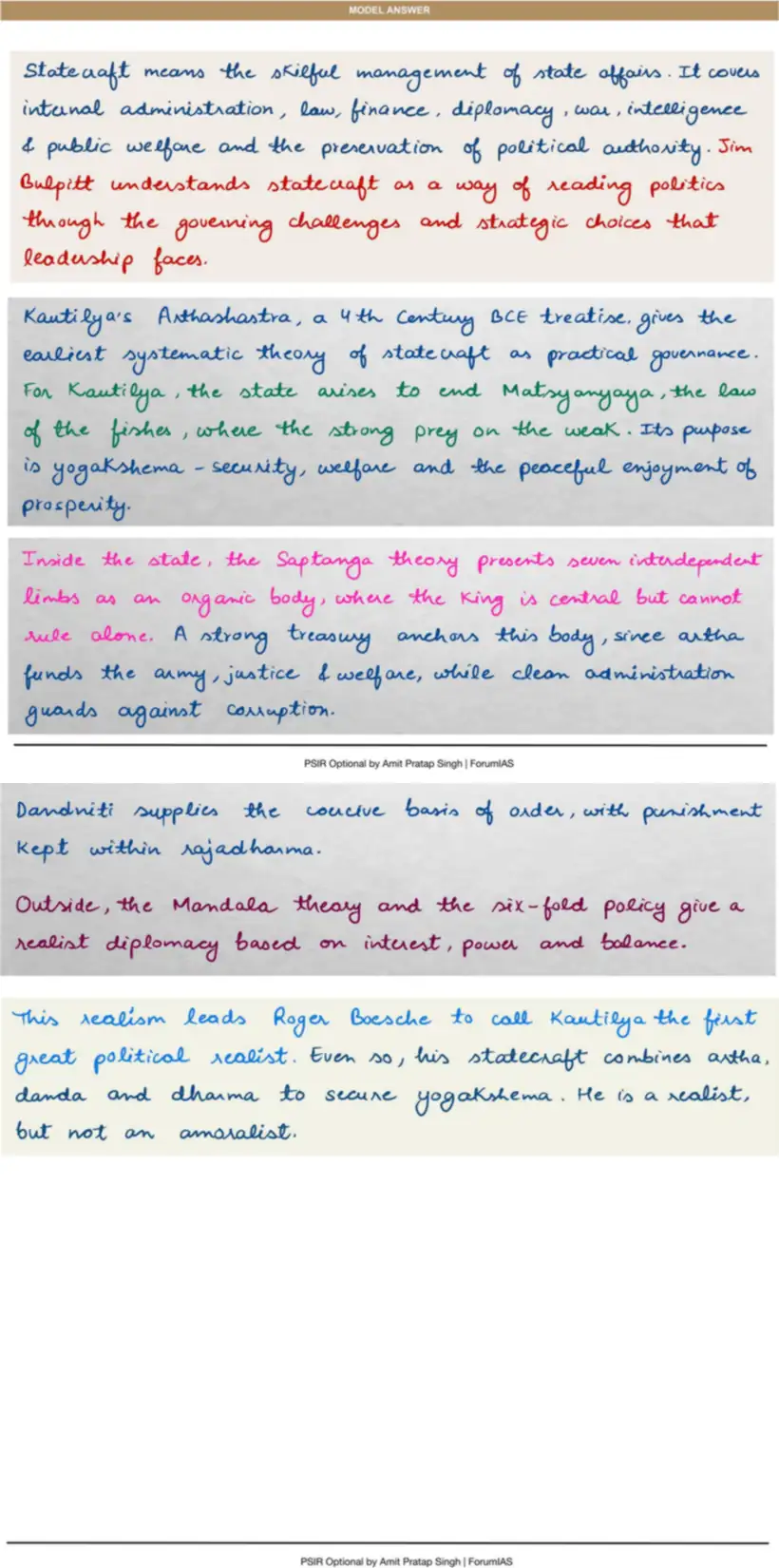
statecraft defined → Bulpitt → Arthashastra as practical governance → state ends Matsyanyaya → purpose = yogakshema → Saptanga (organic state, seven interdependent limbs; king central but dependent) → treasury / artha funds army, justice, welfare; clean administration vs corruption → dandniti (coercive order) kept under rajadharma → Mandala + six-fold policy (realist diplomacy: interest, power, balance) → Boesche: first great political realist → artha + danda + dharma synthesis
realist, even labelled the first great political realist (amoral, power-centred reading) → power disciplined by rajadharma and aimed at yogakshema — realist, not amoralist
Route 1 integrated statecraft: artha (foundation), danda (order), dharma (legitimacy), yogakshema (purpose) → realist, not amoralist
Route 2 Kautilya’s continuing relevance: earliest, comprehensive, non-Western theory of statecraft that ties power to welfare
Model answer
Handwritten, in the form it would be written in the examination hall.
Also asked on this head
Indian Political Thought — 21 questions in the Vault.
- Analyze Kautilya’s Saptanga theory. How do you explain its significance in present-day politics?
- Discuss Gandhi’s approach to property in relation to trusteeship.
- Discuss B. R. Ambedkar’s views on democracy and State socialism.
How this is taught
The same flow snapshot, built for every head of the syllabus, with the answer written in class.
The first session of Foundation 2027 is published in full.
Six programmes across three levels.