
Buddhist thought on Dhamma facilitates the emancipation of political action. Explain.
How the answer moves
The flow snapshot — the routes in, the body, the counter-view and the routes out.
Route 1 Dhamma = righteousness / justice / moral law → stands above Ānā (command) → guided by it, power freed from greed, turned to welfare
Route 2 in Buddhism politics rooted in ethics → command alone not legitimate → Dhamma gives political action its moral direction → hence emancipatory
Dhamma superior to state → empowers order + restrains tyranny → force without Dhamma not legitimate → one standard binds king & subject, public & private acts → power becomes responsibility, else Rativijja → emancipation = freedom from greed / domination / caste arrogance / ritual hierarchy / self-interest → worth by conduct not birth → Ambedkar: morality protecting weak from strong → reduces suffering, not domination → no fixed system, only a moral compass → Aśoka (welfare / impartial justice / tolerance) → Gandhi (Ahimsa) + Thich Nhat Hanh (mindful action)
risk of politicisation → ethno-nationalist capture of Dhamma → moral ideals hard to fix in secular institutions
Route 1 power must serve welfare → authority morally accountable → political action guided by Dhamma
Route 2 not a return to moralism, but Dhamma as a moral compass → authority becomes an instrument of moral & social emancipation
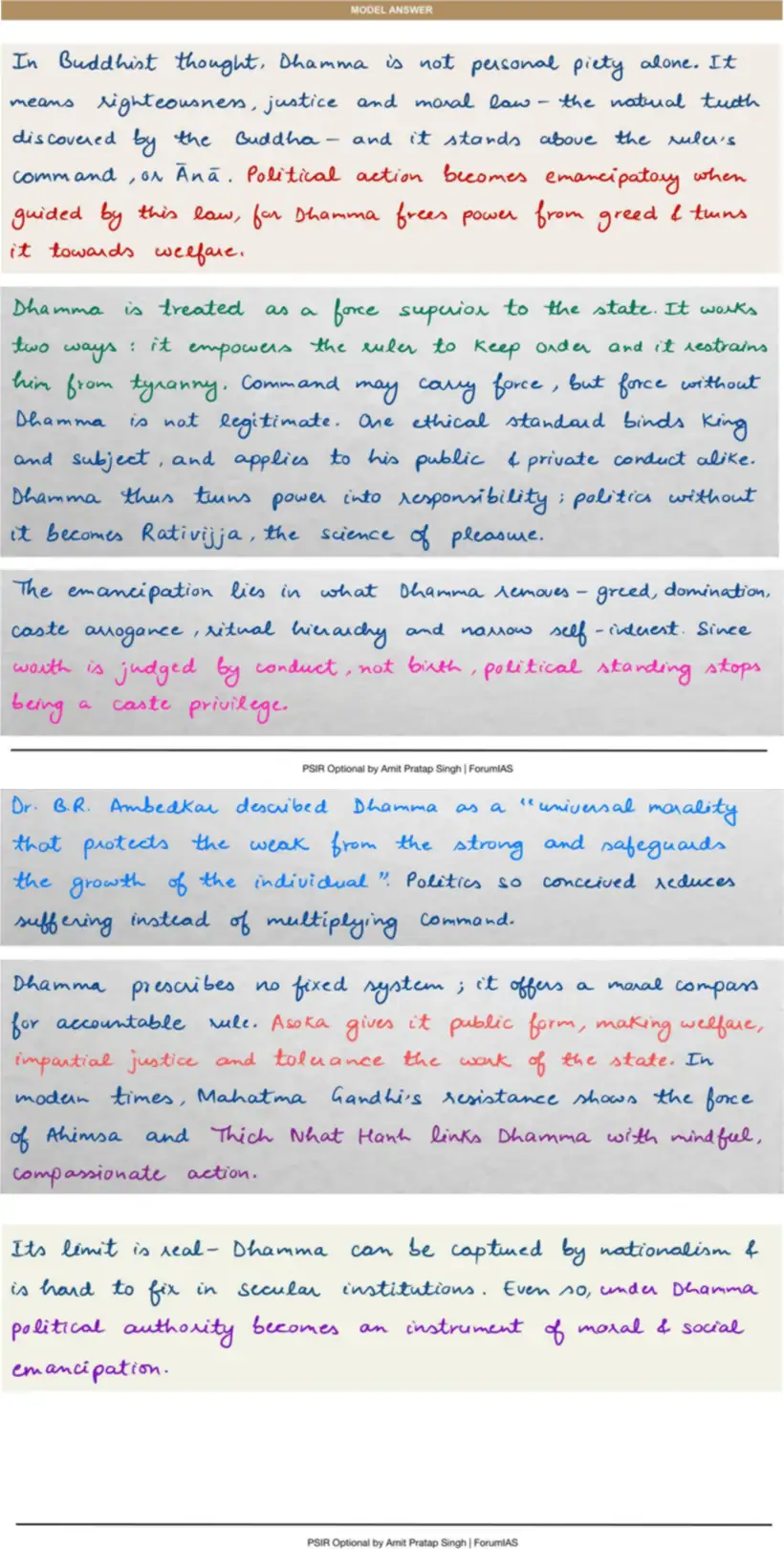
Model answer
Handwritten, in the form it would be written in the examination hall.
Also asked on this head
Indian Political Thought — 21 questions in the Vault.
- Analyze Kautilya’s Saptanga theory. How do you explain its significance in present-day politics?
- Discuss Gandhi’s approach to property in relation to trusteeship.
- Discuss B. R. Ambedkar’s views on democracy and State socialism.
How this is taught
The same flow snapshot, built for every head of the syllabus, with the answer written in class.
The first session of Foundation 2027 is published in full.
Six programmes across three levels.