
Kautilya’s views on the elements of the State.
How the answer moves
The flow snapshot — the routes in, the body, the counter-view and the routes out.
Route 1 State as a living body — Kautilya’s Saptanga = seven interdependent limbs; “a single wheel cannot move the chariot”
Route 2 sovereignty (Garner) — making a ~4th-century-BCE account strikingly comprehensive
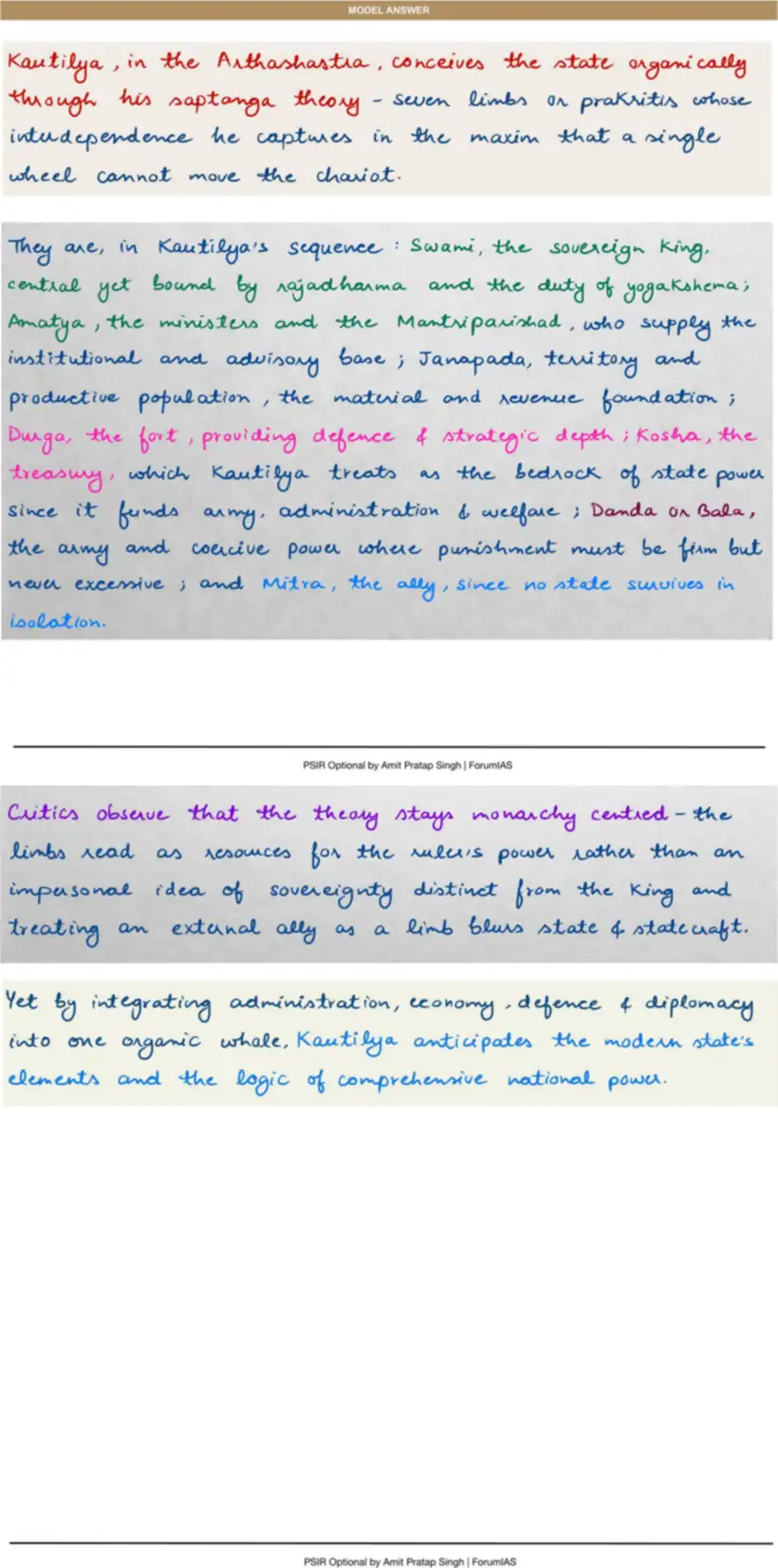
Swami (sovereign king, bound by rajadharma, owes yogakshema) → Amatya (ministers, Mantriparishad — institutional base) → Janapada (territory + productive population — revenue/social base) → Durga (fort — defence, strategic depth) → Kosha (treasury — bedrock; funds army, administration, welfare) → Danda/Bala (army + coercion — punishment firm, never excessive) → Mitra (ally — no state survives in isolation). Thread: organic interdependence; the king must strengthen every limb
theory is monarchy-centred — limbs read as resources for the king’s power, not an impersonal/juristic sovereignty distinct from the ruler; including an external ally (Mitra) as a “limb” blurs state and statecraft. [Balance: A.S. Altekar reads Mitra’s inclusion as analogous to recognition in modern statehood]
Route 1 by binding administration, economy, defence and diplomacy into one organic whole, Saptanga is an integrated theory of the state that anticipates its modern elements
Route 2 reads as an early template of comprehensive national power — leadership, territory, treasury, military, diplomacy — still resonant in national-security and statecraft analysis
Model answer
Handwritten, in the form it would be written in the examination hall.
Also asked on this head
Indian Political Thought — 21 questions in the Vault.
- Analyze Kautilya’s Saptanga theory. How do you explain its significance in present-day politics?
- Discuss Gandhi’s approach to property in relation to trusteeship.
- Discuss B. R. Ambedkar’s views on democracy and State socialism.
How this is taught
The same flow snapshot, built for every head of the syllabus, with the answer written in class.
The first session of Foundation 2027 is published in full.
Six programmes across three levels.