
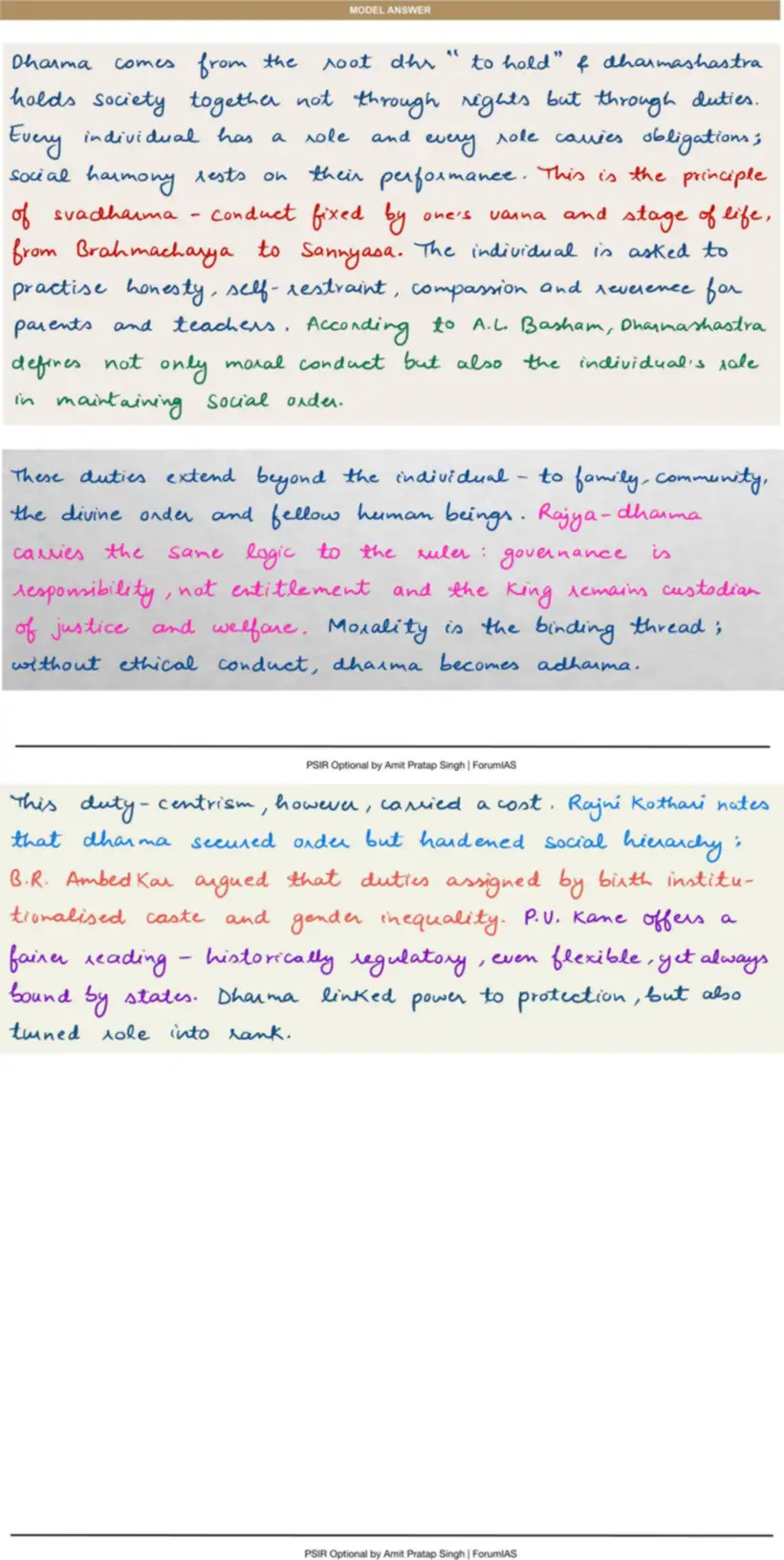
Dharmashastra presents a duty-centric worldview for individuals and communities. Comment.
How the answer moves
The flow snapshot — the routes in, the body, the counter-view and the routes out.
Route 1 dharma from root dhr, “to hold” → society held together by duties, not rights
Route 2 duty-centric worldview → role + obligation as the axis → harmony through svadharma
svadharma: varna + ashrama fix the duty → individual virtues (honesty, self-restraint, reverence for parents/teachers) → Basham: moral conduct and the individual’s role in social order → duties extend outward (family, community, divine order, fellow humans) → Rajya-dharma: ruler as custodian, governance = responsibility not entitlement → morality the binding thread; ethical failure = adharma
Kothari: order secured but hierarchy hardened → Ambedkar: duties assigned by birth → caste + gender inequality
Route 1 Kane’s contextual reading: regulatory, even flexible, yet bound by status
Route 2 duty linked power to protection, but turned role into rank
Model answer
Handwritten, in the form it would be written in the examination hall.
Also asked on this head
Indian Political Thought — 21 questions in the Vault.
- Analyze Kautilya’s Saptanga theory. How do you explain its significance in present-day politics?
- Discuss Gandhi’s approach to property in relation to trusteeship.
- Discuss B. R. Ambedkar’s views on democracy and State socialism.
How this is taught
The same flow snapshot, built for every head of the syllabus, with the answer written in class.
The first session of Foundation 2027 is published in full.
Six programmes across three levels.