
Explain the sources of ancient Indian political thought.
How the answer moves
The flow snapshot — the routes in, the body, the counter-view and the routes out.
Route 1 no single treatise → thought scattered across genres → embedded in dharma / danda / kingship
Route 2 Mahendra Prasad Singh → religion, morality, sages as sources → ideas gathered, not found in one text
Vedas + Upanishads (rajan, sabha/samiti, dharma as inner law) → Epics (Mahabharata/Shantiparva: rajadharma, dandaniti, origin of state; Ramayana: Rama-rajya) → Dharmasutras/Dharmashastras/Smritis (Manusmriti, Manu = first law-giver: varna, ashrama, rajadharma) → Arthashastra (Kautilya: realist statecraft — admin, tax, diplomacy, war) → Buddhist + Jain (Jatakas, Mahasammat, Somadeva: consensual + welfare kingship) → inscriptions / coins / foreign accounts (Megasthenes, Fahien, Huan Tsang: actual practice)
Western doubt (Max Mueller: India = only religion) → Indian depth affirmed (Bhandarkar, Barker)
Route 1 scattered genres together → rich, serious political tradition
Route 2 the plurality of sources is itself the defining mark of the tradition
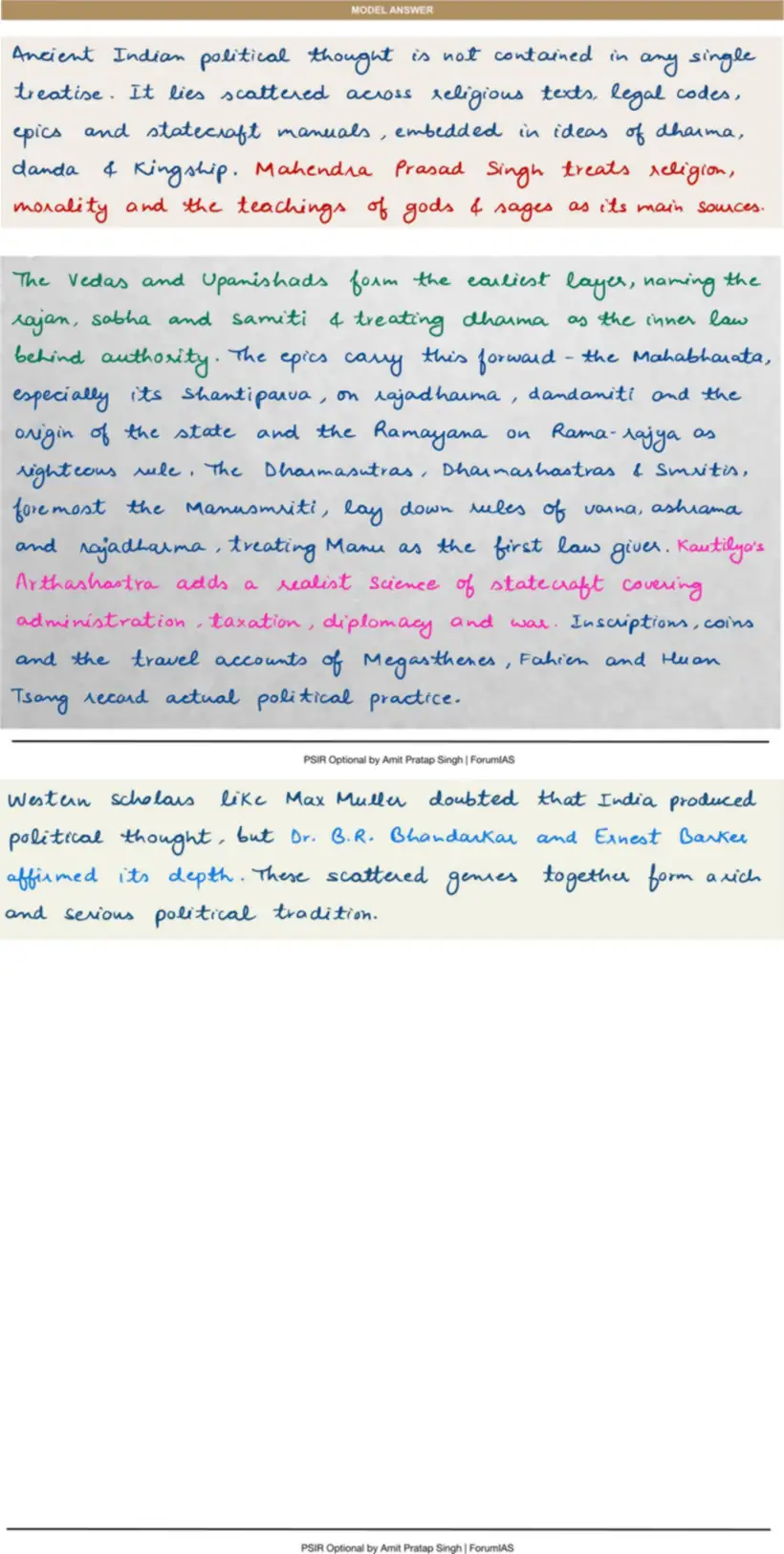
Model answer
Handwritten, in the form it would be written in the examination hall.
Also asked on this head
Indian Political Thought — 21 questions in the Vault.
- Analyze Kautilya’s Saptanga theory. How do you explain its significance in present-day politics?
- Discuss Gandhi’s approach to property in relation to trusteeship.
- Discuss B. R. Ambedkar’s views on democracy and State socialism.
How this is taught
The same flow snapshot, built for every head of the syllabus, with the answer written in class.
The first session of Foundation 2027 is published in full.
Six programmes across three levels.