
Do you think that the Buddhist traditions have lent ereater ethical foundation to the ancient Indian political thought? Give your arguments.
How the answer moves
The flow snapshot — the routes in, the body, the counter-view and the routes out.
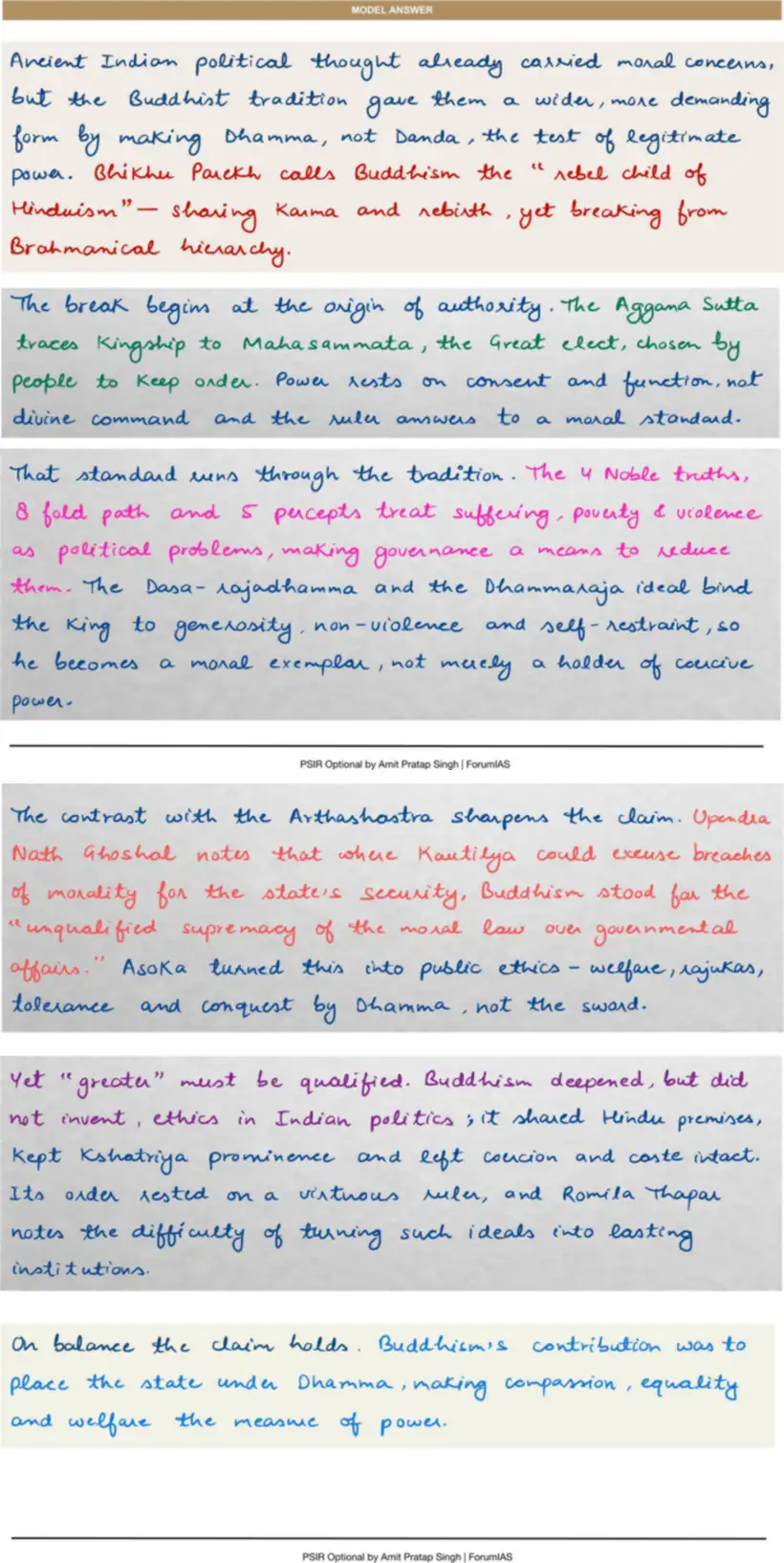
Route 1 moral concerns already present in Indian thought → Buddhism’s shift = Dhamma over Danda as the test of power
Route 2 Parekh’s “rebel child of Hinduism” → breaks Brahmanical hierarchy while sharing Karma/rebirth → raises the ethical bar
Agganna Sutta / Mahāsammata → consent + function, not divine command → Four Noble Truths / Eightfold Path / Five Precepts → governance as means to reduce suffering → Dasa-rājadhamma / Dhammarāja → ruler as moral exemplar → Ghoshal vs Kautilya → supremacy of moral law over the state → Aśoka → welfare, rajukas, tolerance, conquest by Dhamma
deepened, did not invent → shared Hindu premises → Kshatriya prominence retained → coercion + caste left intact → order depends on a virtuous ruler → Thapar: ideals hard to institutionalise
Route 1 claim holds → Buddhism placed the state under Dhamma → compassion / equality / welfare become the measure of power
Route 2 “greater” = moral law made supreme over the state → authority as an instrument of emancipation, even if the ethic was deepened, not originated
Model answer
Handwritten, in the form it would be written in the examination hall.
Also asked on this head
Indian Political Thought — 21 questions in the Vault.
- Analyze Kautilya’s Saptanga theory. How do you explain its significance in present-day politics?
- Discuss Gandhi’s approach to property in relation to trusteeship.
- Discuss B. R. Ambedkar’s views on democracy and State socialism.
How this is taught
The same flow snapshot, built for every head of the syllabus, with the answer written in class.
The first session of Foundation 2027 is published in full.
Six programmes across three levels.