
Study Approach
Start with the big picture: First understand the geological evolution of India. Follows a chronological sequence: Formation of the Indian Plate → Himalayan uplift → Development of the Indo-Gangetic Plain → Classification of Rock Systems → Economic and Geological Significance.
Study Block 1: Geological Evolution of India
How to Read This Block
Begin with the major geological events that shaped India. Focus on plate movement, continental collision, and sediment deposition rather than memorizing dates.
What to Understand
- Evolution of the Indian Plate
- Formation of the Himalayas
- Development of the Indo-Gangetic Plain
- Why geological history determines present-day landforms and mineral resources
Study Block 2: Classification of Rock Systems
Study the four rock systems in chronological order:
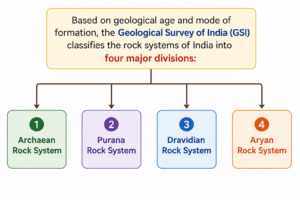
Archaean → Purana → Dravidian → Aryan
How to Read This Block
For every rock system, use the same headings:
- Geological age
- Mode of formation
- Rock types
- Distribution
- Minerals
- Economic importance
What to Memorize
- Geological sequence
- Major rock types
- Important mineral associations
- Major locations
- Geological eras
What to Understand
- Difference between igneous, sedimentary, and metamorphic rocks.
- Why different minerals occur in different rock systems.
- Relationship between rock formation and India’s mineral wealth.
Study Block 3: Important Rock Systems
Study each separately:
- Archaean & Dharwar
- Cuddapah
- Vindhyan
- Gondwana
- Deccan Trap
- Quaternary
Focus Areas
Link every rock system with:
- Characteristic rocks
- Minerals
- Fossils
- Agriculture
- Economic importance
Examples:
- Dharwar → Gold & Iron
- Vindhyan → Diamonds
- Gondwana → Coal
- Deccan Trap → Black Soil
- Quaternary → Bangar, Khadar, Karewas
Study Block 4: Special Geological Concepts
Study:
- Marine Transgression
- Karewas
- Meghalayan Age
Understand how these processes occurred and why they are significant for Indian geography and geology.
Diagram-Based Preparation
Practice these diagrams repeatedly:
- Geological timeline:
Archaean → Purana → Dravidian → Aryan - Geological evolution flowchart:
Gondwanaland → Plate Movement → Himalayan Collision → Indo-Gangetic Plain - India’s geological map showing:
- Dharwar Belt
- Vindhyan Basin
- Gondwana Basins
- Deccan Trap
- Quaternary Deposits
- Flowchart:
Rock System → Rock Type → Minerals → Economic Importance
Important for Prelims
- Order of rock systems
- Geological eras
- Dharwar minerals
- Vindhyan diamonds
- Gondwana coalfields
- Deccan Trap
- Bangar, Khadar, Karewas
- Marine Transgression
- Meghalayan Age
- Important fossil associations
Important for Mains
- Geological evolution of India
- Classification and significance of rock systems
- Relationship between geology and mineral distribution
- Geological controls on agriculture and soils
- Economic importance of rock systems
- Plate tectonics and Himalayan formation
GEOLOGICAL STRUCTURE OF INDIA
| ARCHAEAN ROCK SYSTEM |
| PURANA ROCK SYSTEM |
| DRAVIDIAN ROCK SYSTEM |
| ARYAN ROCK SYSTEM |
| QUATERNARY ROCK SYSTEM |
| MARINE TRANSGRESSION AND MEGHALAYAN AGE |
India’s geological evolution has been shaped by three major events. The Indian Plate, originally part of the ancient Gondwanaland, drifted northward and eventually collided with the Eurasian Plate during the Tertiary Period, leading to the upliftment of the Himalayas. Later, during the Pleistocene Epoch, the Indo-Gangetic Plain was formed through the continuous deposition of sediments by the Ganga, Brahmaputra, and their tributaries, a process that continues even today.
Created by ForumIAS
ARCHAEAN ROCK SYSTEM
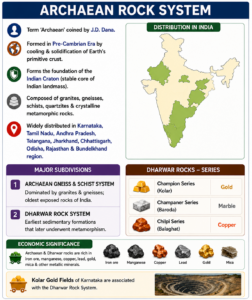
The Archaean Rock System, a term coined by J.D. Dana, represents the oldest rocks of the Earth’s crust. Formed during the Pre-Cambrian Era through the cooling of the primitive crust, these rocks form the foundation of the Indian Craton. They mainly consist of granites, gneisses, schists, quartzites, and crystalline metamorphic rocks and are widely distributed across southern, central, and eastern India.
This system consists of two major subdivisions:
- Archaean Gneiss and Schist System – Dominated by granites and gneisses, forming the oldest exposed rocks of India.
- Dharwar Rock System – Represents some of the earliest sedimentary formations that later underwent metamorphism.
Created by ForumIAS
PURANA ROCK SYSTEM
The Purana Rock System comprises the Cuddapah and Vindhyan Rock Systems, which were formed approximately between 1400 and 600 million years ago. These rocks are primarily sedimentary in origin and were formed through the erosion, transportation, and deposition of Archaean and Dharwar rocks. Common rock types include sandstone, limestone, shale, slate, quartzite, and clay deposits.
Cuddapah Rock System
- The Cuddapah Rock System derives its name from the Kadapa (Cuddapah) district of Andhra Pradesh, where these rocks are extensively exposed.
- These rocks are also found in Andhra Pradesh, southern Chhattisgarh, Odisha, Rajasthan, Delhi, and along parts of the Aravalli Range.
- They consist mainly of shale, slate, quartzite, limestone, and other sedimentary formations.
- Many economically useful minerals and construction materials are obtained from these rocks.
- Sedimentary deposits accumulated in large synclinal basins led to the formation of this rock system.
Vindhyan Rock System
- Named after the Vindhya Mountain Range, this system consists of thick layers of ancient sedimentary rocks deposited over the Archaean basement.
- The Vindhyan formations are estimated to be nearly 4,000 metres thick.
- These rocks are extensively distributed across Madhya Pradesh, Uttar Pradesh, Rajasthan, and Bihar.
- The Vindhyan system contains important diamond-bearing regions, including Panna and the historic Golconda diamond belt.
- Fossil evidence of primitive microorganisms has also been reported from these formations.
- Although poor in metallic minerals, Vindhyan rocks provide abundant ornamental stones, building stones, sandstone, and limestone.
DRAVIDIAN ROCK SYSTEM
The Dravidian Rock System, also known as the Palaeozoic Rock Formation, developed during the Palaeozoic Era (600–300 million years ago). It is often called the Carboniferous Rock System due to extensive coal formation during this period. These rocks occur mainly in the Extra-Peninsular Himalayas and limited parts of the Peninsular Shield. They contain abundant fossils of corals, trilobites, brachiopods, and other marine organisms, reflecting the expansion of early life on Earth.
Although coal formation began during this period, economically significant coal deposits in India are mainly associated with later Gondwana formations.
The term ‘Dravidian’ does not imply that these rocks are confined to South India; it is purely a geological classification.
ARYAN ROCK SYSTEM
The Aryan Rock System represents the youngest major geological formations of India and includes rocks formed after the Carboniferous Period. These rocks belong to the Upper Palaeozoic, Mesozoic, Cenozoic, and Quaternary Eras.
The Aryan Rock System is classified as follows:
○ Upper Palaeozoic Era – Upper Carboniferous formations
○ Mesozoic Era – Gondwana Rock System, Jurassic System, and Deccan Trap Formation
○ Cenozoic Era – Eocene, Oligocene, Miocene, and Pliocene Periods
○ Neozoic (Quaternary) Era – Pleistocene and Holocene Epochs
GONDWANA ROCK SYSTEM
- The Gondwana Rocks were formed during the Mesozoic Era and are among the most economically important rock formations of India.
- They contain nearly 98% of India’s coal reserves.
- Major coalfields associated with Gondwana formations include Jharia, Raniganj, Bokaro, Talcher, Korba, Singrauli, and Wardha Valley.
- Fossil plants such as Glossopteris are characteristic of Gondwana deposits and provide evidence for the existence of Gondwanaland.
DECCAN TRAP FORMATION
- The Deccan Trap was formed due to massive volcanic eruptions around 66 million years ago.
- It is one of the largest volcanic provinces in the world and covers extensive areas of Maharashtra, Madhya Pradesh, Gujarat, Karnataka, Telangana, and parts of Andhra Pradesh.
- The rocks are mainly composed of basaltic lava flows arranged in step-like structures, giving rise to the term “Trap”, derived from the Swedish word meaning staircase.
- Weathering of these basaltic rocks has led to the formation of fertile Black Cotton Soil (Regur Soil).
QUATERNARY ROCK SYSTEM
The Quaternary Rock System includes the most recent geological deposits formed during the Pleistocene and Holocene Epochs. These deposits are mainly unconsolidated sediments laid down by rivers, glaciers, winds, and marine processes.
Important depositional features of this period include:
○ Bangar – Older alluvial deposits occurring above flood levels.
○ Khadar – Newer alluvial deposits replenished annually by floods.
○ Karewas – Lacustrine deposits formed in the Kashmir Valley due to continuous sediment accumulation.
Karewas are particularly important because they support the cultivation of saffron, almonds, walnuts, and other temperate crops.
Significant Quaternary deposits are also found in the Thar Desert, Indo-Gangetic Plain, and Rann of Kutch. The present form of the Rann of Kutch developed as marine areas were gradually filled with sediments during this period.
MARINE TRANSGRESSION AND MEGHALAYAN AGE
MARINE TRANSGRESSION
- Marine Transgression refers to a geological event in which sea level rises relative to land, causing the shoreline to move inland.
- It may occur due to subsidence of land, rise in global sea level, or reduction in the capacity of ocean basins.
- Such events often result in coastal flooding and extensive marine sediment deposition.
MEGHALAYAN AGE
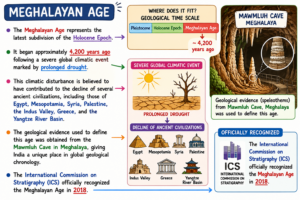
The Meghalayan Age is the latest subdivision of the Holocene Epoch, beginning about 4,200 years ago after a major global climatic event marked by prolonged drought. This climate change is believed to have contributed to the decline of several ancient civilizations, including those in Egypt, Mesopotamia, the Indus Valley, and the Yangtze River Basin.
Created by ForumIAS
Prelims Questions
Q.1) Which of the following rock systems in India is the latest one?
- a) Vindhyan
- b) Cuddapah
- c) Dharwar
- d) Gondwana
U.P.P.C.S. (Pre) 2016
Expected Mains Questions
Q.1) Discuss the characteristics and economic significance of the Archaean Rock System in India.
Q.2) Describe the origin and geographical significance of the Deccan Trap Formation.
Q.3) Examine the role of marine transgression and sedimentation in the geological evolution of India.