
This article explains the importance of forest conservation, India’s National Forest Policy (1952 and 1988), and its major objectives. It also discusses the relationship between forests and tribal communities, highlighting their role in sustainable forest management. Further, this article covers the concept of social forestry and its major types—urban forestry, rural forestry, agro-forestry, community forestry, and farm forestry.
Study Approach
Start with the Big Picture
First understand why forests are important and why their conservation is essential. Then follow this natural flow:
Importance of Forests → Forest Policy in India → Objectives of the National Forest Policy (1988) → Forests and Tribal Communities → Social Forestry and its Types
This sequence helps you connect forest conservation with ecological balance, sustainable development, biodiversity conservation, community participation, and rural livelihoods.
Major Study Blocks
Block 1: Importance of Forest Conservation
Study:
- Ecological importance of forests
- Economic importance
- Direct and indirect benefits
- Need for forest conservation
What to Understand:
- Why forests are called the “green lungs” of the Earth.
- How forests regulate climate and conserve soil and water.
- Why deforestation affects biodiversity and human life.
Block 2: Forest Policy in India
Study:
- Forest Policy, 1952
- National Forest Policy, 1988
- Need for policy revision
What to Understand:
- Why the 1988 policy shifted from commercial forestry to ecological conservation.
- Importance of sustainable forest management.
- Role of local communities in forest conservation.
Block 3: Objectives of the National Forest Policy, 1988
Focus on:
- Increasing forest cover
- Environmental stability
- Biodiversity conservation
- Preventing land degradation
- Afforestation and reforestation
- Meeting rural needs
- People’s participation
What to Understand:
- Why forests are central to tribal livelihoods and culture.
- How tribal knowledge contributes to biodiversity conservation.
- Why participatory forest management is more effective than exclusionary policies.
Block 5: Social Forestry
Understand:
- Meaning of Social Forestry
- Objectives
- National Commission on Agriculture (1976)
Important for Prelims
- Forest Policy 1952
- National Forest Policy 1988
- 33% forest cover target
- Objectives of the National Forest Policy
- National Commission on Agriculture (1976)
- Types of Social Forestry
- Agro-Forestry, Community Forestry, Farm Forestry
- Role of tribal communities in forest conservation
Important for Mains
- Importance of forest conservation in sustainable development
- National Forest Policy, 1988 and its significance
- Forests and livelihood security of tribal communities
- People’s participation in forest management
- Social Forestry as a tool for rural development
- Afforestation and biodiversity conservation
- Forest conservation and climate change mitigation
- Community-based forest management for ecological sustainability
Forest Conservation
| Table Content |
| Forest Policy in India |
| Forests and Tribal Communities |
| Social Forestry |
Forests are one of the most valuable natural resources and play a crucial role in maintaining ecological balance. They are closely linked with human life, biodiversity, climate, soil conservation, and economic development. Forests provide numerous direct benefits such as timber, fuelwood, fodder, fruits, medicines, and other forest products. They also provide indirect benefits by regulating climate, conserving soil, controlling floods, and maintaining biodiversity. Therefore, forest conservation is essential for the survival and prosperity of humankind.
Forest Policy in India
- Recognizing the importance of forests, the Government of India adopted a nationwide forest policy in 1952, which was later revised in 1988 to address emerging environmental concerns and the needs of local communities.
- The National Forest Policy, 1988 emphasizes sustainable forest management. It aims to conserve and expand forest resources while ensuring that the needs of forest-dependent communities are met in a sustainable manner.
Objectives of the National Forest Policy, 1988
• Increasing Forest Cover: The policy aims to bring 33 percent of the total geographical area of the country under forest and tree cover in order to maintain ecological balance.
• Maintaining Environmental Stability: The policy seeks to maintain environmental stability and restore ecological balance in areas where forests have been degraded or destroyed.
• Conserving Biodiversity: It aims to protect the country’s natural heritage by conserving its rich biodiversity, wildlife, and genetic resources.
• Preventing Land Degradation: The policy focuses on reducing soil erosion, checking the expansion of desert areas, and minimizing the occurrence of floods and droughts.
• Promoting Afforestation: Special emphasis is placed on afforestation and reforestation of degraded and barren lands to increase forest cover.
• Meeting Rural Needs: The policy aims to improve forest productivity so that adequate supplies of timber, fuelwood, fodder, and other forest products are available to rural populations dependent on forests.
• Encouraging People’s Participation: The policy encourages the active participation of local communities, particularly women, in tree plantation, forest protection, and conservation activities.
Forests and Tribal Communities
- Forests are closely associated with the lives and livelihoods of tribal communities. For many tribal groups, forests are not only a source of livelihood but also an integral part of their culture and identity.
- Forests provide tribal communities with food, fruits, edible leaves, honey, medicinal plants, roots, and other essential resources. They also supply materials required for constructing houses, making handicrafts, and carrying out traditional occupations.
- Tribal communities possess valuable traditional knowledge about forests and natural resource management. Their experience and understanding of local ecosystems can significantly contribute to forest conservation and sustainable development.
- Instead of treating tribal people merely as collectors of minor forest produce, they should be encouraged to participate actively in forest management and conservation programmes.
Social Forestry
Social forestry refers to the management, protection, and planting of trees on barren, degraded, and community lands with the objective of improving the environment and promoting rural development.
The National Commission on Agriculture (1976) classified social forestry into three categories: Urban Forestry, Rural Forestry and Farm Forestry.
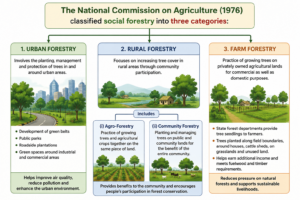
Created by ForumIAS
1. Urban Forestry
- Urban forestry involves the planting, management, and protection of trees in and around urban areas.
- It includes the development of green belts, public parks, roadside plantations, and green spaces around industrial and commercial establishments. Urban forestry helps improve air quality, reduce pollution, and enhance the urban environment.
2. Rural Forestry
Rural forestry focuses on increasing tree cover in rural areas through community participation. It mainly includes Agro-Forestry and Community Forestry.
Agro-Forestry
- Agro-forestry is the practice of growing trees and agricultural crops together on the same piece of land.
- This system helps farmers obtain food grains, fruits, timber, fodder, and fuelwood simultaneously while improving soil fertility and reducing environmental degradation.
Community Forestry
- Community forestry involves planting and managing trees on public and community lands such as village commons, grazing lands, temple lands, canal banks, roadside strips, railway lands, and school premises.
- The main objective of community forestry is to provide benefits to the entire community and encourage people’s participation in forest conservation. It also provides opportunities for landless and economically weaker sections to benefit from tree-growing activities.
3. Farm Forestry
- Farm forestry refers to the practice of growing trees on privately owned agricultural lands for commercial as well as domestic purposes.
- Under this programme, state forest departments provide tree seedlings to farmers, especially small and medium landholders, to encourage tree plantation.
- Trees can be planted along field boundaries, around houses and cattle sheds, on grasslands, and on other unused portions of agricultural land.
- Farm forestry helps farmers earn additional income, meet their fuelwood and timber requirements, and reduce pressure on natural forests.
Prelims Question
Q.1) An example of a multipurpose tree used in social forestry is
a) Sheesham
b) Dhak
c) Eucalyptus
d) Khejri
U.P.P.C.S. (Mains) 2002
Expected Mains Questions
Q.1) “The National Forest Policy, 1988 marked a shift from commercial forestry to ecological conservation.” Discuss.
Q.2) Discuss the role of social forestry in reducing pressure on natural forests and promoting sustainable livelihoods.
Q.3) Forest conservation is essential not only for biodiversity but also for ensuring environmental stability and economic development. Examine.