
Solar energy has emerged as the backbone of India’s clean energy transition due to abundant sunlight, supportive government policies, and growing electricity demand. This article explains India’s major solar initiatives including the National Solar Mission, PM Surya Ghar, PM-KUSUM, International Solar Alliance, Solar Parks, PLI Scheme, and OSOWOG—along with the challenges facing solar development, its significance for energy security and sustainable development, and the way forward to accelerate India’s journey towards net-zero emissions by 2070.
Study Approach
Start with the Big Picture
First understand why solar energy has become central to India’s energy transition—rising electricity demand, energy security, climate commitments, and abundant solar potential. Then follow the natural flow:
Solar Potential → Government Initiatives → Major Schemes → Challenges → Significance → Way Forward
This sequence helps you connect renewable energy with climate change, sustainable development, energy security, agriculture, manufacturing, and India’s global leadership.
Major Study Blocks
Block 1: Solar Energy Potential in India
Study
- Solar radiation in India
- Number of sunny days
- Renewable energy potential
- Role in India’s energy mix
- Net Zero 2070 commitment
What to Understand
- Why India is ideal for solar power generation.
- Why solar energy is important for energy security.
- How solar energy supports climate change mitigation.
Block 2: Government Solar Missions and Schemes.
Study each scheme using the same framework:
Launch Year → Objective → Key Features → Significance
Focus on:
- National Solar Mission (2010)
- PM Surya Ghar: Muft Bijli Yojana (2024)
- PM-KUSUM (2019)
- Solar Park Scheme (2014)
- PLI Scheme
- One Sun One World One Grid (OSOWOG)
- International Solar Alliance (ISA)
Block 3: Major Solar Infrastructure
Study:
- Major Solar Parks
- Leading solar-producing states
- Manufacturing initiatives
Block 4: Challenges in Solar Energy Development
Study under dimensions:
- Technical
- Economic
- Land-related
- Environmental
- Grid Integration
Intermittent Solar → Need for Storage → Grid Balancing → Reliable Renewable Energy
Block 5: Significance of Solar Energy
Study under dimensions:
- Energy Security
- Climate Change
- Economic Development
- Employment
- Rural Development
- Manufacturing
- Global Leadership
Understand interconnections:
- Solar Energy → Energy Security → Reduced Coal Imports
- Solar Energy → Lower Emissions → Climate Action
- Solar Energy → Rural Electrification → Inclusive Growth
- Solar Energy → Manufacturing → Make in India
- Solar Energy → International Cooperation → Global Leadership
Block 6: Way Forward
Focus on:
- Green Energy Corridors
- Battery Energy Storage Systems
- Pumped Hydro Storage
- Rooftop Solar Expansion
- Domestic Manufacturing
- Solarisation of Agriculture
- Smart Grids
- Forecasting & Grid Management
Important for Prelims
- National Solar Mission
- PM Surya Ghar Scheme
- PM-KUSUM
- International Solar Alliance
- OSOWOG
- Solar Park Scheme
- PLI Scheme
- Major Solar Parks and States
- Launch years
- Headquarters of ISA
- Current solar capacity and renewable energy targets
Important for Mains
- Solar energy and India’s energy security
- Solar power in achieving Net Zero 2070
- Role of solar energy in climate change mitigation
- Rooftop solar and decentralised energy
- Solarisation of agriculture
- Challenges in large-scale solar deployment
- Domestic manufacturing and Atmanirbhar Bharat
- Grid integration and energy storage
- India’s leadership in global renewable energy governance
- Policy reforms for accelerating India’s clean energy transition
Solar Missions in India
| Table Content |
| Major Solar Initiatives in India |
| Challenges in Solar Energy Development |
| Significance of Solar Energy in India |
| Way Forward |
Solar energy is the most abundant and rapidly growing renewable energy source in India. India receives about 4–7 kWh of solar radiation per square metre per day and enjoys nearly 300 sunny days annually. Due to favorable climatic conditions, solar energy has become a key component of India’s energy security and climate change strategy. Solar power contributes significantly to achieving India’s commitments under the Paris Climate Agreement and the target of net-zero emissions by 2070.
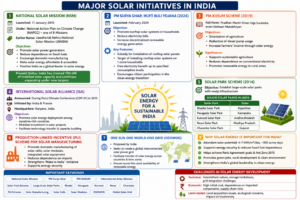
Major Solar Initiatives in India
Created by ForumIAS
Challenges in Solar Energy Development
Technical Challenges
- Solar power generation is intermittent in nature as it depends on sunlight and is affected by weather conditions, seasonal variations, and nighttime hours.
- The lack of efficient and affordable energy storage systems limits the availability of solar power when sunlight is not available.
- Integrating large amounts of solar power into the electricity grid creates grid management and transmission challenges due to fluctuations in power generation.
Economic Challenges
- The installation of solar power projects requires high initial investment in solar panels, batteries, and supporting infrastructure.
- India’s solar sector continues to have a significant dependence on imported solar cells, modules, and other components, making it vulnerable to supply chain disruptions and price fluctuations.
Land-Related Issues
- Large-scale solar parks require extensive land, making land acquisition a major challenge in many regions.
- The establishment of solar projects in ecologically sensitive areas may lead to environmental concerns and affect local biodiversity.
Significance of Solar Energy in India
1. Supports India’s energy security: India’s electricity demand is rising rapidly; peak demand touched about 270.73 GW on 21 May 2026. Solar energy helps diversify India’s power basket and reduces excessive dependence on coal and imported fuels. Example: India’s solar installed capacity reached about 154.24 GW by 30 April 2026.
2. Helps in climate change mitigation: Solar power is crucial for India’s target of expanding non-fossil energy and reducing carbon intensity. It provides clean electricity without direct greenhouse gas emissions. Example: MNRE notes that solar capacity increased from 2.82 GW in 2014 to 154.24 GW in 2026, showing a major shift towards clean energy.
3. Reduces electricity burden on households: Rooftop solar can lower household power bills and reduce pressure on distribution companies. Example: Under PM Surya Ghar: Muft Bijli Yojana, India added 9.56 GW rooftop solar capacity till March 2026, and April 2026 alone saw 2.7 lakh rooftop installations.
4. Creates employment and green skills: Solar energy generates jobs in installation, maintenance, manufacturing, project development and grid management. Example: IRENA estimated that India had about 2.38 lakh jobs in grid-connected solar PV in 2023, an 18% increase from 2022.
5. Promotes rural development and decentralised power: Solar pumps, mini-grids and rooftop systems improve access to reliable electricity in villages, farms, schools and health centres. Example: Solar pumps under schemes such as PM-KUSUM help reduce dependence on diesel pumps and support irrigation in areas with unreliable grid supply.
6. Strengthens India’s manufacturing and global leadership: Solar energy supports domestic manufacturing of modules, cells and related equipment, helping India reduce import dependence and become part of global clean-energy supply chains. Example: India became the world’s 3rd largest solar power capacity holder and was reported as the 2nd largest contributor to annual solar capacity additions in 2025
Way Forward
- Strengthen transmission and grid infrastructure: India must expand green energy corridors, substations and smart grids to carry solar power from high-potential states like Rajasthan, Gujarat and Ladakh to demand centres. This is urgent because India already has about 154.24 GW solar capacity as of 30 April 2026, and transmission gaps have begun causing renewable energy curtailment.
- Promote large-scale battery storage and pumped hydro storage: Solar power is intermittent, so India needs storage to supply power after sunset and during cloudy periods. Example: solar parks in Rajasthan and Gujarat should be linked with battery storage systems to provide round-the-clock renewable power.
- Accelerate rooftop solar adoption: Rooftop solar should be promoted through easier subsidy approval, low-interest loans, net-metering clarity and DISCOM support. Example: PM Surya Ghar: Muft Bijli Yojana aims to cover 1 crore households by FY 2026–27 with an outlay of ₹75,021 crore, while rooftop solar capacity reached 9.56 GW by March 2026.
- Expand solarisation of agriculture: Solar pumps can reduce diesel use, lower farmers’ irrigation cost and reduce pressure on rural electricity supply. Example: under PM-KUSUM, more than 10 lakh standalone solar pumps had been installed and about 13 lakh grid-connected pumps solarised by March 2026.
- Increase domestic manufacturing of solar equipment: India should strengthen domestic production of polysilicon, wafers, cells, modules, inverters and batteries to reduce import dependence. Example: Production Linked Incentive schemes and solar manufacturing parks can help India become a global clean-energy manufacturing hub.
- Improve forecasting, regulation and DISCOM readiness: Better weather forecasting, real-time grid management and balanced deviation-settlement rules are needed to integrate solar smoothly. Example: India’s stricter grid rules from April 2027 aim to improve grid stability, but they must be supported with storage, forecasting tools and fair compliance mechanisms so that investor confidence is not hurt.
Solar energy is not just a clean source of power but a foundation for India’s sustainable future. By strengthening innovation, domestic manufacturing, grid infrastructure, and public participation, India can achieve energy security, meet its climate commitments, and emerge as a global leader in renewable energy.
Expected Prelims Question
Q.1) Which of the following is NOT a challenge associated with solar energy development in India?
a) Intermittent power generation
b) High initial investment
c) Dependence on imported components
d) High greenhouse gas emissions during electricity generation
Q.2) PM Surya Ghar: Muft Bijli Yojana primarily aims to:
a) Promote utility-scale solar parks
b) Promote rooftop solar systems in households
c) Increase coal-based electricity generation
d) Promote offshore wind energy
Q3. Consider the following objectives of PM-KUSUM Scheme:
- Solarisation of agriculture.
- Reduction in diesel pump usage.
- Promotion of rooftop solar in urban households.
Which of the statements given above is/are correct?
a) 1 only
b) 1 and 2 only
c) 2 and 3 only
d) 1, 2 and 3
Q4. The International Solar Alliance (ISA) was jointly launched by:
a) India and Germany
b) India and France
c) India and Japan
d) India and Australia
Q5. The headquarters of the International Solar Alliance (ISA) is located in:
a) New Delhi
b) Gurugram, Haryana
c) Noida, Uttar Pradesh
d) Jaipur, Rajasthan
Q.6) Which of the following Solar Parks is correctly matched?
| Solar Park | State |
| 1. Bhadla | Rajasthan |
| 2. Pavagada | Karnataka |
| 3. Rewa | Madhya Pradesh |
| 4. Kurnool | Andhra Pradesh |
Select the correct answer using the code below.
a) 1 and 2 only
b) 2, 3 and 4 only
c) 1, 2, 3 and 4
d) 1 and 4 only
Q.7) The Production Linked Incentive (PLI) Scheme for Solar Manufacturing aims to promote the domestic manufacturing of:
- Solar cells
- Solar modules
- Integrated solar equipment
Select the correct answer using the code below.
a) 1 only
b) 2 and 3 only
c) 1 and 2 only
d) 1, 2 and 3
Q.8) One Sun One World One Grid (OSOWOG) is an initiative that seeks to:
a) Promote nuclear energy cooperation
b) Develop a global interconnected solar power grid
c) Establish solar parks in every district
d) Replace all thermal power plants
Expected Mains Questions
Q.1) Discuss the objectives and achievements of the National Solar Mission in promoting renewable energy in India.
Q.2) What is the One Sun One World One Grid (OSOWOG) initiative? Discuss its significance for global energy cooperation.
Q.3) Despite rapid growth in installed capacity, India’s solar energy sector continues to face multiple challenges. Examine these challenges and suggest suitable measures to overcome them.