
This article introduces the concept of Natural Vegetation in India and explains how variations in climate, rainfall, soil, and altitude shape different forest ecosystems across the country. It covers the classification, distribution, climatic conditions, characteristic tree species, and ecological significance of major forest types, including evergreen, deciduous, thorn, mangrove, and montane forests.
Study Approach
Start with the big picture
First understand Natural Vegetation as a result of the interaction between climate, soil, relief and altitude. Then follow the natural flow:
Factors Affecting Vegetation → Types of Forests → Distribution → Characteristic Species → Economic & Ecological Significance → Conservation
This sequence helps you connect Physical Geography with Environment, Biodiversity, Climate Change, Agriculture and Disaster Management.
Major Study Blocks
Block 1: Factors Affecting Natural Vegetation
Study:
- Rainfall
- Temperature
- Soil
- Relief
- Altitude
- Humidity
What to understand:
- Why vegetation varies from region to region.
- Why rainfall is the most important controlling factor.
- How altitude changes vegetation in mountain regions.
- Relationship between climate and vegetation.
Block 2: Tropical Evergreen and Semi-Evergreen Forests
Focus on climatic conditions and adaptations.
Study:
- Rainfall and temperature
- Evergreen mechanism
- Distribution
- Characteristic species
What to understand:
- Why these forests remain green throughout the year.
- Why biodiversity is highest in these forests.
- Why dense canopy develops.
Block 3: Tropical Deciduous Forests
Study:
- Moist deciduous
- Dry deciduous
- Distribution
- Economic importance
What to understand:
- Why trees shed leaves.
- Difference between moist and dry deciduous forests.
- Importance of hardwood timber.
Block 4: Tropical Thorn Forests
Focus on:
- Rainfall
- Distribution
- Xerophytic adaptations
- Important species
What to understand:
- Why leaves become small or thorny.
- How plants conserve moisture.
- Adaptation to drought conditions.
Block 5: Delta (Mangrove) Forests
Study:
- Habitat
- Distribution
- Adaptations
- Importance
What to understand:
- Why mangroves grow in saline water.
- Importance in coastal protection.
- Ecological significance.
What to memorize:
- Sundarbans
- Ganga-Brahmaputra Delta
- Godavari Delta
- Krishna Delta
Block 6: Montane Forests
Study vegetation according to altitude.
Focus on:
- Altitudinal succession
- Characteristic trees
- Southern mountain forests
Important for Prelims
- Factors affecting vegetation
- Rainfall ranges
- Forest classification
- Distribution of forests
- Characteristic tree species
- Mangroves
- Sholas
- Deodar
- Flame of the Forest (Palash)
- State-wise vegetation
Important for Mains
- Natural vegetation and climate
- Forests and biodiversity conservation
- Ecological significance of forests
- Forests and carbon sequestration
- Mangroves and coastal protection
- Himalayan forests and ecological security
- Deforestation and climate change
- Sustainable forest management
- Role of forests in disaster risk reduction
Natural Vegetation
| Table Content |
| Tropical Evergreen and Semi Evergreen forests |
| Tropical Deciduous forests |
| Tropical Dry Deciduous forests |
| Arid or Tropical Thorn Forests |
| Delta Forests |
| Montane Forests |
Natural vegetation refers to a plant community that has been left undisturbed over a long time, so as to allow its individual species to adjust themselves to climate and soil conditions as fully as possible.
Depending upon the variations in the climate and the soil, the vegetation of India changes from one region to another. On the basis of certain common features such as predominant vegetation type and climatic regions, Indian forests can be divided into the following groups:
Types of Forests
Tropical Evergreen and Semi Evergreen forests
- Climatic Thresholds: These forests typically thrive in warm, highly humid regions that receive an annual rainfall exceeding 200 cm and maintain a mean annual temperature above 22o C.
- Relative Humidity: The ambient humidity level within this eco-zone stays exceptionally high at approximately 70%.
- Density and Height: Driven by continuous high warmth and moisture, the trees grow very tall and cluster together to form intensive, highly dense forest canopies.
- Alternative Nomenclature: Because of their distinct equatorial rain system characteristics, these forests are globally referred to as “Selvas”.
- Evergreen Mechanism: Different tree species follow individual biological clocks for shedding leaves. Because there is no uniform time for leaf fall across the vegetation, the forest retains its rich green appearance all year round.
- Geographical Footprint in India: They are primarily distributed across Assam, Kerala, West Bengal, the Andaman and Nicobar Islands, Meghalaya, Tripura, Mizoram, and the Western Coastal Plain.
- Major flora characteristic of this zone includes Cinchona, Rubber, Coconut, Bamboo, Mahogany, and Ebony.
Tropical Deciduous forests
- Alternative Nomenclature: These ecosystems are widely recognized and referred to as monsoon forests.
- Water Conservation Adaptation: To prevent excessive moisture loss during the dry season, the trees systematically shed their leaves to conserve water.
- Precipitation Threshold: The regions supporting this vegetation receive an average annual rainfall ranging between 70 cm and 200 cm.
- Sub-Classification: Based on the specific availability of water, these systems are divided into two distinct sub-categories: Tropical Moist Deciduous Forests and Tropical Dry Deciduous Forests.
- Geographical Distribution of Moist Deciduous Variant: Within India, the moist deciduous forests are primarily located along the eastern slopes of the Western Ghats, the north-eastern region of the Indian peninsula, and the Bhabar and Tarai (Terai) tracts.
- Key Indicator Species: Prominent tree varieties thriving in these environments include Sal, Teak, Neem, Shisham, and Mango.
- Economic Utility: The dense hardwood harvested from these trees is exceptionally valuable and widely used for manufacturing high-quality furniture.
Tropical Dry Deciduous forests
- Precipitation Threshold: These forests are situated in climatic zones where the annual rainfall ranges between 70 cm and 100 cm.
- Geographical Distribution: In northern India, they are mainly found throughout Uttar Pradesh. They also span extensive tracts across Andhra Pradesh, Maharashtra, Karnataka, and Tamil Nadu.
- Key Indicator Species: The dominant and characteristic trees of this forest zone include Rosewood, Mango, Sandalwood, and Mahua.
- Economic Significance: Due to the quality of their timber and non-timber produce, these forest ecosystems are highly valuable and economically important.
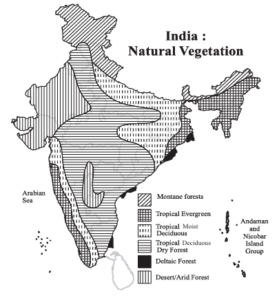
Created by ForumIAS
Arid or Tropical Thorn Forests
- Alternative Nomenclature: Arid forests are commonly referred to as ‘Tropical Thorn Forests’.
- Precipitation Threshold: These ecosystems are strictly confined to dry areas receiving an annual rainfall of less than 70 cm (with core tracts dropping below 50 cm).
- Geographical Distribution: They span the semi-arid regions of south-west Punjab, south-west Haryana, Rajasthan, and Gujarat.
- Structural Composition: The vegetation cover consists of a sparse variety of hardy grasses and shrubs rather than dense canopies.
- Moisture Conservation Adaptation: To survive prolonged drought conditions, the plants remain leafless for most part of the year, presenting a distinct scrub vegetation profile.
- Key Indicator Species: The most important species thriving in this zone include Babool, Ber, Wild Date Palm, Khair, Neem, Khejri, and Palas.
Delta Forests
- Alternative Nomenclature: Deltaic forests are widely recognized as mangrove, swampy, or littoral forests.
- Habitat Environment: These unique coastal ecosystems thrive along coastal zones, specifically establishing in salt marshes, tidal creeks, mudflats, and brackish estuaries.
- River System Association: They develop heavily in the fertile, low-lying deltaic basins formed by major rivers such as the Ganga, Brahmaputra, Godavari, and Krishna.
- Prime Representative Ecosystem: The globally famous Sundarban forest serves as the world’s premier example of a well-developed deltaic mangrove system.
Montane Forests
- Altitude-Driven Dynamics: In mountainous terrain, steady drops in temperature with increasing elevation trigger corresponding changes in natural vegetation communities.
- Primary Classification: Mountain forests are broadly classified into two distinct geographic zones: the Northern Mountain Forests and the Southern Mountain Forests.
- Himalayan Succession: The Himalayan range exhibits a complete succession of plant communities, transitioning vertically all the way from tropical species up to tundra forms.
- Foothill Ecosystems: Deciduous forest types dominate the lowest reaches and foothills of the Himalayas.
- Wet Temperate Zone (1,000–2,000m): Situated directly above the foothills, this zone is characterized predominantly by broadleaf evergreen varieties like Oak and Chestnut.
- Temperate Coniferous Zone (2,000–3,000m): Located along the southern slopes of the Himalayas, this band features coniferous species such as Pine, Deodar, Silver Fir, Spruce, and Cedar. These temperate coniferous groups also appear in high-altitude pockets across southern and north-east India.
- Deodar Specifics: Deodar is a highly valued endemic species that grows primarily in the western part of the Himalayan range at an altitude spanning 1,500 to 2,500 meters.
- Alpine Zone (3,000–4,900m): Alpine forests establish and grow extensively all along the high-elevation tracts of the Himalayas.
- Southern Peninsular Profile: The southern mountain forests are confined to three separate highland regions: the Western Ghats, the Vindhyas, and the Nilgiris.
- Thermal Stratification in the South: Vegetation in these peninsular heights is distinctly temperate across higher elevations and sub-tropical along lower tracts.
- The Sholas: The temperate mountain forests of the south are locally known as Sholas within the Nilgiris, Anamalai, and Palani Hills.
Butea monosperma, alternatively known as Dhak or Palash, is famously called the “Flame of the Forest” and stands as the officially designated State Flower of Uttar Pradesh.
Prelims Questions
Q.1) Which of the following plants have no flowers?
(a) Jackfruit
(b) Fig
(c) Orchid
(d) Fern
U.P.P.C.S. (Pre) 1991
Q.2) Match the following
(A) Teak 1. Himalayan Tarai Region
(B) Deodar 2. Central India
(C) Sundari 3. Sunderban
(D) Cinchona 4. High Altitude regions of Himalaya
Code :
A B C D
a) 2 4 3 1
b) 3 2 1 4
c) 4 1 3 2
d) 2 3 4 1
U.P.P.C.S. (Pre) 1992
Q.3) Match List-I with List-II and select the correct answer using the code given below:
List I (Forest) List II (Region)
- Tropical moist deciduous 1.Arunachal Pradesh
- Tropical dry deciduous 2.Sahyadris
- Alpine 3.Middle Ganga Plain
- Tropical evergreen 4.Tarai
Code :
A B C D
a) 4 3 1 2
b) 4 2 1 3
c) 1 3 2 4
d) 3 1 4 2
U.P.P.C.S.(Pre) 2001
Q.4) Match List-I with List-II and select the correct answer by using the codes given below:
List-I List-II
- Tropical forest 1. Sunderbans
- Conifer forest 2. Himachal Pradesh
- Mangroves 3. Rajasthan
- Deciduous forest 4. Silent Valley
Code :
A B C D
a) 1 2 4 3
b) 2 1 4 3
c) 1 4 2 3
d) 4 2 1 3
U.P.P.C.S. (Pre) 2017
Expected Mains Questions
Q.1) Discuss the major types of natural vegetation found in India. Explain how climatic factors influence their distribution across different regions.
Q.2) Mangrove forests are important for both ecological security and coastal resilience. Discuss their distribution, significance and the challenges faced by them in India.
Q.3) Discuss the role of natural vegetation in maintaining ecological balance and supporting sustainable development in India.