
Study Approach
Start with the big picture: Begin by understanding the classification of India’s islands rather than memorizing island names. Follow the sequence: Major Island Groups → Andaman Islands → Nicobar Islands → Lakshadweep Islands → Other Important Islands. Think as moving from location and origin to physical features, strategic importance, and special facts.
Study Block 1: Classification of Indian Islands
How to Read This Block
First learn the two major island groups and their location on the map.
- Andaman & Nicobar Islands (Bay of Bengal)
- Lakshadweep Islands (Arabian Sea)
What to Memorize
- Number of islands
- Capital
- Sea location
- Geological origin
- Important channels
What to Understand
- Why Andaman–Nicobar Islands are of volcanic origin.
- Why Lakshadweep Islands are coral islands.
- Difference between volcanic and coral islands.
Study Block 2: Andaman and Nicobar Islands
How to Read This Block
- Location
- Important islands
- Highest peak
- Important channels
- Tribes
- Geological features
- Strategic importance
Pay special attention to Barren Island, Narcondam Island, North Sentinel Island, Saddle Peak, and Mount Thullier.
Study Block 3: Lakshadweep Islands
Focus Areas
Study under one framework:
- Coral origin
- Island groups
- Capital
- Atolls, reefs, and banks
- Vulnerability to sea-level rise
Understand why coral islands have low elevation and lack hills and rivers.
Study Block 4: Other Important Islands
Instead of memorizing randomly, classify them according to their importance.
- River Island
- Barrier Island
- Petroleum
- Space Centre
- Missile Testing
- International Boundary
- Population
Diagram-Based Preparation
- India outline map showing:
- Andaman & Nicobar Islands
- Lakshadweep Islands
- Label on the map:
- Port Blair
- Kavaratti
- Barren Island
- Narcondam Island
- Minicoy
- Great Nicobar
- Car Nicobar
- Sriharikota
- Majuli
- Pamban
- Flowchart:
Indian Islands → Andaman & Nicobar → Andaman + Nicobar - Flowchart:
Lakshadweep → Amindivi → Laccadive → Minicoy
Important for Prelims
- Location of island groups
- Important channels (10° Channel, Duncan Passage)
- Capitals
- Highest peaks
- Active volcano
- Coral vs volcanic islands
- Tribal groups
- Important islands (Majuli, Sriharikota, Pamban, Abdul Kalam Island)
- Barrier island, atoll, reef, lagoon
Important for Mains
- Strategic importance of Indian islands
- Geological origin of island groups
- Coral reef ecosystems and conservation
- Islands and India’s maritime security
- Blue Economy
- Climate change and sea-level rise
- Tribal communities and sustainable development
INDIAN ISLANDS
| Table Content |
| Andaman Islands and Nicobar Islands |
| Lakshadweep Islands |
| Other Important Islands of India |
| Significance of Indian Islands |
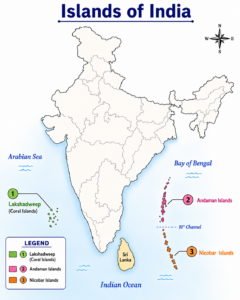
India’s island territory is mainly divided into two major island groups – the Andaman and Nicobar Archipelago in the Bay of Bengal and the Lakshadweep Islands in the Arabian Sea. Besides these, a few smaller islands are found in the Indo-Gangetic Delta, the Palk Strait region, and along the Indian coastline.
- The Andaman and Nicobar Islands comprise about 836 islands, of which only 31 are inhabited. Located at the junction of the Bay of Bengal and the Andaman Sea, these islands are largely the emerged portions of submerged volcanic mountain chains.
- The 10° Channel separates the Great Andaman Group from the Nicobar Group of Islands. Port Blair, situated in South Andaman, serves as the capital of the Union Territory.
Created by ForumIAS
Andaman Islands and Nicobar Islands
Andaman Islands
- The Andaman Islands are divided into North Andaman, Middle Andaman, and South Andaman.
- The Duncan Passage separates Little Andaman from South Andaman.
- Important islands of this group include Interview Island, Landfall Island, Rutland Island, and North Sentinel Island.
- The terrain is composed mainly of sandstone, shale, and limestone formations.
- Saddle Peak (732 m) in North Andaman is the highest peak of the archipelago, while Mount Harriet is another important peak in South Andaman.
- The islands are home to four major Negrito tribes – Great Andamanese, Onge, Jarawa, and Sentinelese.
- Barren Island, India’s only active volcano, is located in this island group. Narcondam Island is another volcanic island of great geographical significance.
Nicobar Islands
- The Nicobar Group consists of about 22 islands and lies closer to Sumatra Island of Indonesia.
- Great Nicobar Island is the largest as well as the southernmost island of the Nicobar group and is located only about 147 km from Sumatra.
- Car Nicobar, the northernmost island of the group, is largely of coral origin.
- The islands are inhabited mainly by two Mongoloid tribes – the Shompen and the Nicobarese.
- Mount Thullier is the highest peak of the Nicobar Islands and is located on Great Nicobar Island.
Lakshadweep Islands
- The Lakshadweep Islands are a group of coral islands situated in the Arabian Sea, southwest of the Kerala coast.
- The island group consists of about 36 islands, along with several reefs, atolls, and submerged banks.
- Kavaratti is the capital of the Union Territory.
- Amindivi Islands form the northern part of the archipelago, while Minicoy Island is the southernmost island.
- Due to their low elevation above sea level, these islands are highly vulnerable to sea-level rise and coastal erosion.
Lakshadweep is divided into three major groups:
- Amindivi Islands – Amini, Kiltan, Chetlat, Kadmat, Bitra, and Perumal Par.
- Laccadive Islands – Andrott, Kalpeni, Kavaratti, Pitti, and Suheli Par.
- Minicoy Island – The second-largest island of Lakshadweep after Andrott.
- The islands lack major topographic features such as hills, rivers, and valleys due to their coral origin.
Other Important Islands of India
- Majuli Island (Assam): The world’s largest inhabited freshwater river island, located on the Brahmaputra River. It is also India’s first island district.
- Salsette Island (Maharashtra): India’s most populous island, on which a major part of Mumbai Metropolitan Region is located.
- Sriharikota Island (Andhra Pradesh): A barrier island that houses the Satish Dhawan Space Centre (ISRO).
- Aliabet Island (Gujarat): Located in the Gulf of Khambhat, it is associated with India’s early offshore petroleum exploration activities.
- New Moore Island (Purbasha Island): A former island in the Sundarbans Delta that disappeared due to rising sea levels and coastal submergence.
- Pamban Island (Tamil Nadu): Situated between mainland India and Sri Lanka, it is connected to the mainland by the famous Pamban Bridge.
- Abdul Kalam Island (Odisha): Formerly known as Wheeler Island, it serves as a key missile testing facility off the Odisha coast and was renamed in 2015.
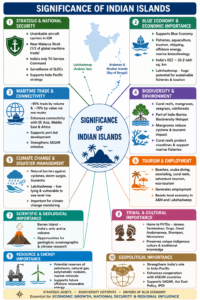
Significance of Indian Islands
- Strategic and National Security Importance
- India’s islands act as unsinkable aircraft carriers in the Indian Ocean Region (IOR).
- The Andaman & Nicobar Islands lie close to the Malacca Strait, through which nearly one-third of global maritime trade and a major share of East Asia’s energy imports pass.
- India’s only Tri-Service Command (Andaman & Nicobar Command) is located here, strengthening surveillance and maritime security.
- Islands help monitor Sea Lines of Communication (SLOCs) and support India’s Indo-Pacific strategy.
- Blue Economy and Economic Importance
- India’s islands support the Blue Economy through fisheries, aquaculture, tourism, shipping, offshore energy, and marine biotechnology.
- India’s Exclusive Economic Zone (EEZ) is about 20.2 lakh sq. km, providing access to vast marine resources, with island territories contributing significantly to this maritime domain.
- Lakshadweep offers immense potential for sustainable fisheries and marine tourism.
- Maritime Trade and Connectivity
- About 95% of India’s trade by volume and nearly 70% by value is carried through sea routes.
- Island territories enhance India’s connectivity with Southeast Asia, the Middle East, and Africa while supporting port-led development and SAGAR (Security and Growth for All in the Region).
- Biodiversity and Environmental Importance
- The islands contain coral reefs, mangroves, seagrass meadows, tropical rainforests, and endemic flora and fauna.
- The Andaman & Nicobar Islands are part of the Indo-Burma Biodiversity Hotspot and possess extensive mangrove ecosystems that reduce cyclone and tsunami impacts.
- Coral reefs protect coastlines from erosion and support rich marine fisheries.
- Climate Change and Disaster Management
- Islands serve as natural barriers against storm surges, cyclones, and tsunamis.
- Lakshadweep, being a low-lying coral archipelago, is highly vulnerable to sea-level rise, making it an important region for climate change monitoring.
- Tourism and Employment
- Islands attract tourists through beaches, scuba diving, snorkeling, coral reefs, adventure tourism, and eco-tourism.
- Tourism generates employment and boosts local economies in Andaman & Nicobar and Lakshadweep.
- Scientific and Geological Importance
- Barren Island is India’s only active volcano.
- Coral reefs and marine ecosystems provide valuable opportunities for geological, oceanographic, and climate research.
- Tribal and Cultural Importance
- The islands are home to Particularly Vulnerable Tribal Groups (PVTGs) such as the Jarawa, Sentinelese, Onge, Great Andamanese, Shompen, and Nicobarese.
- They preserve unique indigenous cultures and traditional ecological knowledge.
- Resource and Energy Importance
- Offshore regions around islands possess potential reserves of petroleum, natural gas, polymetallic nodules, and marine minerals.
- Islands also support future offshore renewable energy development.
- Geopolitical Importance
- Island territories strengthen India’s role in the Indo-Pacific, enhance cooperation with ASEAN countries, and improve maritime diplomacy.
- They support initiatives such as SAGAR, Act East Policy, and the Indo-Pacific Oceans Initiative (IPOI).
Created by ForumIAS
India’s islands are not merely isolated landforms; they are strategic maritime assets, biodiversity hotspots, and drivers of the Blue Economy, making their sustainable development essential for India’s economic growth, national security, and regional influence.
Prelims Questions
Q.1) Barren Island is located in-
- a) Bay of Bengal
- b) Arabian sea
- c) Mediterranean Sea
- d) China sea
U.P.P.S.C. (GIC) 2010
Q.2) Which one of the following Indian Island lies between
India and Sri Lanka?
- a) Elephanta
- b) Nicobar
- c) Rameshwaram
- d) Salsette
U.P.P.C.S. (Pre) 2006
Expected Mains Questions
Q.1) Differentiate between the Andaman & Nicobar Islands and the Lakshadweep Islands with reference to their origin, physical features, and strategic importance.
Q.2) Examine the significance of India’s island territories in strengthening maritime security, regional connectivity, and the Blue Economy.
Q.3) Examine the role of India’s islands in biodiversity conservation and sustainable development.