
Mention the difference between Italian and German brands of fascism.
How the answer moves
The flow snapshot — the routes in, the body, the counter-view and the routes out.
Route 1 Note the shared interwar origins and common features, then turn to the substantial differences.
Route 2 Open on the single sharpest divide — race — and branch out to doctrine, state, and institutions.
Shared base — authoritarianism, aggressive nationalism, anti-liberalism, leader cult → ideological coherence — John Pollard (Italy weaker in doctrine), Umberto Eco (“a fuzzy totalitarianism”) → race — Andrew Vincent: Italian rationalism vs Nazi race-centred irrationalism; racial laws late in Italy → the state — Gentile’s Italy (state as supreme ethical form) vs Nazism (state instrumental to the racial Volk) → institutions — Italy compromised with Church & army vs total Nazi penetration → terror — the Holocaust & extermination camps without Italian equivalent
For all the differences, both converge as totalitarian, expansionist, leader-centred regimes — the contrast is of degree and emphasis, not of fundamental type.
Route 1 The decisive differences are race and the scale of terror.
Route 2 Italian fascism was statist and rationalist; Nazism was racial and exterminatory.
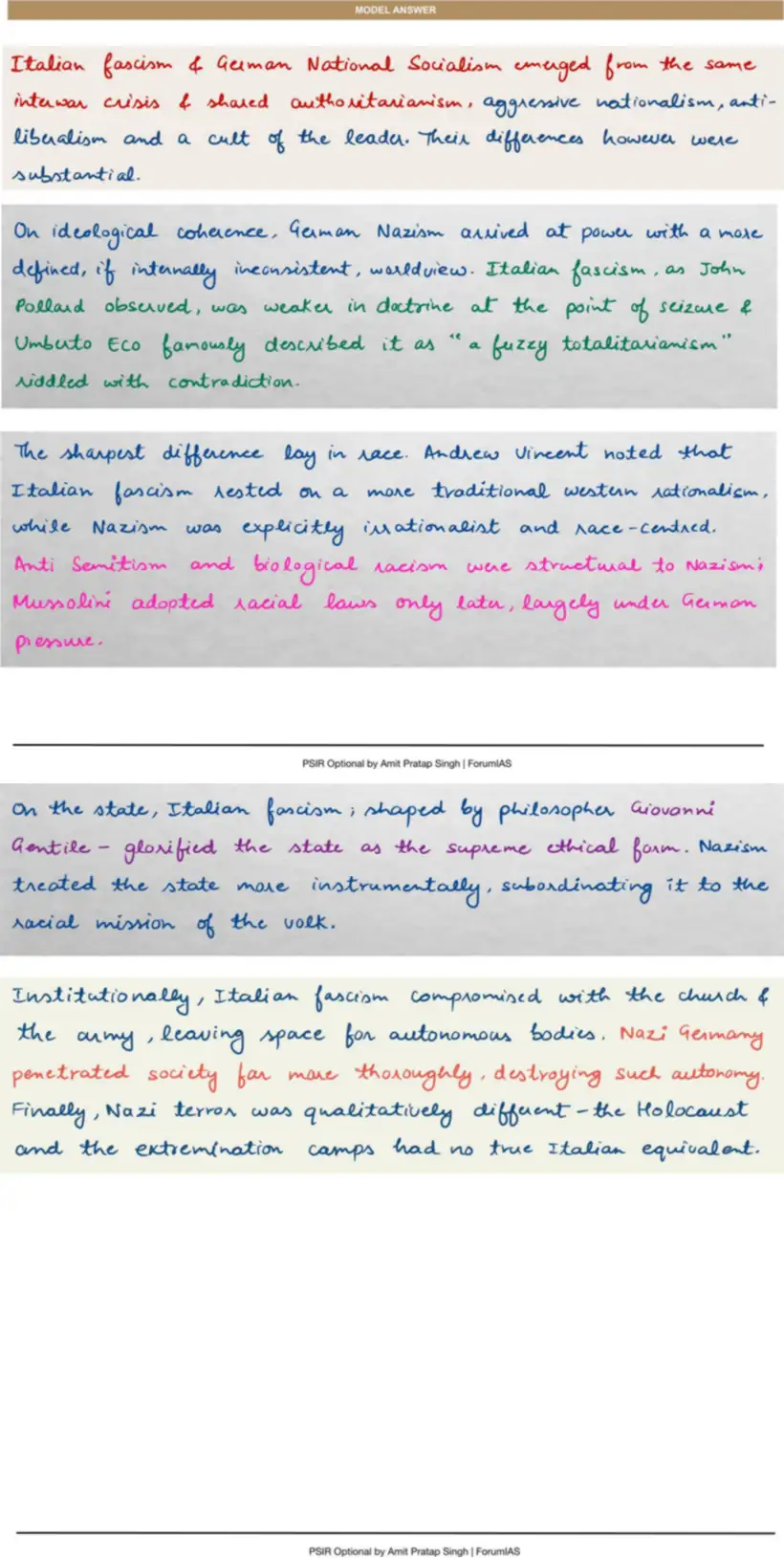
Model answer
Handwritten, in the form it would be written in the examination hall.
Also asked on this head
Political Ideologies — 23 questions in the Vault.
- Wollstonecraft developed first systematic feminist critique. Discuss her main ideas.
- Herbert Marcuse turned Freudianism on its head in his critical theory. (150 words)
- Factors like community, culture and nation weaken the hegemony of neo-liberalism today. Discuss.
How this is taught
The same flow snapshot, built for every head of the syllabus, with the answer written in class.
The first session of Foundation 2027 is published in full.
Six programmes across three levels.