
Explicate the ideological components of Gandhism
How the answer moves
The flow snapshot — the routes in, the body, the counter-view and the routes out.
Route 1 Note that Gandhism is not a systematic doctrine (Humayun Kabir: a practical idealist) yet forms a coherent ethical–political whole.
Route 2 Anchor the answer in its foundations — Satya and Ahimsa — from which every component flows.
Ethical base — inseparability of means & ends (truth as goal, non-violence as means) → Satyagraha — active soul-force; “hate the sin, not the sinner” → Dashrath Singh, Gandhism: A Quest for New Civilization — Sarvodaya, Swaraj, Ahimsa, Swadeshi → Swaraj — self-rule with self-restraint → Sarvodaya — from Ruskin’s Unto This Last: progress of all → economic core — Trusteeship & Swadeshi → critique of modern civilisation — Tolstoy, Thoreau, Ruskin → Ram Rajya — decentralised moral self-rule, not theocracy
Often read as unsystematic and anti-modern — resting on moral conversion and a rejection of industrial civilisation rather than on institutional power.
Route 1 Gandhism is a comprehensive ideology where ethics, economics and politics are inseparable.
Route 2 Its enduring claim is a moral alternative to the coercive modern state.
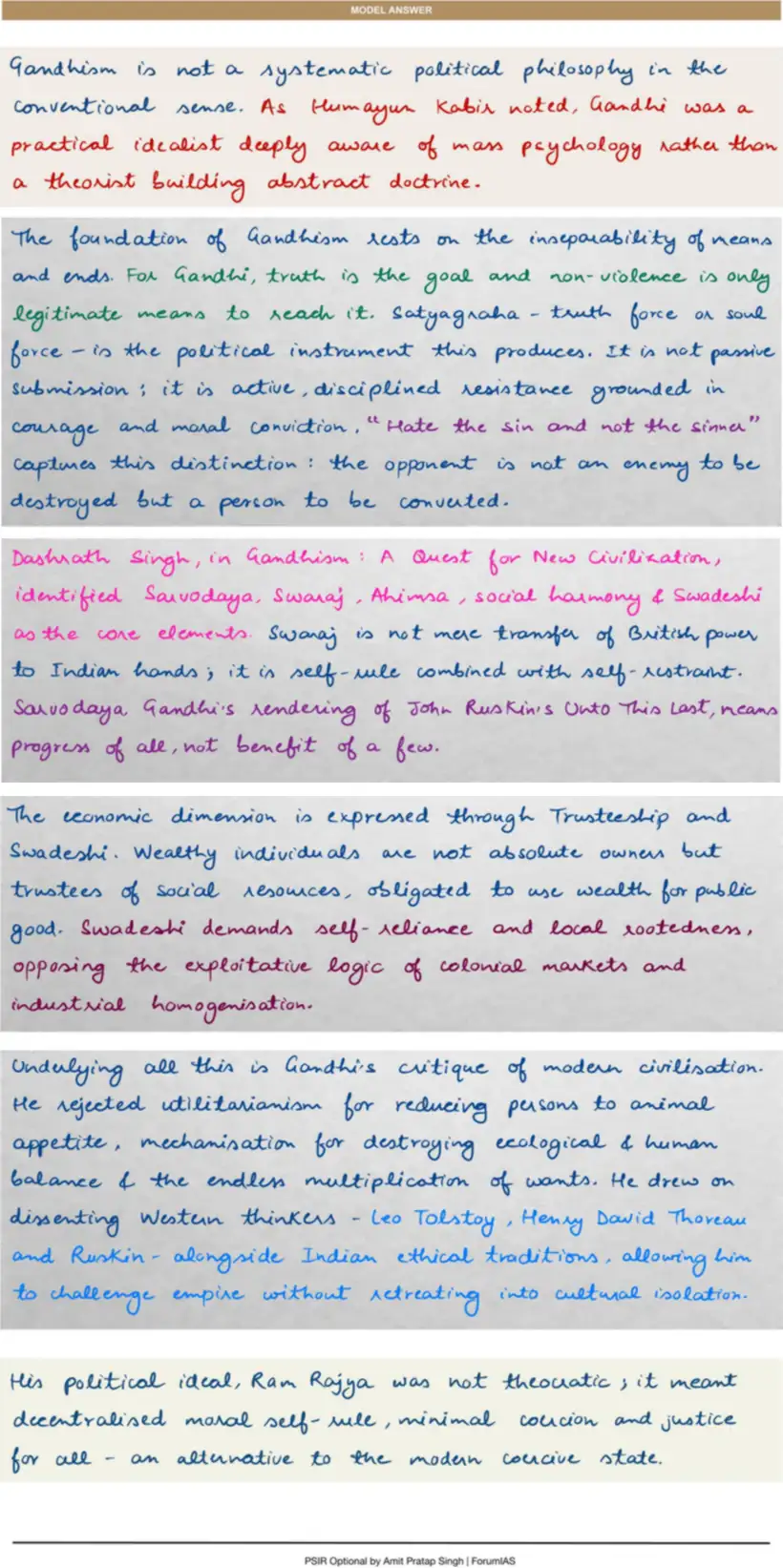
Model answer
Handwritten, in the form it would be written in the examination hall.
Also asked on this head
Political Ideologies — 23 questions in the Vault.
- Wollstonecraft developed first systematic feminist critique. Discuss her main ideas.
- Herbert Marcuse turned Freudianism on its head in his critical theory. (150 words)
- Factors like community, culture and nation weaken the hegemony of neo-liberalism today. Discuss.
How this is taught
The same flow snapshot, built for every head of the syllabus, with the answer written in class.
The first session of Foundation 2027 is published in full.
Six programmes across three levels.