
Distinguish between liberal feminism and radical feminism.
How the answer moves
The flow snapshot — the routes in, the body, the counter-view and the routes out.
Route 1 Frame both as responses to women’s subordination that diverge on its origin and its cure.
Route 2 Open on the decisive fault-line — legal exclusion versus patriarchy as the root of oppression.
Shared starting point — the subordination of women → Liberal feminism — site is legal inequality & institutional exclusion → equal access; Wollstonecraft, J.S. Mill, Friedan, Harriet Taylor, Okin → state as instrument; accepts the public–private distinction → Radical feminism — root is patriarchy as structural male domination → Millett, Firestone, Dworkin, MacKinnon → Carol Hanisch — “the personal is political”; rejects the public–private divide
They part on three counts — site (institutions vs patriarchal structure), scope (public sphere vs private life), and method (reform vs structural transformation).
Route 1 Liberal feminism seeks inclusion; radical feminism demands dismantling the gendered order that makes exclusion possible.
Route 2 Read together, they are complementary — reform secures access, structural critique exposes its limits.
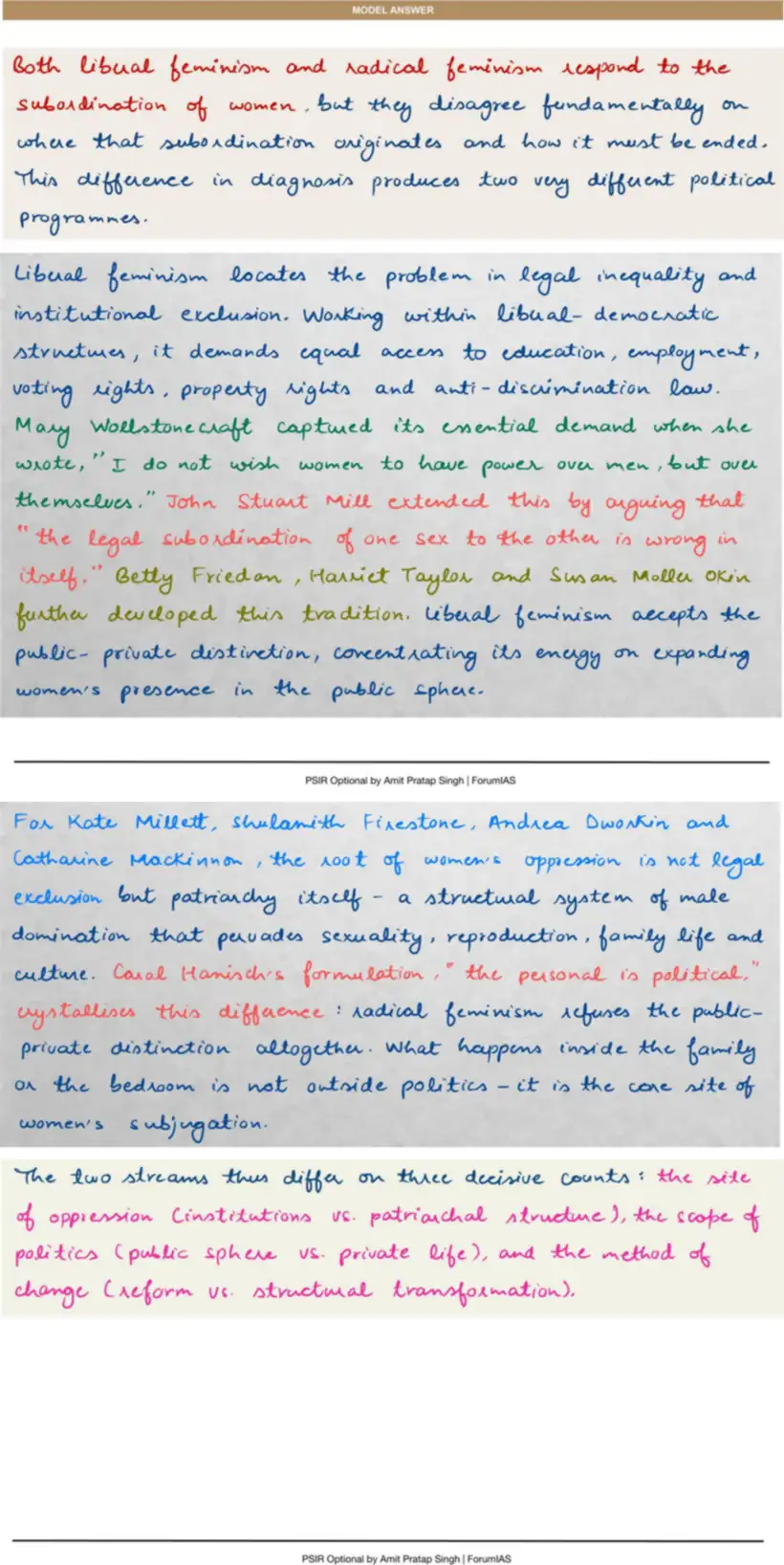
Model answer
Handwritten, in the form it would be written in the examination hall.
Also asked on this head
Political Ideologies — 23 questions in the Vault.
- Wollstonecraft developed first systematic feminist critique. Discuss her main ideas.
- Herbert Marcuse turned Freudianism on its head in his critical theory. (150 words)
- Factors like community, culture and nation weaken the hegemony of neo-liberalism today. Discuss.
How this is taught
The same flow snapshot, built for every head of the syllabus, with the answer written in class.
The first session of Foundation 2027 is published in full.
Six programmes across three levels.