
Fascism displays an ambivalent stance towards parliamentary democracy. Explain.
How the answer moves
The flow snapshot — the routes in, the body, the counter-view and the routes out.
Route 1 Frame fascism through its oppositions, then locate the ambivalence — hostile to parliament in principle, instrumental in practice.
Route 2 Open with the puzzle — why an anti-democratic ideology contests elections at all.
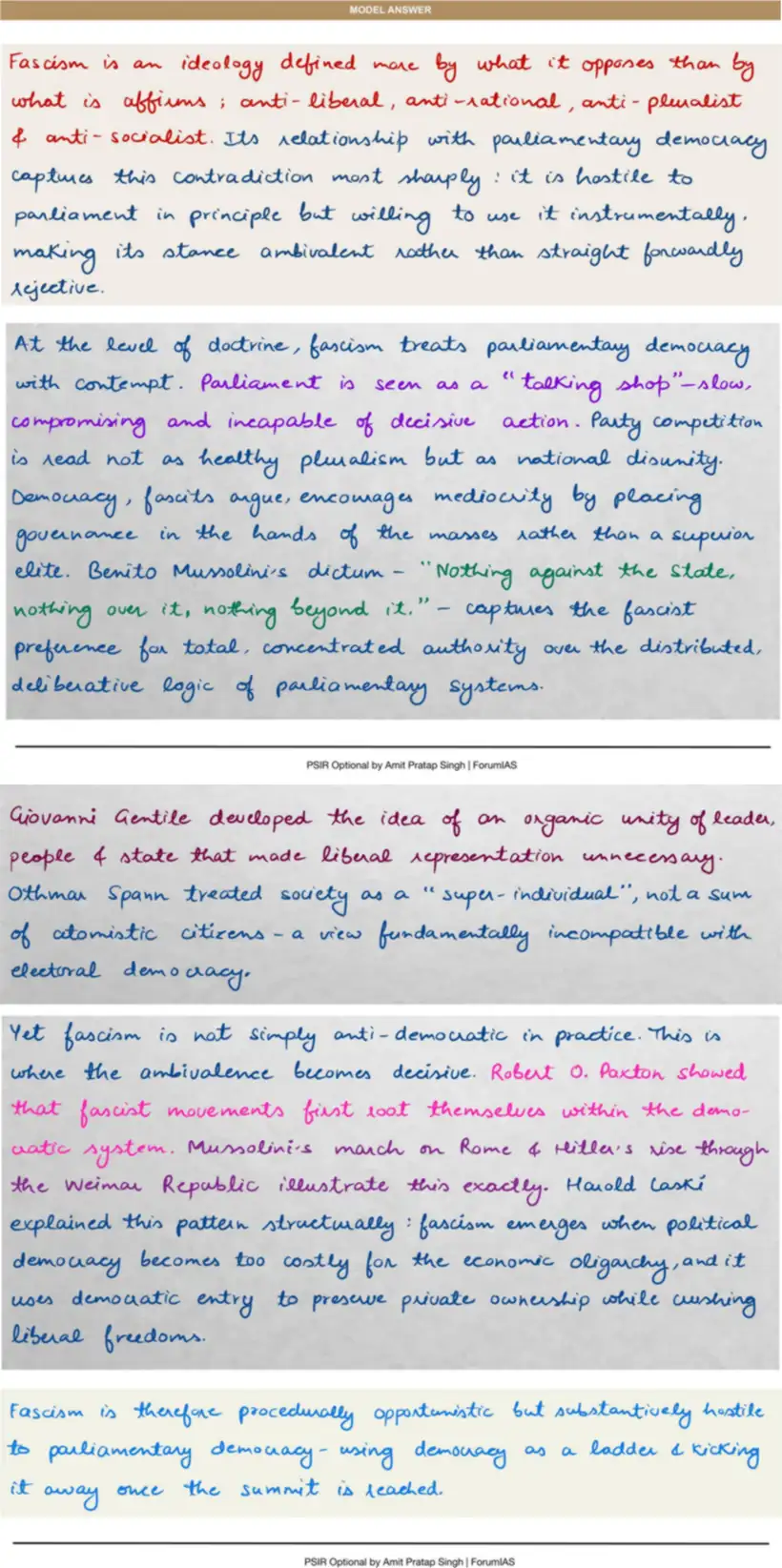
Doctrinal contempt — parliament as a “talking shop”; competition as disunity; democracy breeds mediocrity → Mussolini’s dictum — total, concentrated authority → philosophical basis — Giovanni Gentile (organic unity of leader, people, state) & Othmar Spann (society as a “super-individual”) → instrumental use — Robert O. Paxton: root within the system, then seize power (March on Rome; Hitler via Weimar) → hollowing out — parties banned, liberties suspended, elections reduced to theatre → Harold Laski — fascism arises when democracy is too costly for the economic oligarchy
The fascist self-justification — that a mystical leader–nation bond is “more democratic” than elections — is refuted by the practice of terror and one-party rule.
Route 1 Fascism is procedurally opportunistic but substantively hostile to parliamentary democracy.
Route 2 It uses democracy as a ladder and kicks it away once the summit is reached.
Model answer
Handwritten, in the form it would be written in the examination hall.
Also asked on this head
Political Ideologies — 23 questions in the Vault.
- Wollstonecraft developed first systematic feminist critique. Discuss her main ideas.
- Herbert Marcuse turned Freudianism on its head in his critical theory. (150 words)
- Factors like community, culture and nation weaken the hegemony of neo-liberalism today. Discuss.
How this is taught
The same flow snapshot, built for every head of the syllabus, with the answer written in class.
The first session of Foundation 2027 is published in full.
Six programmes across three levels.