
Define Socialism. Discuss the salient features of Fabian Socialism.
How the answer moves
The flow snapshot — the routes in, the body, the counter-view and the routes out.
Route 1 Define socialism as social control over the means of production (Tom Bottomore), then position Fabianism as one distinctive strategy within it.
Route 2 Open with C.E.M. Joad’s image of socialism as “a hat that has lost its shape,” then locate Fabianism as its British gradualist form.
Socialism defined — Bottomore: equal access, minimal domination → vs capitalism — market allocation vs equality of outcome → Fabianism — British gradualism (Fabius Cunctator, 1884) → Sidney & Beatrice Webb, Shaw, Wallas, Wells, Besant, Pease, Cole → constitutional, parliamentary road — not revolution → gradual socialization; the state as instrument of reform → middle-class intellectuals lead the case → nationalization, municipal reform, welfare → Labour Party & welfare state
Fabianism stayed confined to intellectual circles, lacked mass energy, and set aside the labour theory of value and class conflict Marxists held essential.
Route 1 Fabianism’s significance is its constitutional, evolutionary route that shaped the welfare state.
Route 2 It shows reformist socialism’s strength — durable institutions — and its limit — no mass-revolutionary base.
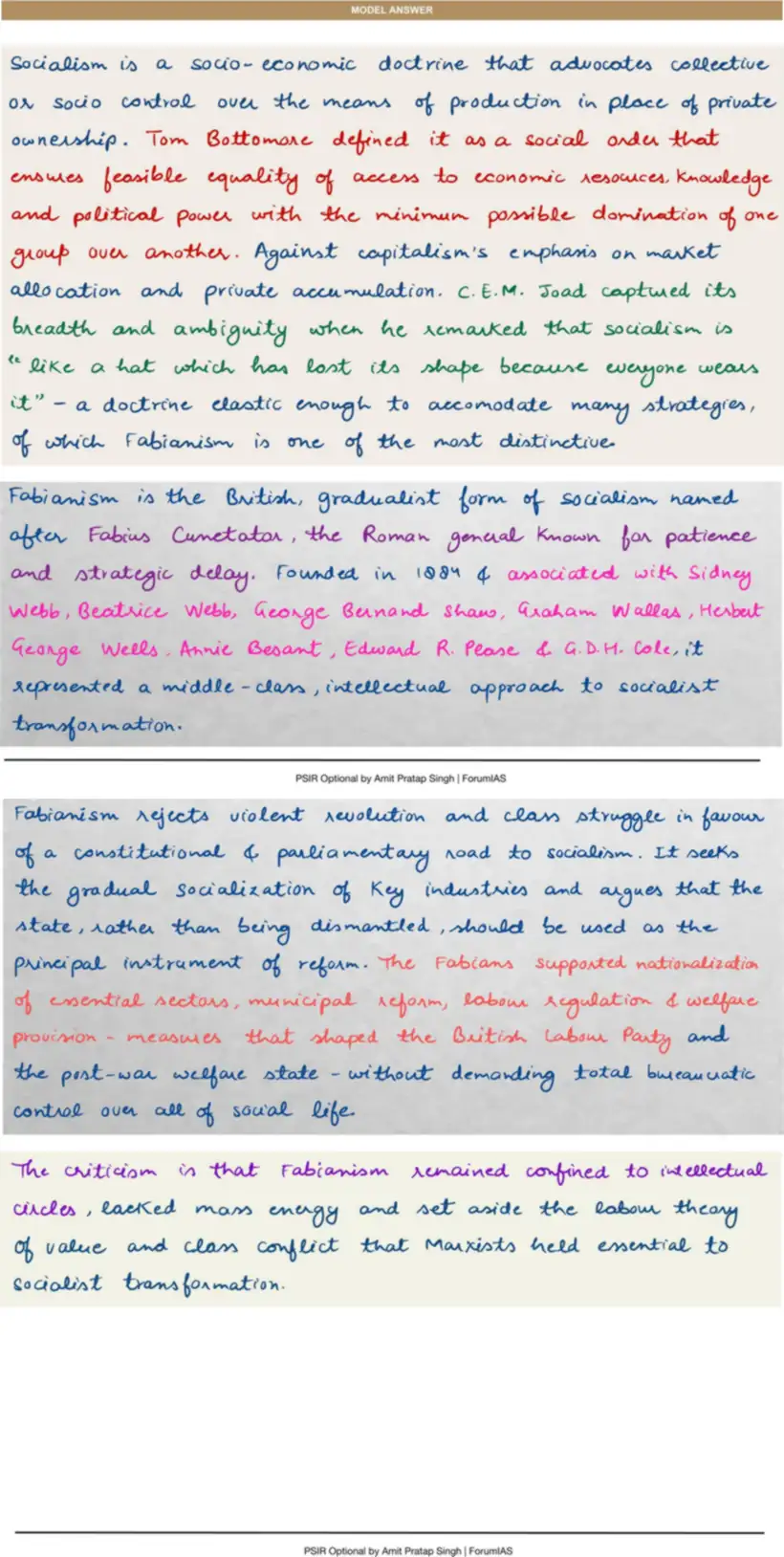
Model answer
Handwritten, in the form it would be written in the examination hall.
Also asked on this head
Political Ideologies — 23 questions in the Vault.
- Wollstonecraft developed first systematic feminist critique. Discuss her main ideas.
- Herbert Marcuse turned Freudianism on its head in his critical theory. (150 words)
- Factors like community, culture and nation weaken the hegemony of neo-liberalism today. Discuss.
How this is taught
The same flow snapshot, built for every head of the syllabus, with the answer written in class.
The first session of Foundation 2027 is published in full.
Six programmes across three levels.