
Revolt of 1857 is a ‘Sepoy Mutiny’ or ‘First War of Independence’.
How the answer moves
The flow snapshot — the routes in, the body, the counter-view and the routes out.
Route 1 two labels mark the extremes → answer sits between, not at either pole
Route 2 colonial “mutiny” reading vs nationalist “war of independence” reading → neither label alone fits 1857
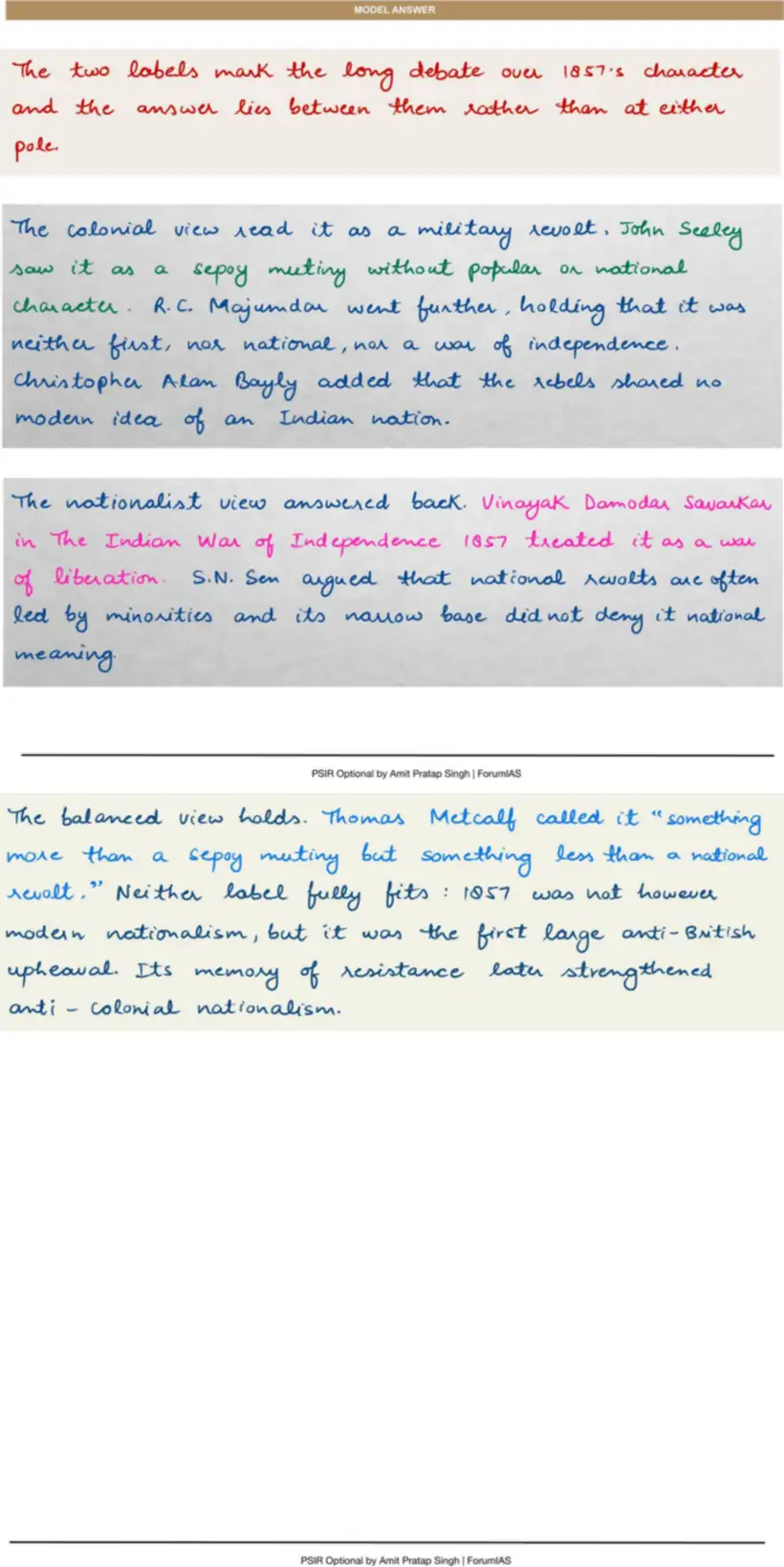
colonial / military reading → Seeley (sepoy mutiny, no popular / national character) → Majumdar (neither first, nor national, nor a war of independence) → Bayly (rebels shared no modern idea of an Indian nation) → nationalist reading answers back → Savarkar (war of liberation, The Indian War of Independence, 1857) → S.N. Sen (national revolts often led by minorities → narrow base ≠ no national meaning) → balanced view → Metcalf (“more than a mutiny, less than a national revolt”)
against both extremes → not a mere mutiny (mass base of princes, peasants, artisans) yet not a modern national war (no pan-Indian consciousness) → middle position corrects both poles
Route 1 neither label fully fits → not yet modern nationalism, but the first large anti-British upheaval
Route 2 lasting weight lies in the memory of resistance → later strengthened anti-colonial nationalism → a watershed in modern India
Model answer
Handwritten, in the form it would be written in the examination hall.
Also asked on this head
Indian Nationalism — 17 questions in the Vault.
- From passive resistors to armed revolutionaries, the Indian Freedom Struggle has a strong imprint of women freedom fighters. Elucidate.
- How did Swadeshi grow into a demand for Swaraj? (150 words)
- Analyse the workers’ movement in India in the pre-Independence period. (150 words)
How this is taught
The same flow snapshot, built for every head of the syllabus, with the answer written in class.
The first session of Foundation 2027 is published in full.
Six programmes across three levels.