
Differentiate Moderate Nationalism from Extremist/ Militant Nationalism in terms of their objectives and means.
How the answer moves
The flow snapshot — the routes in, the body, the counter-view and the routes out.
Route 1 both Congress phases after 1885, anti-colonial → diverge on objectives (what to demand) + means (how)
Route 2 shared nationalist goal → split over scope of demand and method, not over patriotism
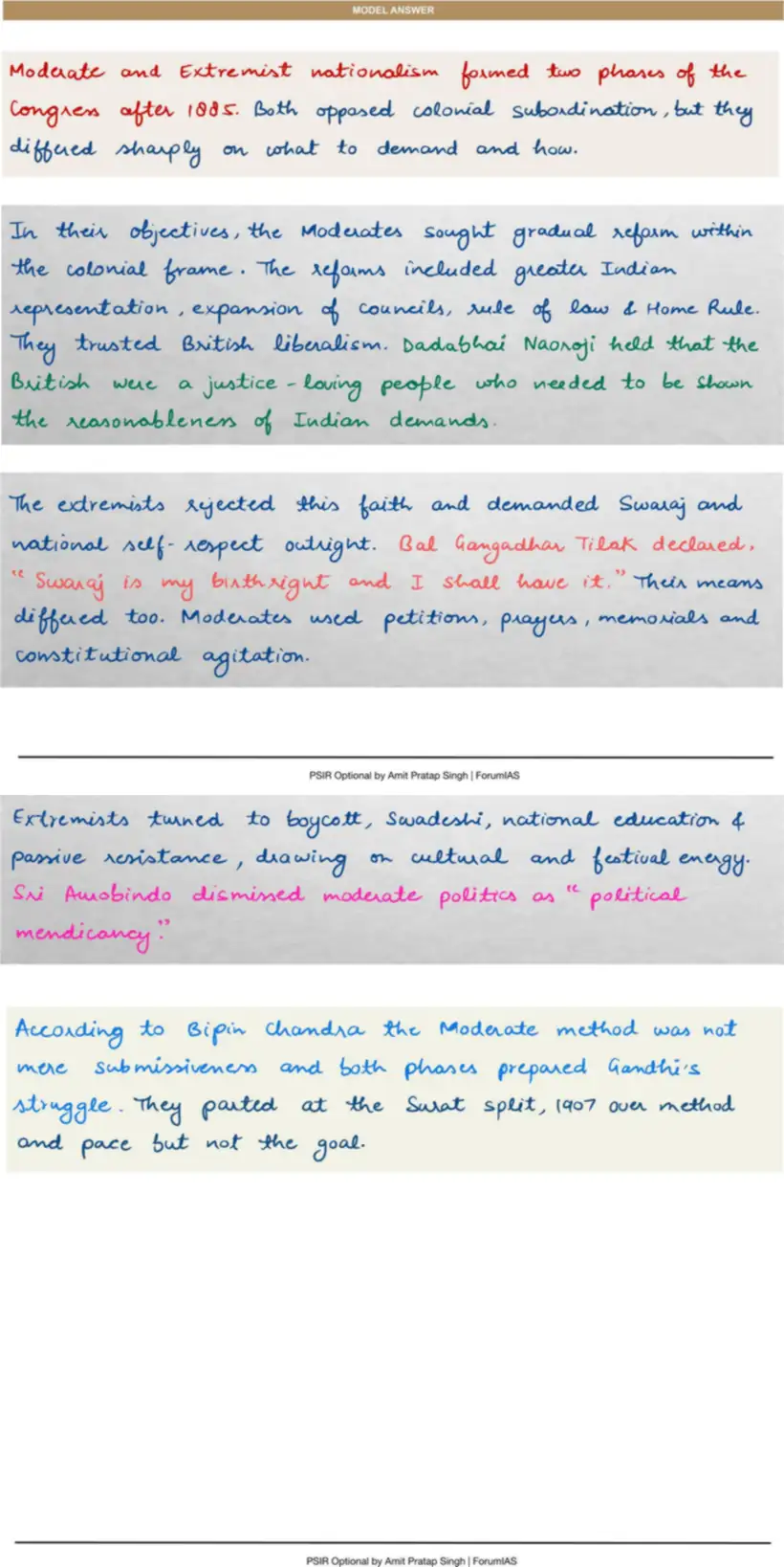
Objectives — Moderates → gradual reform inside the colonial frame (representation, councils, rule of law, Home Rule) → trust in British liberalism (Naoroji: justice-loving British, reasonableness of demands) → Extremists reject the faith → Swaraj + national self-respect (Tilak: “Swaraj is my birthright”). Means — Moderates → petitions, prayers, memorials, constitutional agitation → Extremists → boycott, Swadeshi, national education, passive resistance + cultural / festival energy (Aurobindo: “political mendicancy”)
Bipan Chandra → Moderate method not mere submissiveness → both phases predecessors of Gandhi’s struggle
Route 1 parting at the Surat Split, 1907 → over method and pace, not the goal
Route 2 two complementary stages → together built the ground for Gandhian mass politics
Model answer
Handwritten, in the form it would be written in the examination hall.
Also asked on this head
Indian Nationalism — 17 questions in the Vault.
- From passive resistors to armed revolutionaries, the Indian Freedom Struggle has a strong imprint of women freedom fighters. Elucidate.
- How did Swadeshi grow into a demand for Swaraj? (150 words)
- Analyse the workers’ movement in India in the pre-Independence period. (150 words)
How this is taught
The same flow snapshot, built for every head of the syllabus, with the answer written in class.
The first session of Foundation 2027 is published in full.
Six programmes across three levels.