
Trace the role of militant and revolutionary movements in Indian national movement.
How the answer moves
The flow snapshot — the routes in, the body, the counter-view and the routes out.
Route 1 moderate constitutionalism failed to win concessions → militant + revolutionary movements gave nationalism its first language of defiance
Route 2 goal widened from reform to complete freedom → these two currents drove that shift
militant reaction to moderate “political mendicancy” (Aurobindo) → Tilak, Pal, Rai, Aurobindo → Swaraj through Swadeshi, boycott, national education, passive resistance → Swadeshi Movement (partition of Bengal, 1905) = first mass agitation, beyond elite → Sumit Sarkar: revolutionary trend within Swadeshi → secret societies (Anushilan, Jugantar, Abhinav Bharat, Ghadar) + armed action → HRA → HSRA’s socialist–secular turn → Bhagat Singh’s anti-imperialism + rejection of communalism → women (Pritilata) widen the base
narrow, urban, middle-class base → individual heroism could not replace sustained mass politics
Route 1 courage + radical critique kept complete independence alive when constitutional politics paused
Route 2 not self-sufficient, but energised and radicalised the wider national movement
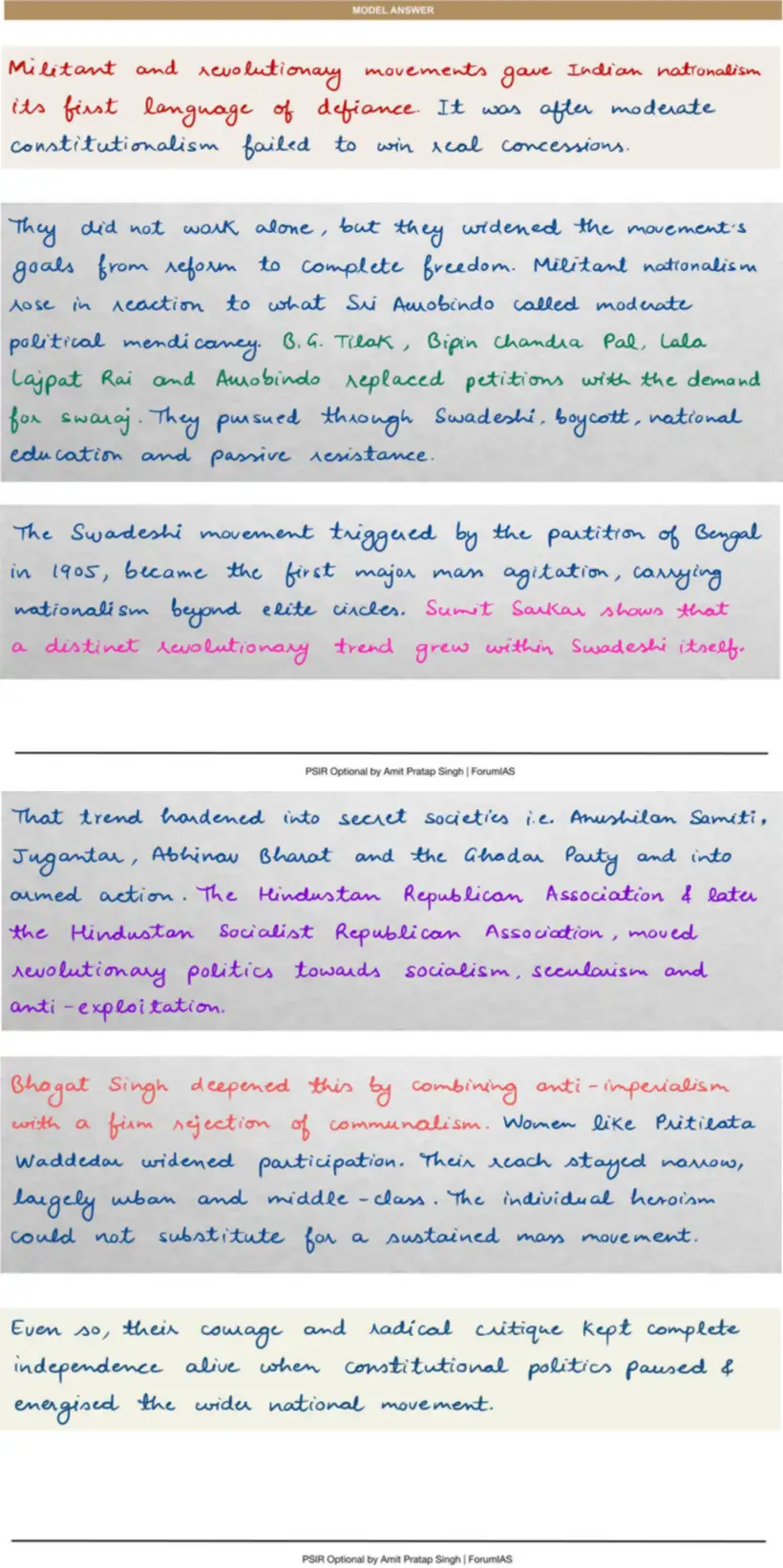
Model answer
Handwritten, in the form it would be written in the examination hall.
Also asked on this head
Indian Nationalism — 17 questions in the Vault.
- From passive resistors to armed revolutionaries, the Indian Freedom Struggle has a strong imprint of women freedom fighters. Elucidate.
- How did Swadeshi grow into a demand for Swaraj? (150 words)
- Analyse the workers’ movement in India in the pre-Independence period. (150 words)
How this is taught
The same flow snapshot, built for every head of the syllabus, with the answer written in class.
The first session of Foundation 2027 is published in full.
Six programmes across three levels.