
Explain briefly the role of Peasant Movements after 1857 and before independence.
How the answer moves
The flow snapshot — the routes in, the body, the counter-view and the routes out.
Route 1 role steadily expands across the period → local economic protest → hardens into organised political action
Route 2 colonial agrarian exploitation breeds recurring unrest → freedom struggle absorbs the peasantry in stages
early revolts (Indigo / Pabna / Deccan) → aimed at planters, zamindars, moneylenders, not yet colonial rule → distress enters public debate + forces colonial legislation → Gandhian phase (Champaran / Kheda / Bardoli) → peasant grievances tied to the national movement → A.R. Desai: mass basis for the first time → 1930s–40s (Kisan Sabhas / AIKS 1936 / Tebhaga / Telangana) → class consciousness + zamindari abolition
broadened the movement, yet Congress hesitant on landlordism → poorer cultivators left at the margins
Route 1 mutually useful but uneven partnership → peasants gave nationalism mass depth
Route 2 economic protest matured into political force → agrarian question pushed onto the nationalist agenda
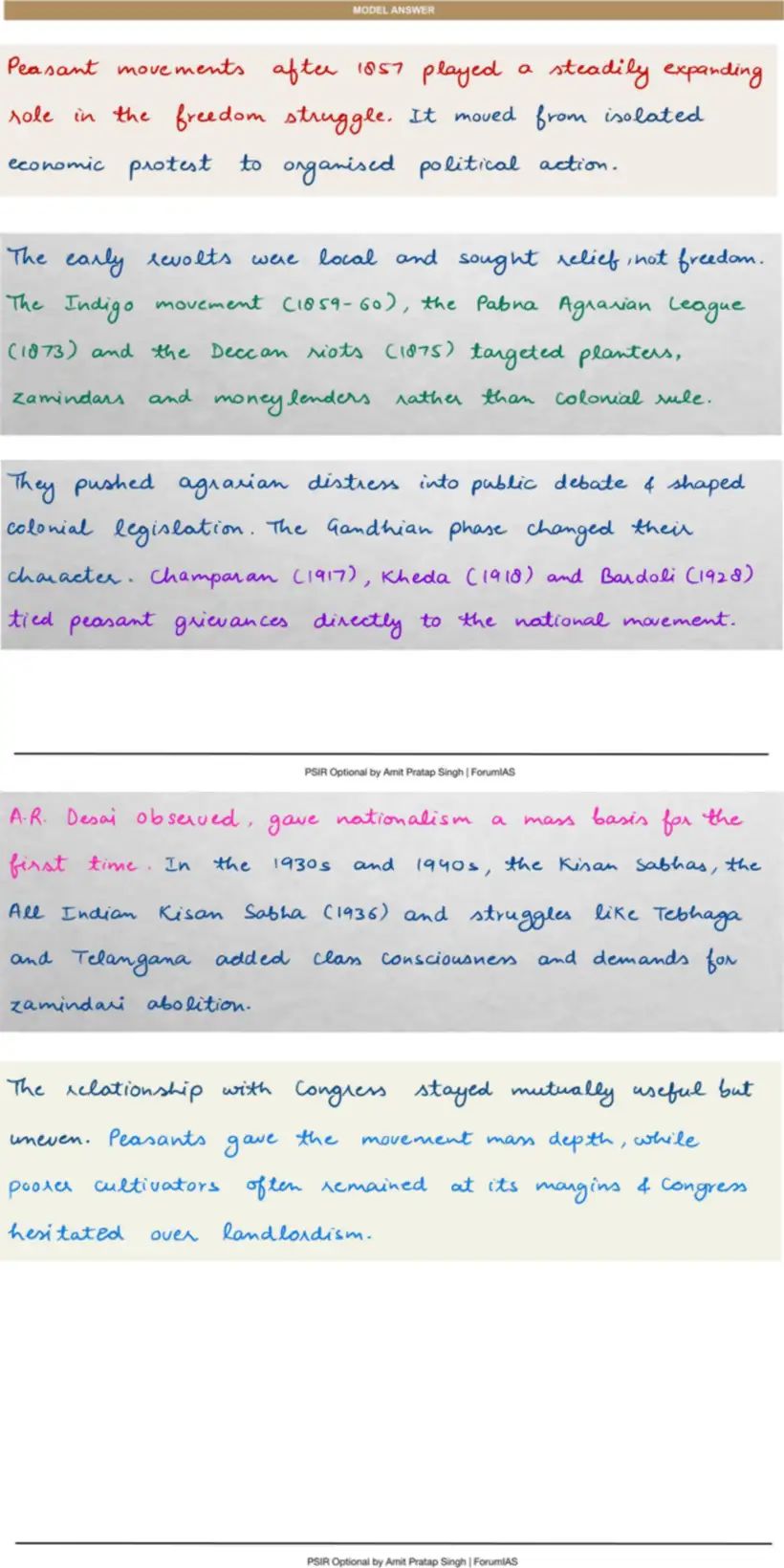
Model answer
Handwritten, in the form it would be written in the examination hall.
Also asked on this head
Indian Nationalism — 17 questions in the Vault.
- From passive resistors to armed revolutionaries, the Indian Freedom Struggle has a strong imprint of women freedom fighters. Elucidate.
- How did Swadeshi grow into a demand for Swaraj? (150 words)
- Analyse the workers’ movement in India in the pre-Independence period. (150 words)
How this is taught
The same flow snapshot, built for every head of the syllabus, with the answer written in class.
The first session of Foundation 2027 is published in full.
Six programmes across three levels.