
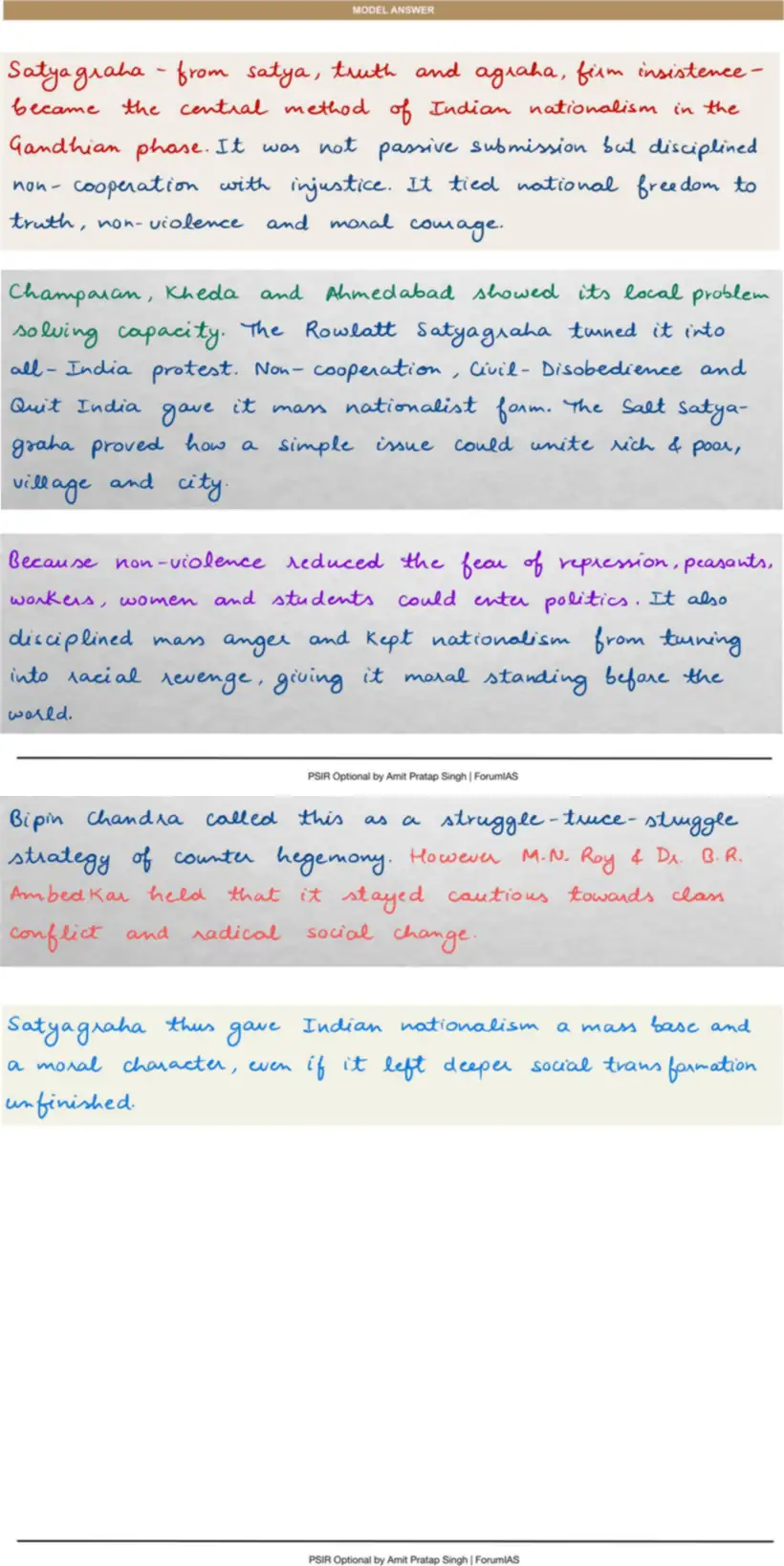
Comment on the Satyagraha and Indian Nationalism in 150 words.
How the answer moves
The flow snapshot — the routes in, the body, the counter-view and the routes out.
Route 1 Satyagraha = satya + agraha → central method of nationalism in the Gandhian phase → not passive submission; disciplined non-cooperation tied to truth / ahimsa / moral courage
Route 2 Gandhian phase made elite politics a mass struggle → a moral method opened freedom to peasant, worker, woman, student
meaning (truth-force, refusal to cooperate with injustice) → Champaran / Kheda / Ahmedabad (local problem-solving) → Rowlatt (local method → all-India protest) → Non-Cooperation / Civil Disobedience / Quit India (mass nationalist form) → Salt Satyagraha (one simple issue unites rich–poor, village–city) → non-violence cut fear of repression → peasants / workers / women / students enter politics → disciplined anger blocked racial revenge → moral standing before the world → Bipan Chandra: struggle–truce–struggle / counter-hegemony
M.N. Roy + Ambedkar → method stayed cautious on class conflict and radical social change
Route 1 gave nationalism a mass base + moral character → social transformation left unfinished
Route 2 lasting worth = ethical self-discipline fused with practical mass mobilisation
Model answer
Handwritten, in the form it would be written in the examination hall.
Also asked on this head
Indian Nationalism — 17 questions in the Vault.
- From passive resistors to armed revolutionaries, the Indian Freedom Struggle has a strong imprint of women freedom fighters. Elucidate.
- How did Swadeshi grow into a demand for Swaraj? (150 words)
- Analyse the workers’ movement in India in the pre-Independence period. (150 words)
How this is taught
The same flow snapshot, built for every head of the syllabus, with the answer written in class.
The first session of Foundation 2027 is published in full.
Six programmes across three levels.