
How are the rising powers challenging the USA and Western dominance in the IMF and the World Bank?
How the answer moves
The flow snapshot — the routes in, the body, the counter-view and the routes out.
Route 1 twins still run on 1944 arithmetic → US 16.5% + 85% veto / G7 ~43% → BRICS ~11% against half the world’s people, a fifth of output → Strange: “structural bias” → stake the line: challenge runs on two tracks, inside and outside
Route 2 power has moved, votes have not → the grievance is representation, not membership → rising powers neither exit nor accept → press for voice inside while building alternatives outside → same two-track spine
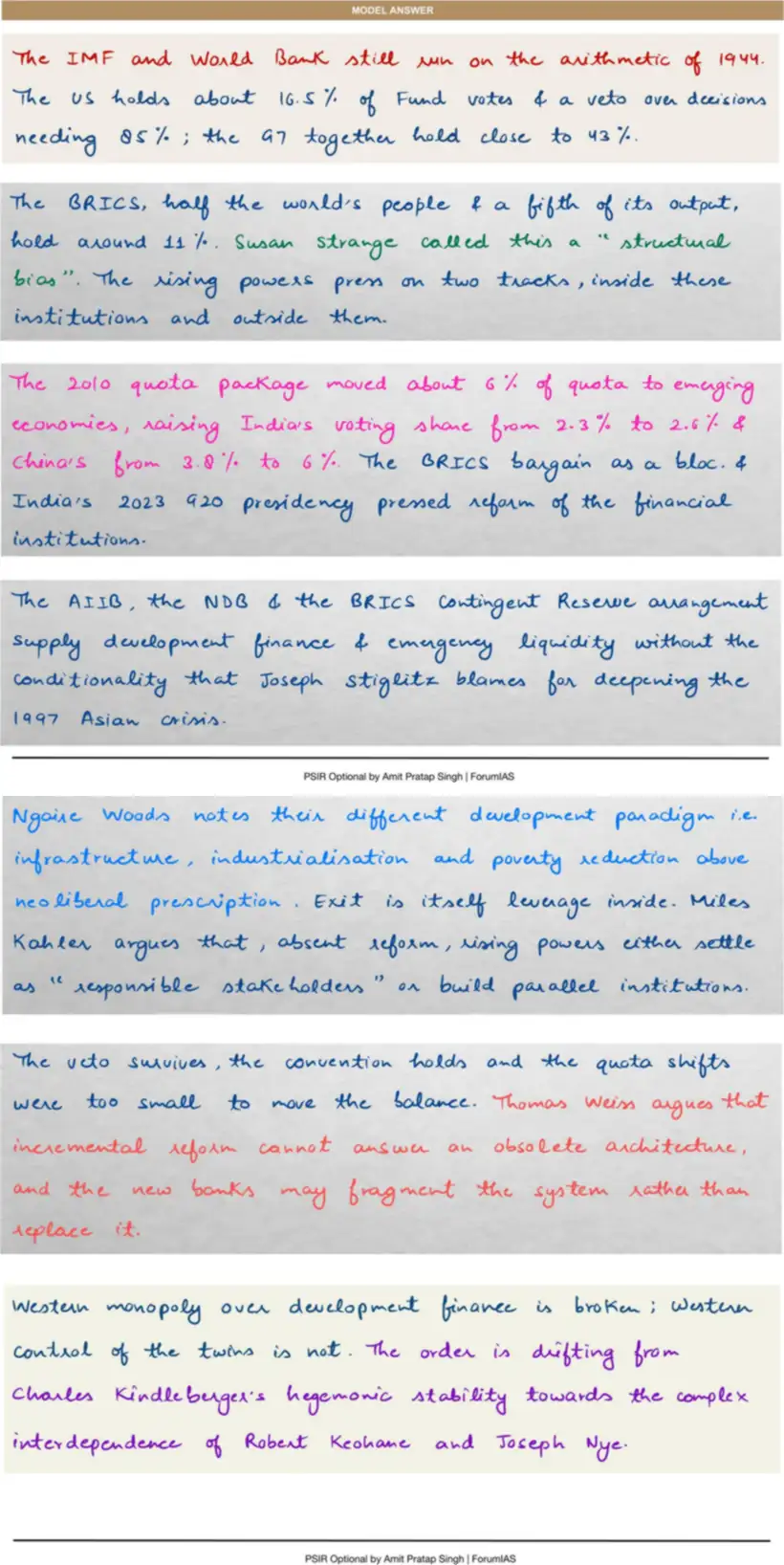
Track 1 (inside): votes must follow economic weight → 2010 quota package (~6% shift; India 2.3 → 2.6, China 3.8 → 6) → contest the European-MD / American-President convention → BRICS bargain as a bloc → India’s 2023 G20 presidency presses reform → Track 2 (outside): AIIB / NDB / BRICS CRA → finance and liquidity without conditionality (Stiglitz: conditionality deepened the 1997 Asian crisis) → Woods: a different development paradigm — infrastructure, industrialisation, poverty reduction over neoliberal prescription → exit works back as leverage inside → Kahler: “responsible stakeholders” or parallel institutions
veto survives → leadership convention holds → quota shifts too small to move the balance → Weiss: incremental reform cannot answer an obsolete architecture → new banks may fragment rather than replace
Route 1 gains real but partial → monopoly over development finance broken, control of the twins intact → drift from Kindleberger’s hegemonic stability towards Keohane–Nye complex interdependence
Route 2 close on Kahler’s fork → the West’s choice is to accommodate the rising powers inside or watch the parallel architecture grow outside → reform is the price of keeping the twins central
Model answer
Handwritten, in the form it would be written in the examination hall.
Also asked on this head
Evolution of the International Economic System — 10 questions in the Vault.
- How did the Council of Mutual Economic Assistance (CMEA) reflect geo-political division of the world during the cold war?
- Trump’s unilateral imposition of reciprocal tariffs on scores of countries poses impending threat to the future of the rule-based multilateral global trading system under the WTO....
- Latin America has made moderate success in countering US-led global economic order by forming various
How this is taught
The same flow snapshot, built for every head of the syllabus, with the answer written in class.
The first session of Foundation 2027 is published in full.
Six programmes across three levels.