
Identify and evaluate the reasons for deadlock in the WTO negotiations on fisheries between the developing and developed countries.
How the answer moves
The flow snapshot — the routes in, the body, the counter-view and the routes out.
Route 1 talks from 2001 → two decades → only a partial deal → science of depletion is agreed → the fight is over the rule-writing principle
Route 2 uniform non-discrimination vs differentiated responsibility → who built the overcapacity decides who cuts
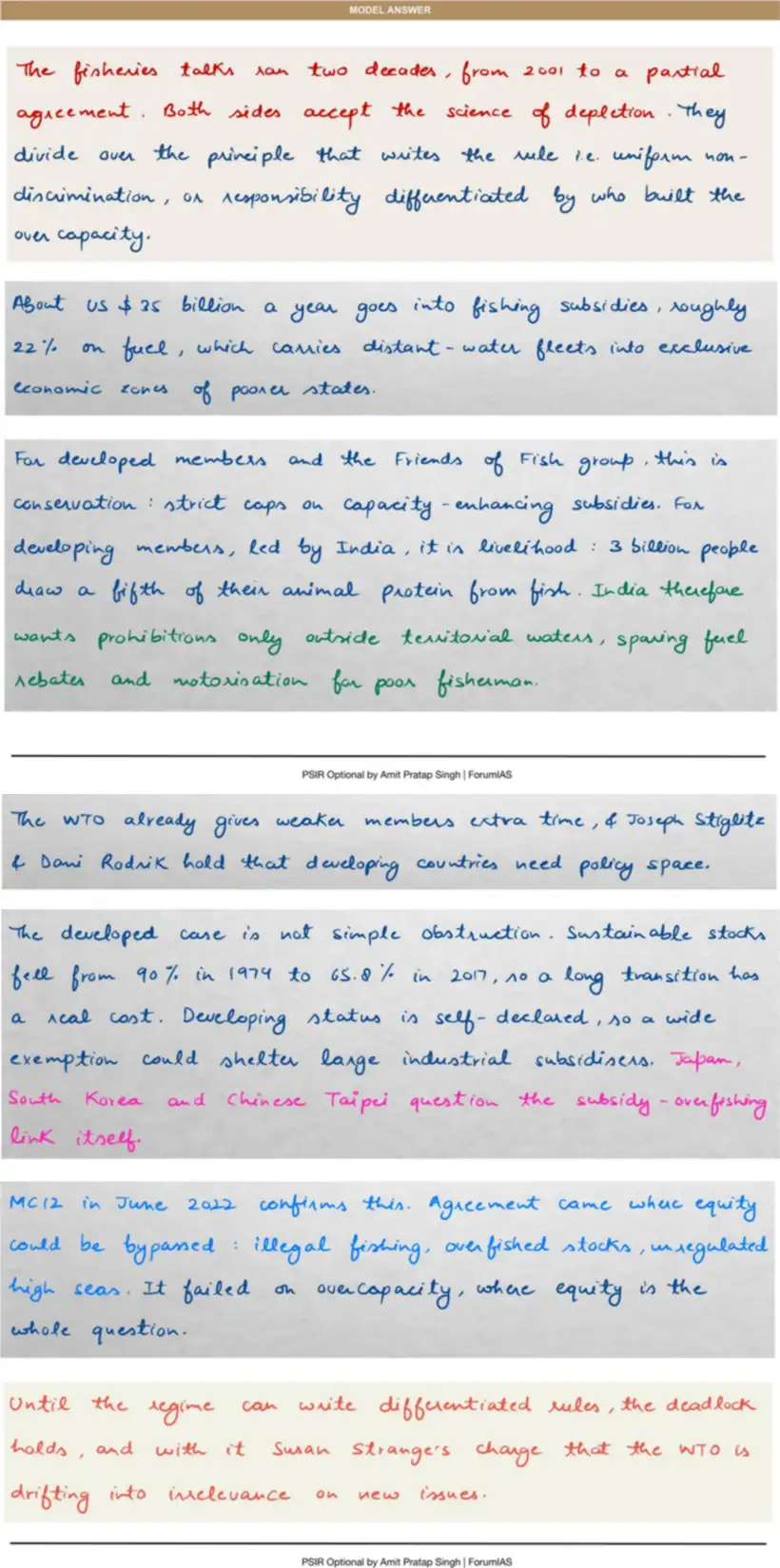
~US$35 bn/year subsidies, ~22% on fuel → distant-water fleets pushed into poorer states’ EEZs → that capacity rests on capital + technology the South lacks → CBDR + polluter-pays → two sides solving different problems: conservation (Friends of Fish; caps on capacity-enhancing subsidies) vs livelihood (3 bn people, one-fifth of animal protein) → India: prohibitions only outside territorial waters, fuel rebates + motorisation spared → crunch point = SDT → 25-year phase-out vs ~7 → draft still bracketed on fuel and vessel subsidies → SDT is not alien to the WTO (extra time already granted) → Stiglitz / Rodrik on policy space
developed case is not simple obstruction → stocks 90% (1974) → 65.8% (2017), so delay carries a cost → developing status is self-declared → a wide exemption could shelter large industrial subsidisers → Japan / South Korea / Chinese Taipei contest the subsidy–overfishing link itself
Route 1 MC12 (June 2022) delivered where equity could be bypassed — IUU, overfished stocks, unregulated high seas — and failed on overcapacity, where it could not
Route 2 deadlock is structural, not tactical → identical rules for unequal fleets → until differentiated rules become possible, Strange’s charge of drift into irrelevance stands
Model answer
Handwritten, in the form it would be written in the examination hall.
Also asked on this head
Evolution of the International Economic System — 10 questions in the Vault.
- How did the Council of Mutual Economic Assistance (CMEA) reflect geo-political division of the world during the cold war?
- Trump’s unilateral imposition of reciprocal tariffs on scores of countries poses impending threat to the future of the rule-based multilateral global trading system under the WTO....
- Latin America has made moderate success in countering US-led global economic order by forming various
How this is taught
The same flow snapshot, built for every head of the syllabus, with the answer written in class.
The first session of Foundation 2027 is published in full.
Six programmes across three levels.