
Critically evaluate the role of the United States of America in the World Trade Organisation (WTO) dispute settlement mechanism and its implications for the future of the WTO.
How the answer moves
The flow snapshot — the routes in, the body, the counter-view and the routes out.
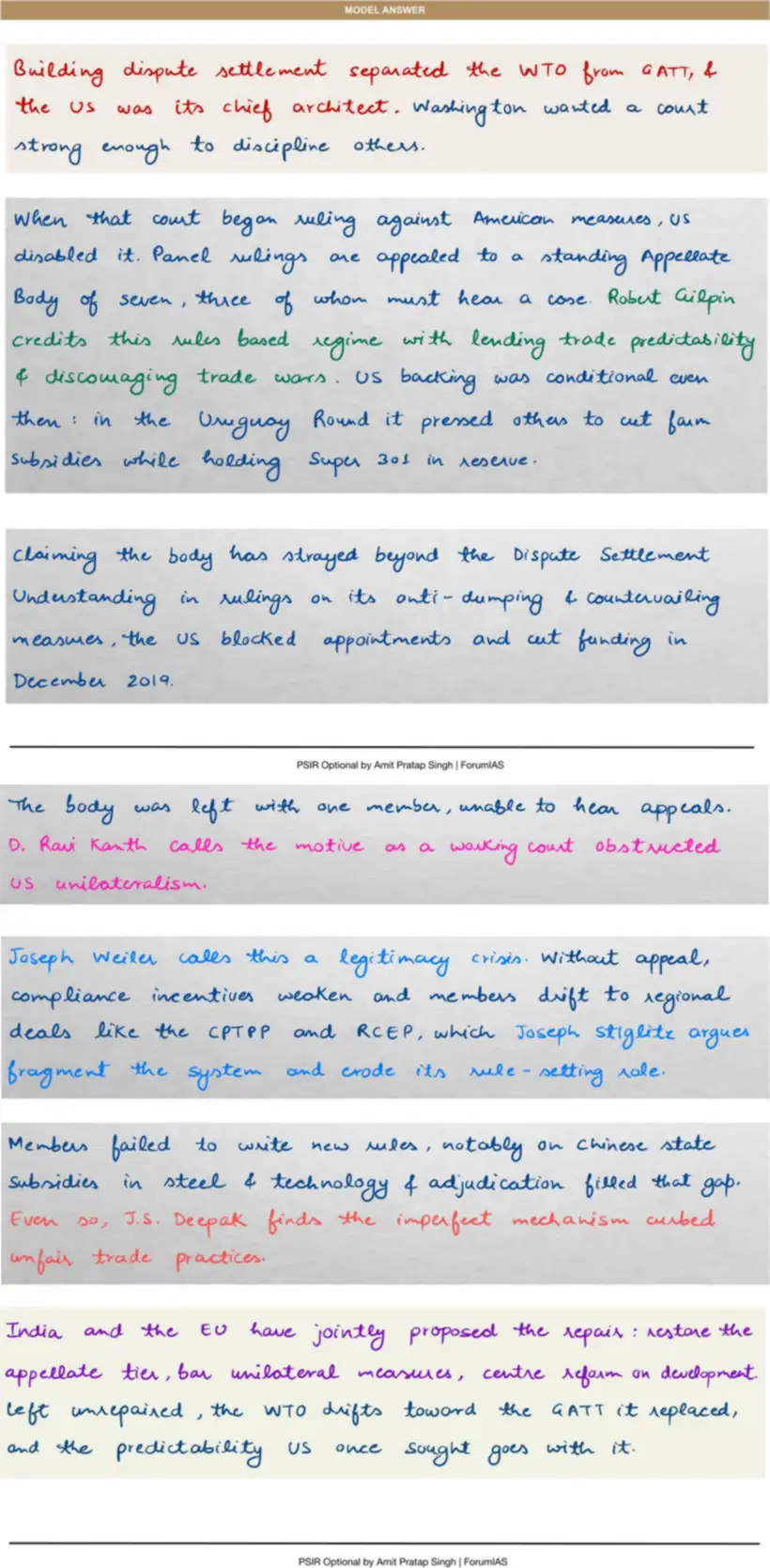
Route 1 binding DSM = what separated WTO from GATT → US as its chief architect → wanted a court to discipline others → court turned on US measures → US disabled it
Route 2 DSM as the WTO’s judicial spine, the one thing GATT lacked → its authority always rested on the consent of the strongest member → that consent was withdrawn
panel → standing Appellate Body of 7, minimum 3 to hear a case → Gilpin: rules-based regime lends predictability, discourages trade wars → but US backing conditional from birth (Uruguay Round: pressing others on farm subsidies while holding Super 301 in reserve) → reservation becomes policy → US claim: Body strayed beyond the DSU on its anti-dumping / countervailing measures → appointments blocked + funding cut, December 2019 → Body down to one member, appeals dead → Ravi Kanth: a working court obstructed US unilateralism → Weiler: legitimacy crisis → compliance incentive falls → drift to CPTPP / RCEP → Stiglitz: fragmentation, rule-setting eroded
US grievance not baseless: members failed to write new rules (Chinese state subsidies in steel, technology), so adjudication filled a gap negotiation left → but Deepak: the imperfect mechanism still curbed unfair trade practices
Route 1 India–EU repair: restore the appellate tier, bar unilateral measures, centre reform on development
Route 2 left unrepaired, the WTO drifts back toward the GATT it replaced, and the predictability Washington itself once sought goes with it
Model answer
Handwritten, in the form it would be written in the examination hall.
Also asked on this head
Evolution of the International Economic System — 10 questions in the Vault.
- How did the Council of Mutual Economic Assistance (CMEA) reflect geo-political division of the world during the cold war?
- Trump’s unilateral imposition of reciprocal tariffs on scores of countries poses impending threat to the future of the rule-based multilateral global trading system under the WTO....
- Latin America has made moderate success in countering US-led global economic order by forming various
How this is taught
The same flow snapshot, built for every head of the syllabus, with the answer written in class.
The first session of Foundation 2027 is published in full.
Six programmes across three levels.