
How far are the world governance mechanisms, dominated by IMF and World Bank, legitimate and relevant? What measures do you suggest to improve their effectiveness in global governance?
How the answer moves
The flow snapshot — the routes in, the body, the counter-view and the routes out.
Route 1 legitimacy ≠ relevance → two separate tests → the twins pass them unequally → function intact, consent missing
Route 2 votes fixed in 1944, economy of today → they still do work nobody else does → the authority to do it was never renewed
relevance secure: 191 members, surveillance + emergency liquidity, Bank’s long-term finance → India 1991, world 2008, COVID → Sri Lanka / Pakistan disliked the terms, no other door → legitimacy breaks: quota vote, US ~16.5% + 85% threshold = effective veto, G7 over 40% → European MD / American Bank President by convention alone → Cox: institutions never neutral → Stiglitz: conditionality blind to national conditions, welfare cuts, protest → the gap now costs them: BRICS weight without vote → exit begins: AIIB, NDB → Kahler: reform, or watch them build their own → measures: quotas to track economic weight (2010 = first instalment), end the leadership convention, conditionality that leaves room to grow → Mottley / Bridgetown: climate vulnerability, not income, to decide concessional access
Weiss: incremental reform cannot save an architecture already obsolete → answer to it: no replacement machinery is on offer
Route 1 the vote must match the economy
Route 2 reform is now self-preservation for the twins, not a concession to the South
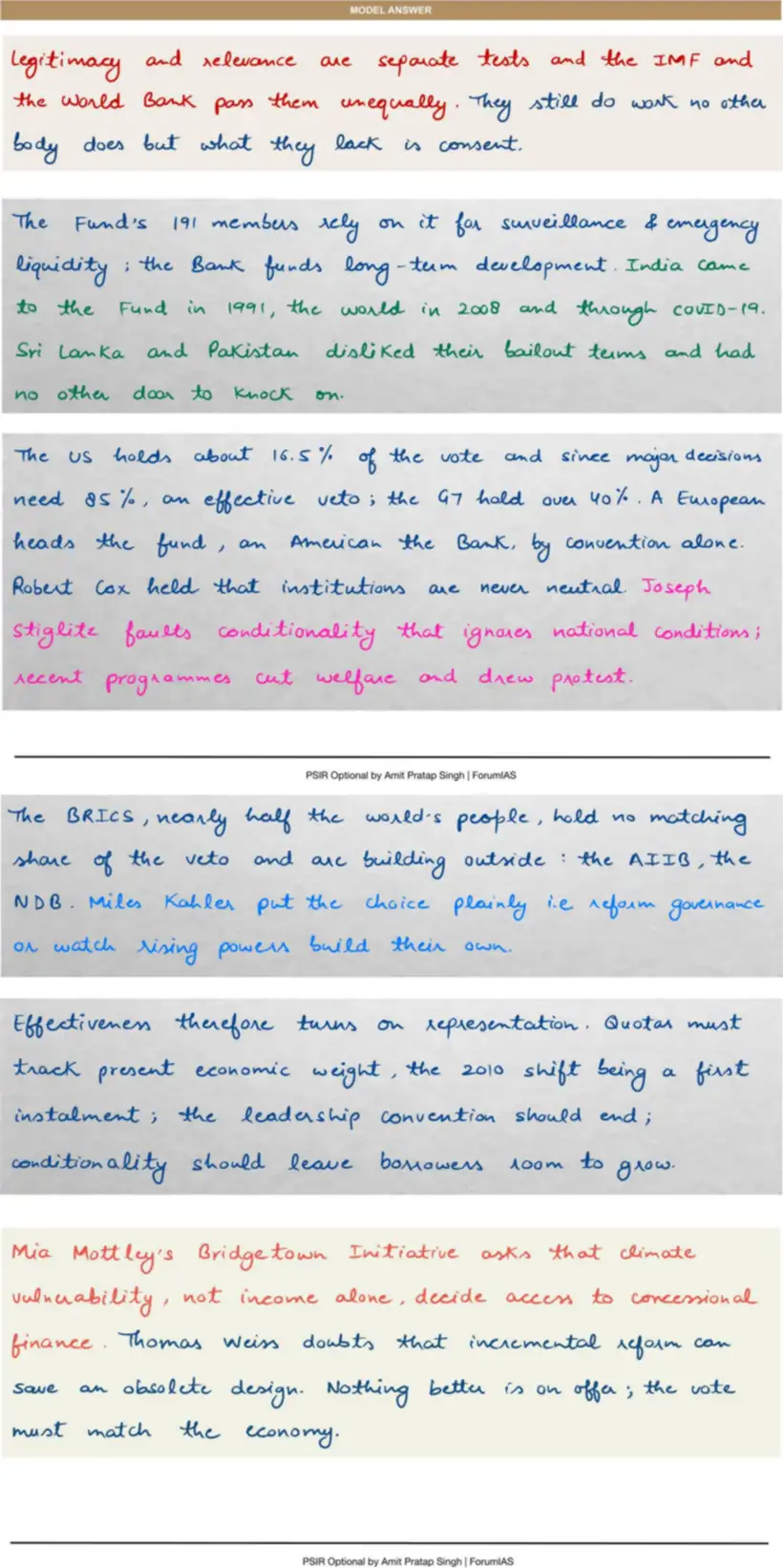
Model answer
Handwritten, in the form it would be written in the examination hall.
Also asked on this head
Evolution of the International Economic System — 10 questions in the Vault.
- How did the Council of Mutual Economic Assistance (CMEA) reflect geo-political division of the world during the cold war?
- Trump’s unilateral imposition of reciprocal tariffs on scores of countries poses impending threat to the future of the rule-based multilateral global trading system under the WTO....
- Latin America has made moderate success in countering US-led global economic order by forming various
How this is taught
The same flow snapshot, built for every head of the syllabus, with the answer written in class.
The first session of Foundation 2027 is published in full.
Six programmes across three levels.