
According to Gramsci, ‘hegemony is primarily based on the organisation of consent. Comment.
How the answer moves
The flow snapshot — the routes in, the body, the counter-view and the routes out.
Route 1 Marx’s missing revolution → Gramsci’s answer is hegemony → rule by organised, manufactured consent, not force alone
Route 2 hegemony = control by cultural means → consent produced, not freely given → “organisation” is the operative word
civil society (family / school / church) → existing order as common sense → intellectuals: traditional (falsely independent) + organic (voice of their class) → philosophy for masses → bourgeoisie unquestioned → consent also organised by accommodation (subaltern demands absorbed → particular interest as general) → Gramsci’s inversion of Marx: belief is the basis of state power, not the reverse → Anderson: state as instrument of socialisation, shaping minds
“primarily” not “wholly” → coercion never disappears → Gramsci (p. 12): apparatus disciplines those who do not consent → force as the armour behind persuasion → consent itself uneven → Jackson (p. 570): “contradictory consciousness” – approbation/apathy, resistance/resignation
Route 1 rule rests first on organised consent (civil society + intellectuals) → force held in reserve
Route 2 consent primary because organised into common sense → coercion the backstop, not the foundation
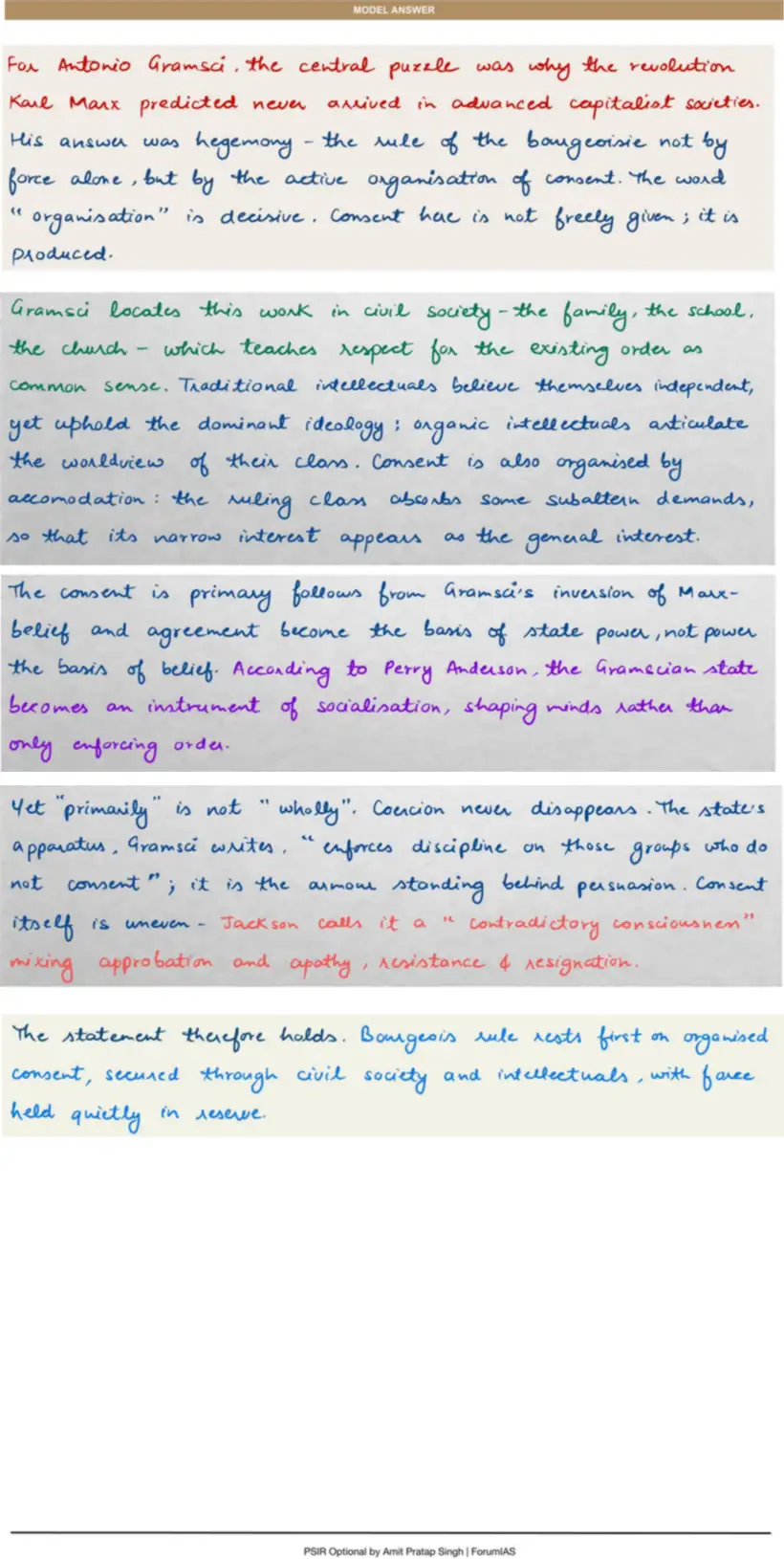
Model answer
Handwritten, in the form it would be written in the examination hall.
Also asked on this head
Western Political Thought — 29 questions in the Vault.
- Mill’s work was crucial to the development of liberalism, because it straddled the divide between classical and modern theories. Analyze.
- “Fortune favours the brave.” In the light of this statement, discuss Machiavelli’s concepts of ‘virtue’ and ‘fortune’.
- Hannah Arendt analysed a few categories of vita activa. Explain.
How this is taught
The same flow snapshot, built for every head of the syllabus, with the answer written in class.
The first session of Foundation 2027 is published in full.
Six programmes across three levels.