
Critically examine Hannah Arendt’s conceptual triad of labour, work and action.
How the answer moves
The flow snapshot — the routes in, the body, the counter-view and the routes out.
Route 1 triad set inside vita activa → the ascending ranking is itself the argument
Route 2 ranking recovers action + freedom from a world fixed on survival/production → reordering = both her achievement and the target of critics
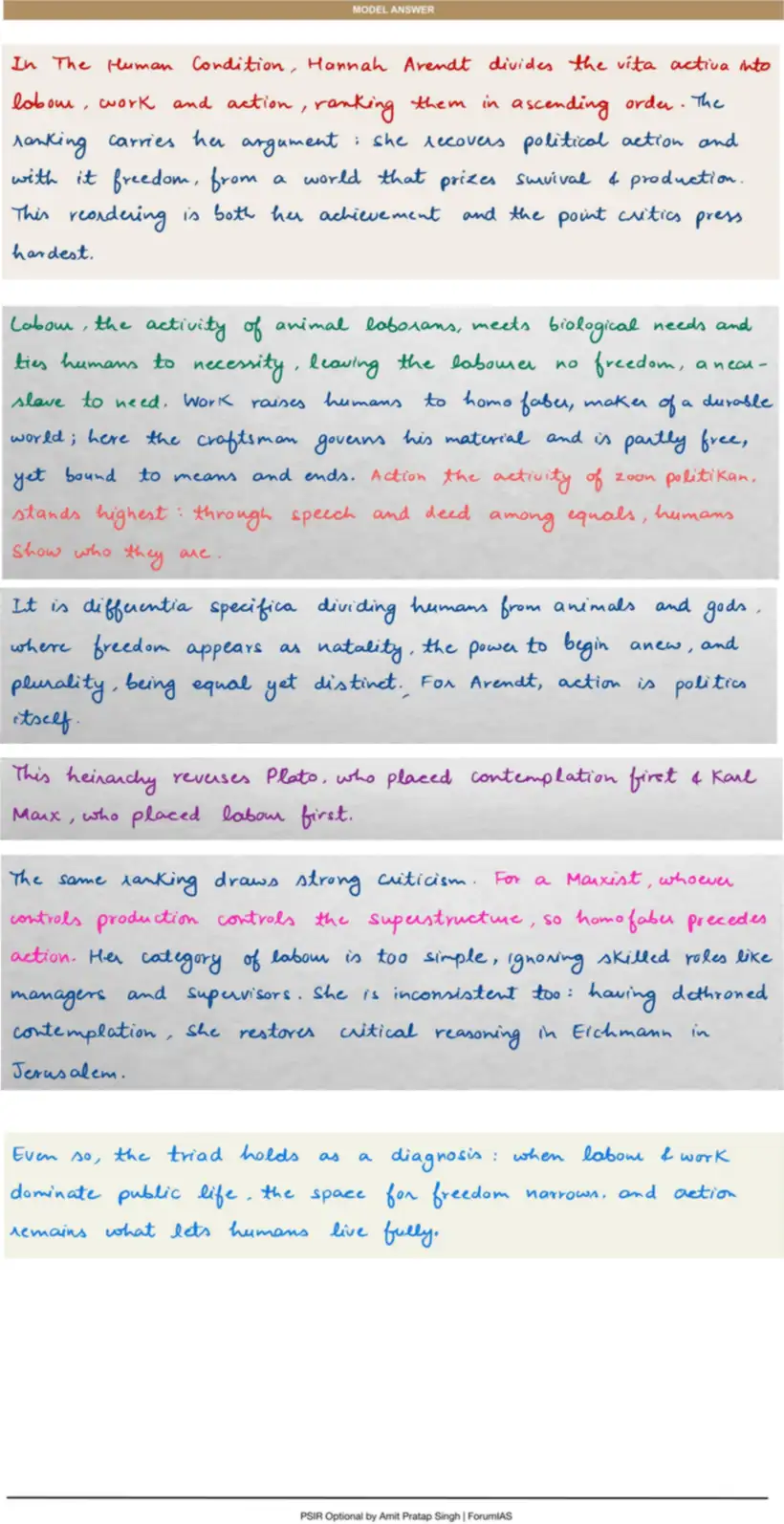
labour (animal laborans → biological necessity → no freedom → near-slave) → work (homo faber → durable world → partly free → bound to means/ends) → action (zoon politikon → highest → speech + deed → discloses who we are) → differentia specifica (apart from animals + gods) → freedom as natality + plurality (equal yet distinct) → action = politics → reverses Plato (contemplation first) + Marx (labour first) → politics an end in itself / participatory democracy vs elite rule
Marxist: control of production → homo faber precedes action → labour category too simple (ignores skilled work) → inconsistency: contemplation restored in Eichmann in Jerusalem
Route 1 the ranking is at once her contribution and her vulnerability
Route 2 triad as a diagnosis → dominance of labour/work narrows freedom → action is what lets humans live fully
Model answer
Handwritten, in the form it would be written in the examination hall.
Also asked on this head
Western Political Thought — 29 questions in the Vault.
- Mill’s work was crucial to the development of liberalism, because it straddled the divide between classical and modern theories. Analyze.
- “Fortune favours the brave.” In the light of this statement, discuss Machiavelli’s concepts of ‘virtue’ and ‘fortune’.
- Hannah Arendt analysed a few categories of vita activa. Explain.
How this is taught
The same flow snapshot, built for every head of the syllabus, with the answer written in class.
The first session of Foundation 2027 is published in full.
Six programmes across three levels.