
Differentiate between Freedom and Liberty. Discuss Marx’s notion of freedom.
How the answer moves
The flow snapshot — the routes in, the body, the counter-view and the routes out.
Route 1 terms used interchangeably → Marx gives them a distinct edge → liberty = liberal non-interference (Mill)
Route 2 liberty = freedom from external restraint, negative → Marx prefers “freedom,” deeper and social → real freedom is more than being left alone
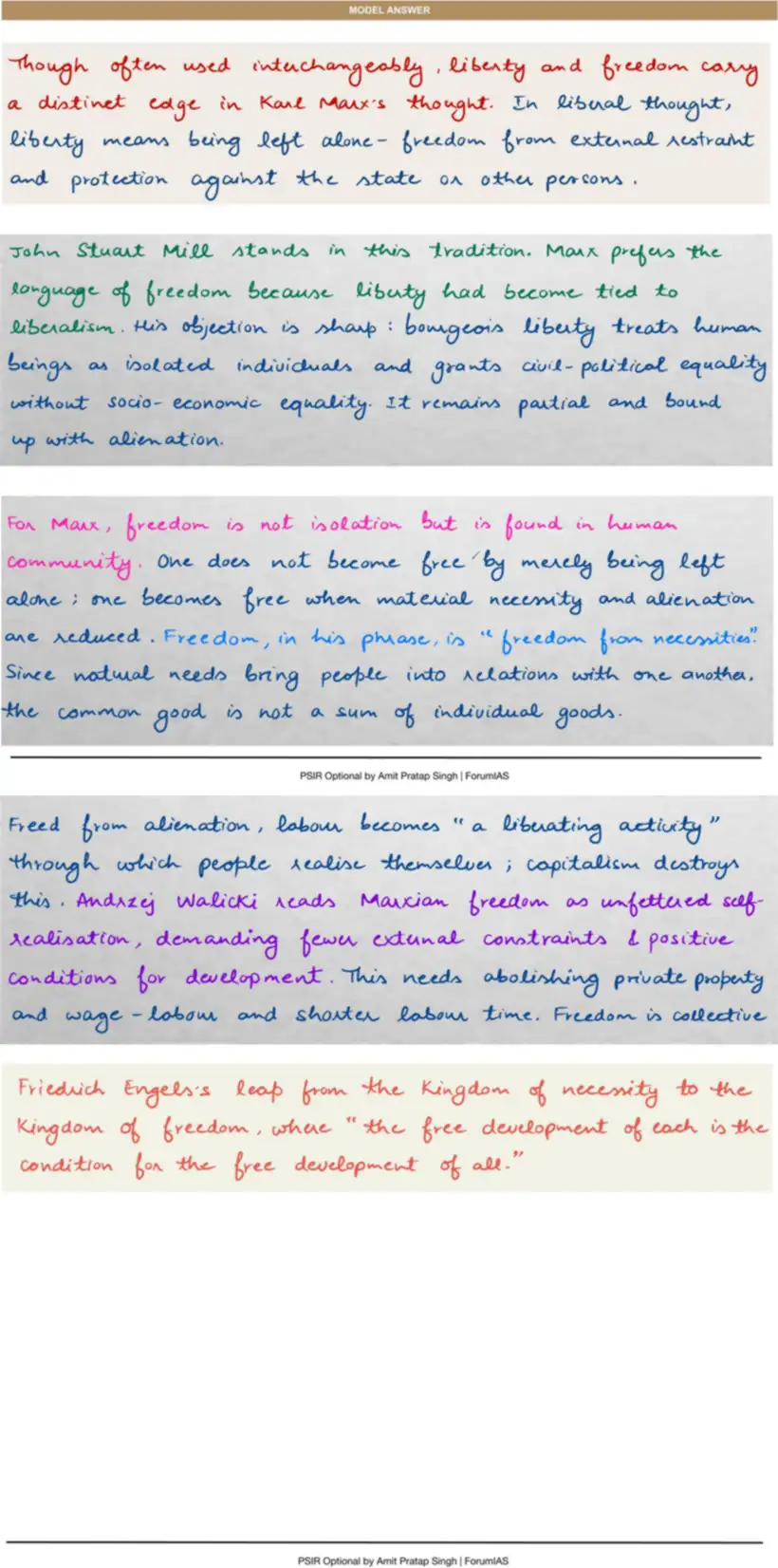
liberal liberty: being left alone, Mill → Marx prefers freedom, liberty tied to liberalism → bourgeois liberty partial: isolated individual, civil-political not socio-economic equality, bound up with alienation → Marx’s freedom: not isolation, social, in community → “freedom from necessities,” necessity + alienation reduced → natural needs connect people, common good not a sum → labour as “a liberating activity,” ruined by capitalism → Walicki: unfettered self-realisation, fewer constraints + positive conditions → conditions: abolish private property + wage-labour, shorter labour time
liberal defence: liberty as non-interference + formal equality guards the individual vs Marx’s social freedom as collective and condition-dependent
Route 1 freedom realised collectively → Engels: kingdom of necessity → kingdom of freedom
Route 2 Marx redefines freedom: from non-interference to self-realisation → “free development of each = free development of all”
Model answer
Handwritten, in the form it would be written in the examination hall.
Also asked on this head
Western Political Thought — 29 questions in the Vault.
- Mill’s work was crucial to the development of liberalism, because it straddled the divide between classical and modern theories. Analyze.
- “Fortune favours the brave.” In the light of this statement, discuss Machiavelli’s concepts of ‘virtue’ and ‘fortune’.
- Hannah Arendt analysed a few categories of vita activa. Explain.
How this is taught
The same flow snapshot, built for every head of the syllabus, with the answer written in class.
The first session of Foundation 2027 is published in full.
Six programmes across three levels.