
Gramscis concept of Hegemony.
How the answer moves
The flow snapshot — the routes in, the body, the counter-view and the routes out.
Route 1 hegemony = Gramsci’s answer to “why no proletarian revolution” → bourgeois power exceeds the economic base
Route 2 rule rests on ideas + culture → ruling worldview made “common sense” → consent, not force alone
hegemony = predominance of one class → coercion + consent → Roger Simon: coercive power + persuasive influence → site = civil society (schools, churches, media) → civil society a real seat of power, beyond the state (vs orthodox Marxism) → Bobbio: theoretician of superstructure
hegemony neither total nor permanent → counter-hegemony built through “war of position” in civil society → consent can be contested before power is seized
Route 1 hegemony frees Marxism from economic determinism → power located in culture, not the economy alone
Route 2 while hegemony holds, revolution is impossible → ideological ground must be won first
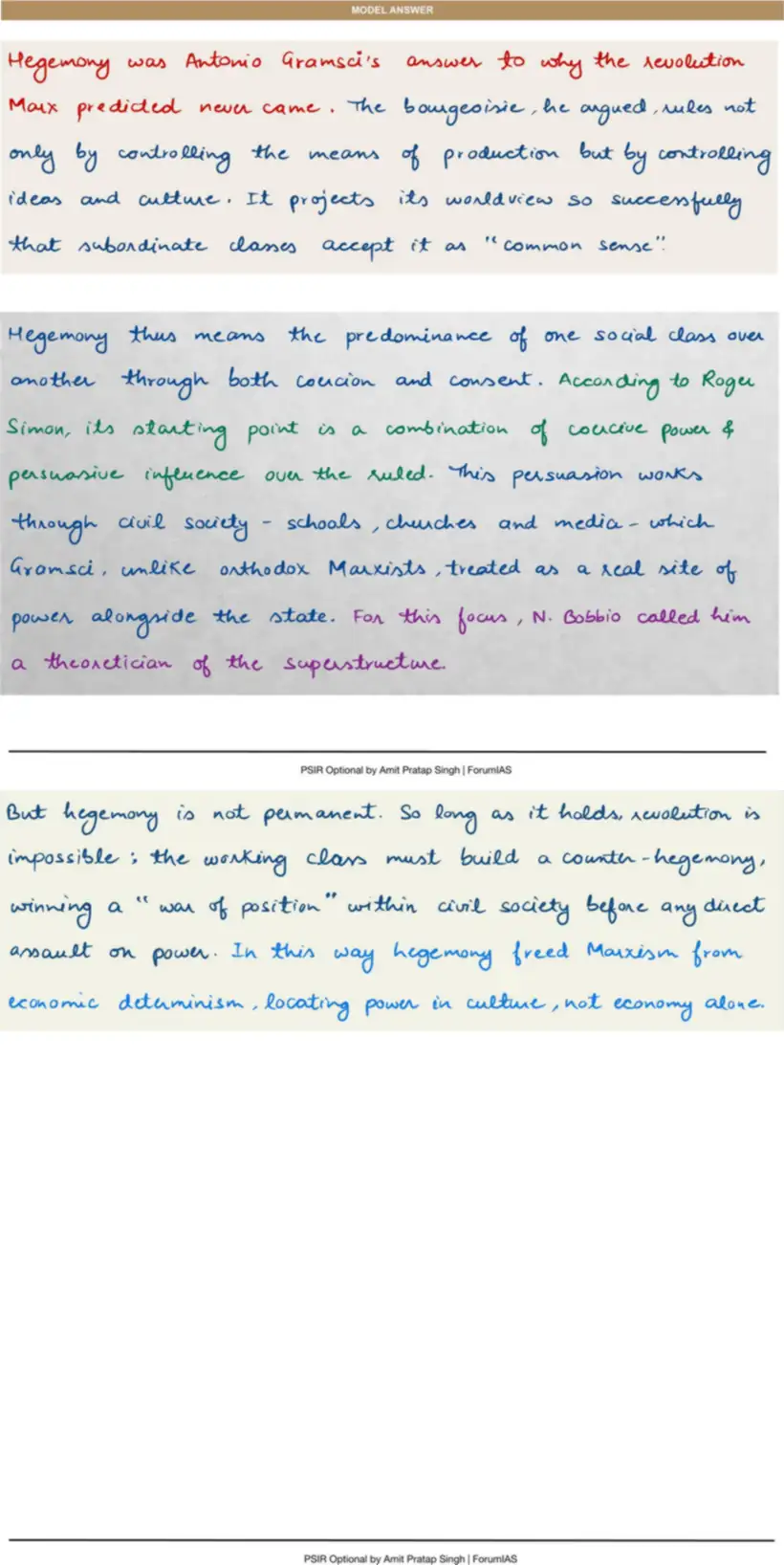
Model answer
Handwritten, in the form it would be written in the examination hall.
Also asked on this head
Western Political Thought — 29 questions in the Vault.
- Mill’s work was crucial to the development of liberalism, because it straddled the divide between classical and modern theories. Analyze.
- “Fortune favours the brave.” In the light of this statement, discuss Machiavelli’s concepts of ‘virtue’ and ‘fortune’.
- Hannah Arendt analysed a few categories of vita activa. Explain.
How this is taught
The same flow snapshot, built for every head of the syllabus, with the answer written in class.
The first session of Foundation 2027 is published in full.
Six programmes across three levels.