
Explain Aristotle’s critique of Plato’s Idealism.
How the answer moves
The flow snapshot — the routes in, the body, the counter-view and the routes out.
Route 1 Coleridge’s split: born either Platonist-idealist or Aristotelian-realist → critique grows from a single root
Route 2 Aristotle refuses ideas placed above matter → ideas inherent in matter → respects Plato, but truth dearer
one metaphysical root (ideas in matter, not above it) → drives method: Plato deductive, general → particular, begins from conclusions vs Aristotle inductive, particular → general, reaches through analysis → drives politics: ideal state vs best possible state (secure, self-sufficient, not utopian) → Plato’s complete unity vs Aristotle’s unity in diversity (excess oneness destroys the state) → communism of wives/property rejected (what belongs to many gets least care → defends family + private property → producers keep fruits of labour) → philosopher king vs rule of law (collective wisdom of ages over the wisest single ruler)
critique corrects, does not discard → beneath it Aristotle stays Platonic: virtue realised through the state, ethics and politics one science → Foster: greatest of all Platonists
Route 1 realism completes idealism, not rejects it → Aristotle remains the greatest Platonist
Route 2 every political break traces to one metaphysical root — ideas in matter — so the quarrel is over ground and method, not moral purpose
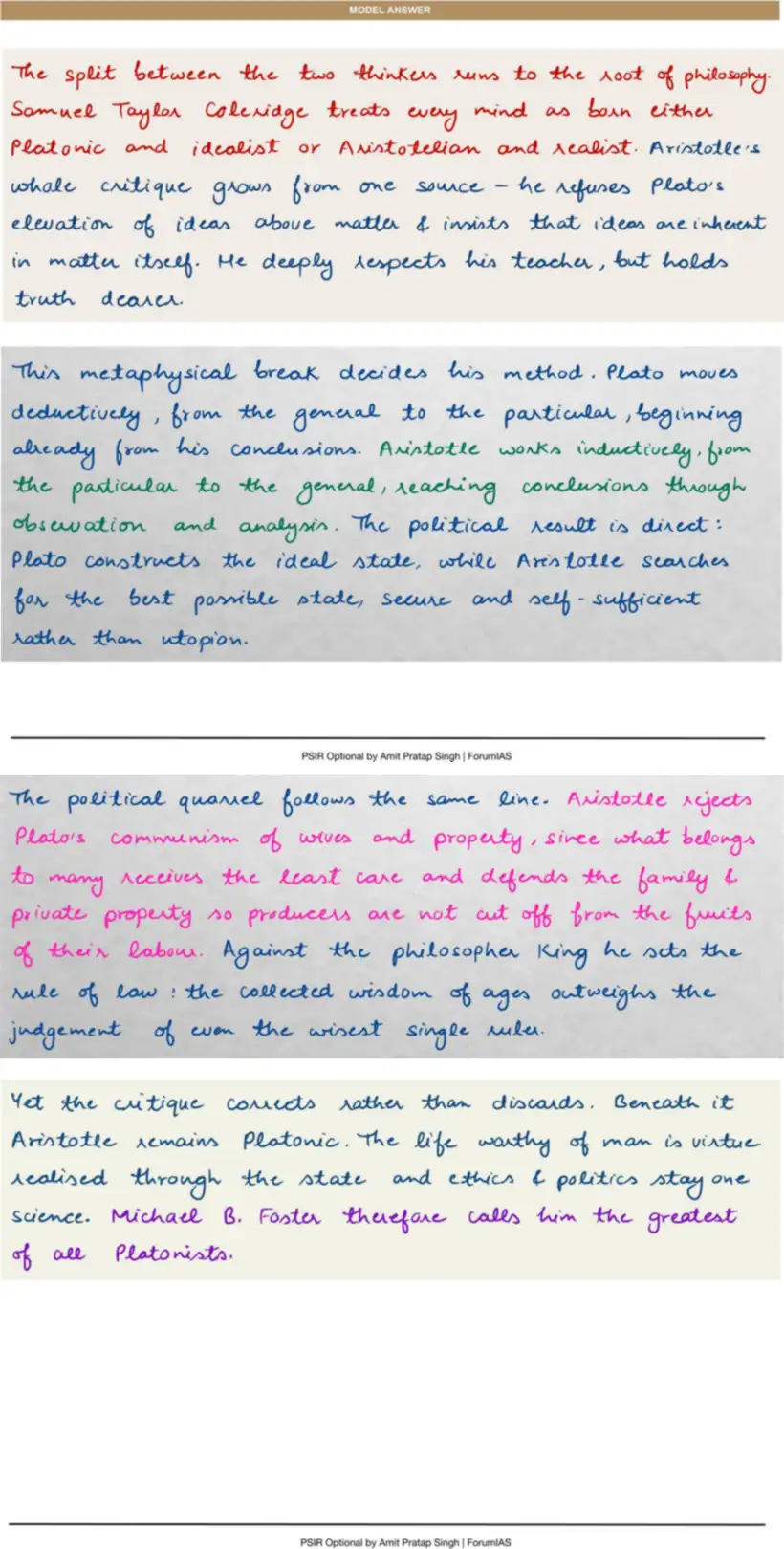
Model answer
Handwritten, in the form it would be written in the examination hall.
Also asked on this head
Western Political Thought — 29 questions in the Vault.
- Mill’s work was crucial to the development of liberalism, because it straddled the divide between classical and modern theories. Analyze.
- “Fortune favours the brave.” In the light of this statement, discuss Machiavelli’s concepts of ‘virtue’ and ‘fortune’.
- Hannah Arendt analysed a few categories of vita activa. Explain.
How this is taught
The same flow snapshot, built for every head of the syllabus, with the answer written in class.
The first session of Foundation 2027 is published in full.
Six programmes across three levels.