
Critically examine Machiavelli’s views on religion and politics.
How the answer moves
The flow snapshot — the routes in, the body, the counter-view and the routes out.
Route 1 religious ordinances ruled state policy → Machiavelli reverses it → religion serves the state, not rules it
Route 2 not anti-religion → utilitarian stance → religion as instrument of statecraft
admits utility (ordinances → greatness of commonwealths; neglect → devastation) → disciplinary force → order & stability → but refuses religion as foundation of politics → religion not above the state → opposes Church’s command → separates religious authority from political power → Dunning → frees politics from vassalage of religion → modern age
Sabine → almost blind to religion’s political role over the next two centuries → purely instrumental view underrates religion’s force
Route 1 worth: founds secular, autonomous politics freed from Church control
Route 2 limit: reduces religion to a mere tool of the state, missing its deeper political power
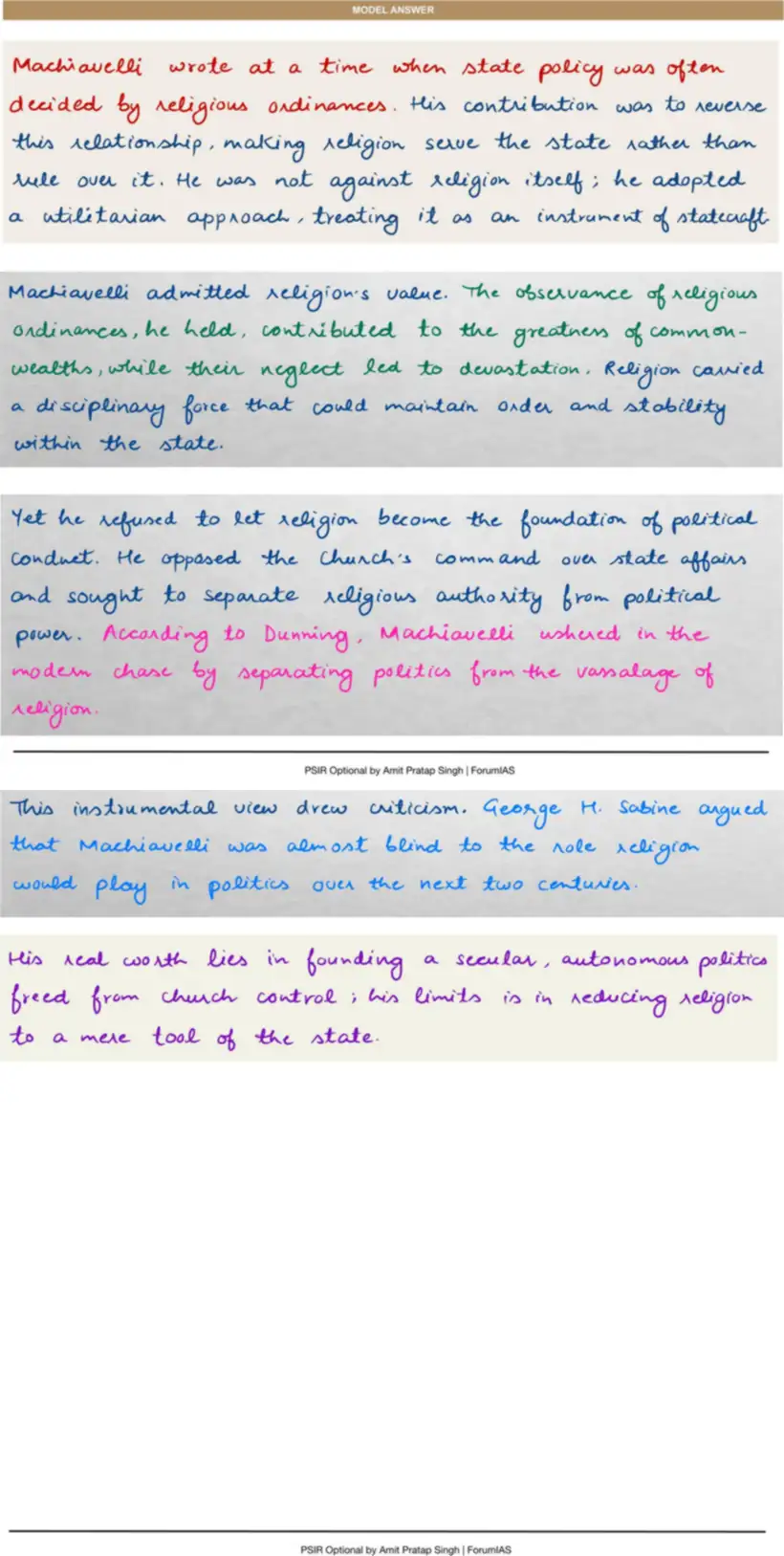
Model answer
Handwritten, in the form it would be written in the examination hall.
Also asked on this head
Western Political Thought — 29 questions in the Vault.
- Mill’s work was crucial to the development of liberalism, because it straddled the divide between classical and modern theories. Analyze.
- “Fortune favours the brave.” In the light of this statement, discuss Machiavelli’s concepts of ‘virtue’ and ‘fortune’.
- Hannah Arendt analysed a few categories of vita activa. Explain.
How this is taught
The same flow snapshot, built for every head of the syllabus, with the answer written in class.
The first session of Foundation 2027 is published in full.
Six programmes across three levels.