
Explain the Aristotelian view of politics. To what extent do you think it has contributed to the development of modern-day constitutional democracies?
How the answer moves
The flow snapshot — the routes in, the body, the counter-view and the routes out.
Route 1 politics as master science → state for the good life → ethical foundation of constitutional govt, reach partial
Route 2 man a political animal (reason/speech) → ethics + justice inseparable from politics → foundation laid, but incomplete
political animal via logos → politics inseparable from ethics, justice at core (Ebenstein: moral over legal sovereignty) → rule of law over personal will (law = reason without passion) → regimes judged by common good vs self-interest → polity / mixed constitution / middle class → contribution: rule of law → constitutionalism, mixed govt → checks & balances, middle class → stability, citizenship (rule & be ruled) → civic republicanism, common good → test of legitimacy → absorbed via Montesquieu / American balance of few & many
contribution foundational, not direct → slavery, exclusion of women & workers, small homogeneous polis → far from inclusive mass democracy
Route 1 Aristotle gives the grammar of constitutional govt (law, balance, civic virtue, common good), not its democratic substance
Route 2 influence deep in foundations, limited in extent
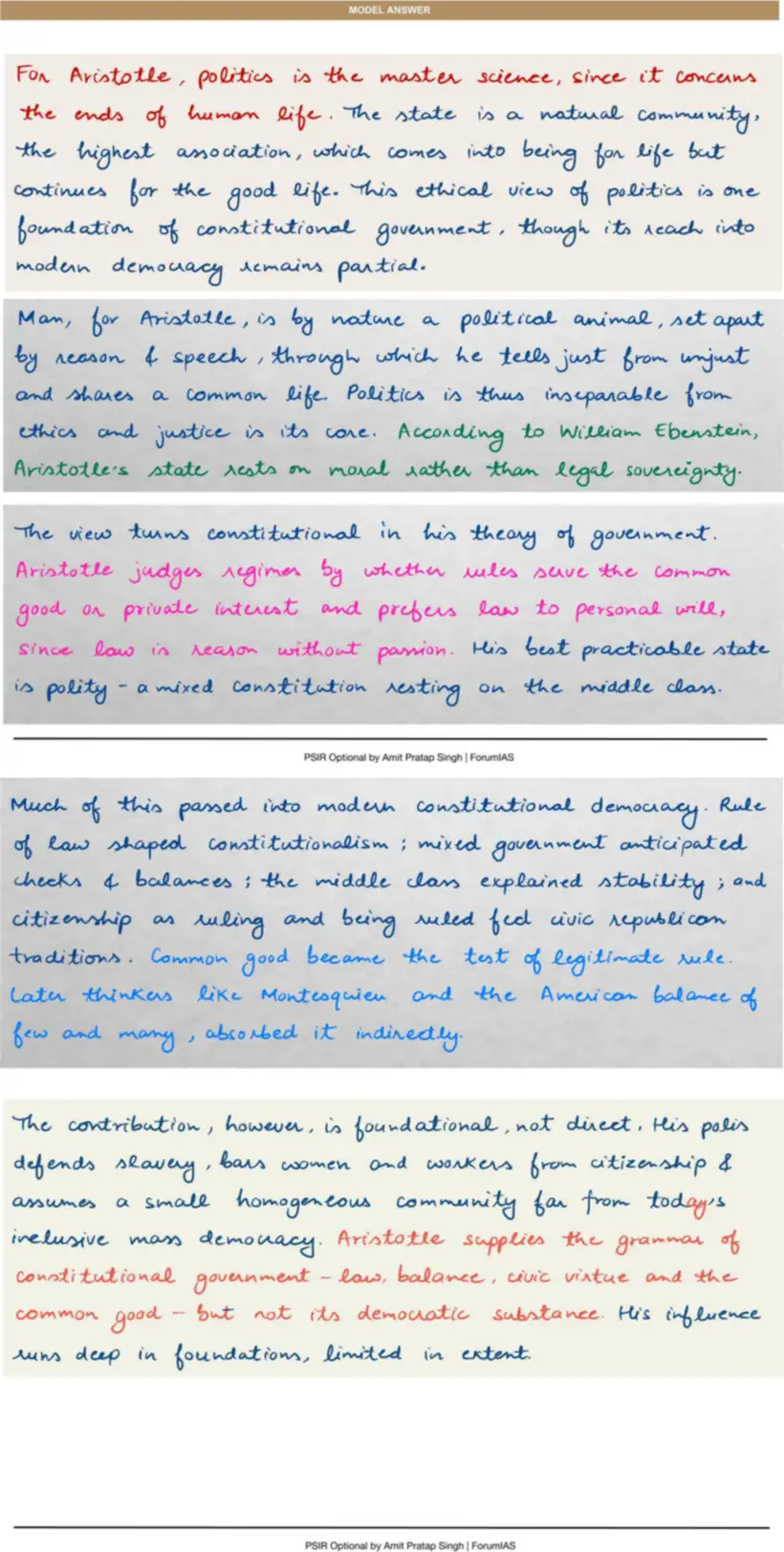
Model answer
Handwritten, in the form it would be written in the examination hall.
Also asked on this head
Western Political Thought — 29 questions in the Vault.
- Mill’s work was crucial to the development of liberalism, because it straddled the divide between classical and modern theories. Analyze.
- “Fortune favours the brave.” In the light of this statement, discuss Machiavelli’s concepts of ‘virtue’ and ‘fortune’.
- Hannah Arendt analysed a few categories of vita activa. Explain.
How this is taught
The same flow snapshot, built for every head of the syllabus, with the answer written in class.
The first session of Foundation 2027 is published in full.
Six programmes across three levels.