
Everywhere, inequality is a cause of revolution – Aristotle. Comment.
How the answer moves
The flow snapshot — the routes in, the body, the counter-view and the routes out.
Route 1 quote = heart of Aristotle’s revolution theory → revolution = any change in constitution/rulers, big or small → root cause = injustice bred by inequality
Route 2 revolution defined broadly → among many causes, inequality the deepest → because it breeds a sense of injustice
proportionate justice → injustice = equals treated unequally / unequals treated equally → felt mis-distribution of honour, office, wealth → discontent → rebellion → inequality real or imagined → relative deprivation → perceived injustice = most combustible material → Canevaro & Mantzouranis: clashing proportional-equality conceptions → roots of stasis / metabole → remedy: strong middle class + mixed polity → narrows gap, softens resentment
Aristotle narrow + status-quoist (revolution only political, seeks prevention) vs Marx → revolution as structural transformation, driving force of history
Route 1 claim powerful but limited → link between inequality and instability stays sharp
Route 2 perceived injustice, not poverty alone, is the real trigger → insight holds across regimes
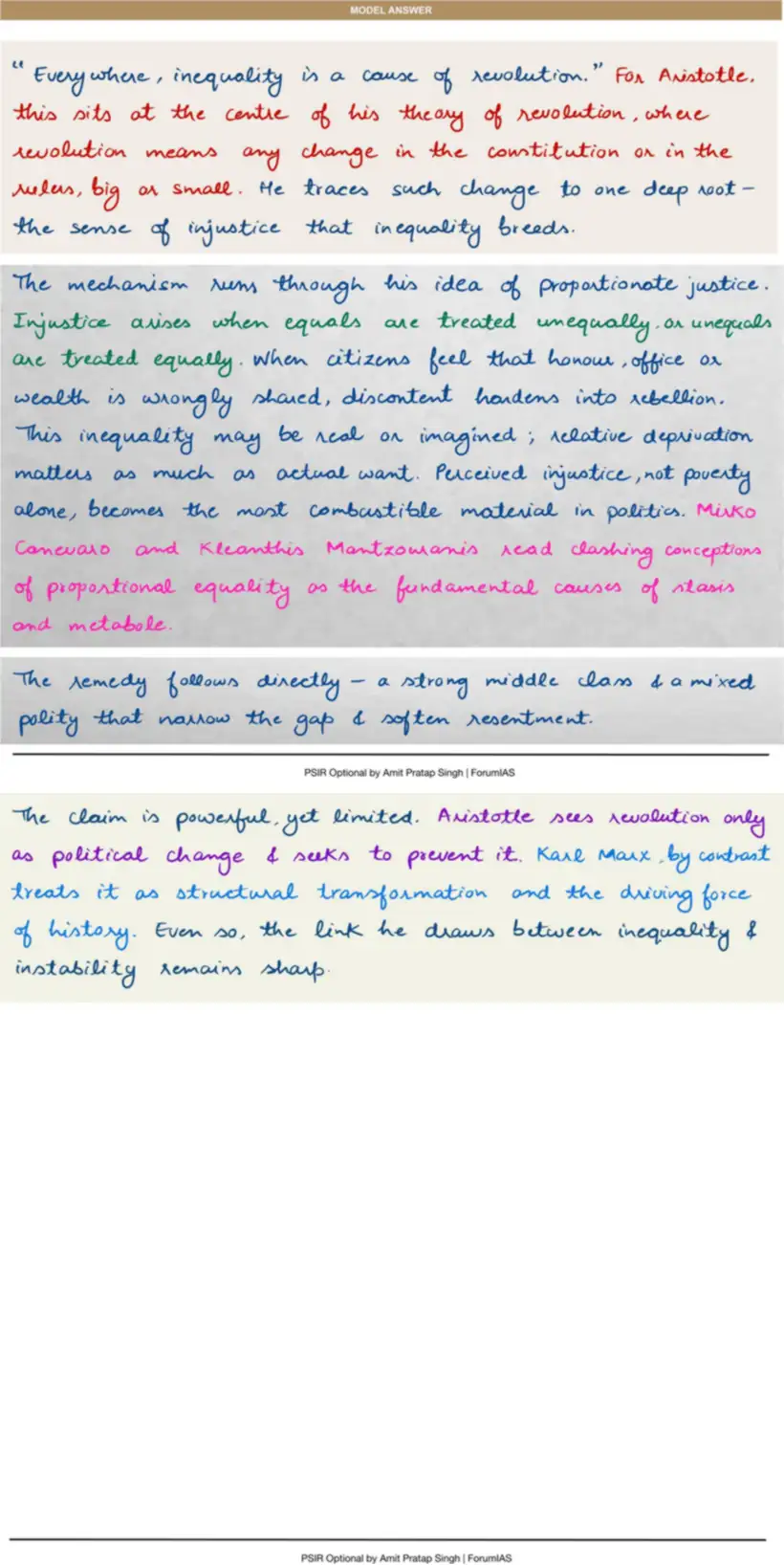
Model answer
Handwritten, in the form it would be written in the examination hall.
Also asked on this head
Western Political Thought — 29 questions in the Vault.
- Mill’s work was crucial to the development of liberalism, because it straddled the divide between classical and modern theories. Analyze.
- “Fortune favours the brave.” In the light of this statement, discuss Machiavelli’s concepts of ‘virtue’ and ‘fortune’.
- Hannah Arendt analysed a few categories of vita activa. Explain.
How this is taught
The same flow snapshot, built for every head of the syllabus, with the answer written in class.
The first session of Foundation 2027 is published in full.
Six programmes across three levels.