
Critically examine Plato’s theory of Forms.
How the answer moves
The flow snapshot — the routes in, the body, the counter-view and the routes out.
Route 1 theory of Forms at centre of Plato’s philosophy → two worlds: material copies vs eternal archetypes (justice, beauty, goodness, ideal state)
Route 2 both strength and weakness flow from one move → the split between changing matter and unchanging Forms
separation drives knowledge: senses = opinion, reason = knowledge of Forms → Cave + divided line = ascent from shadows to sunlight → Idea of Good at the top → metaphysics turns political → only philosopher who knows the Good rules → philosopher-king → Plato both idealist and realist
same separation attacked → Aristotle: form within the object / hylomorphism, can’t explain change, physical world not illusion → Russell & Ayer: metaphysical Forms lack empirical proof
Route 1 theory survives the attacks → raises the lasting question: do justice, truth, goodness need stable standards beyond appearances?
Route 2 the separation is its fault line, but also its lasting strength → the demand for fixed standards beyond shifting appearances keeps it the live question
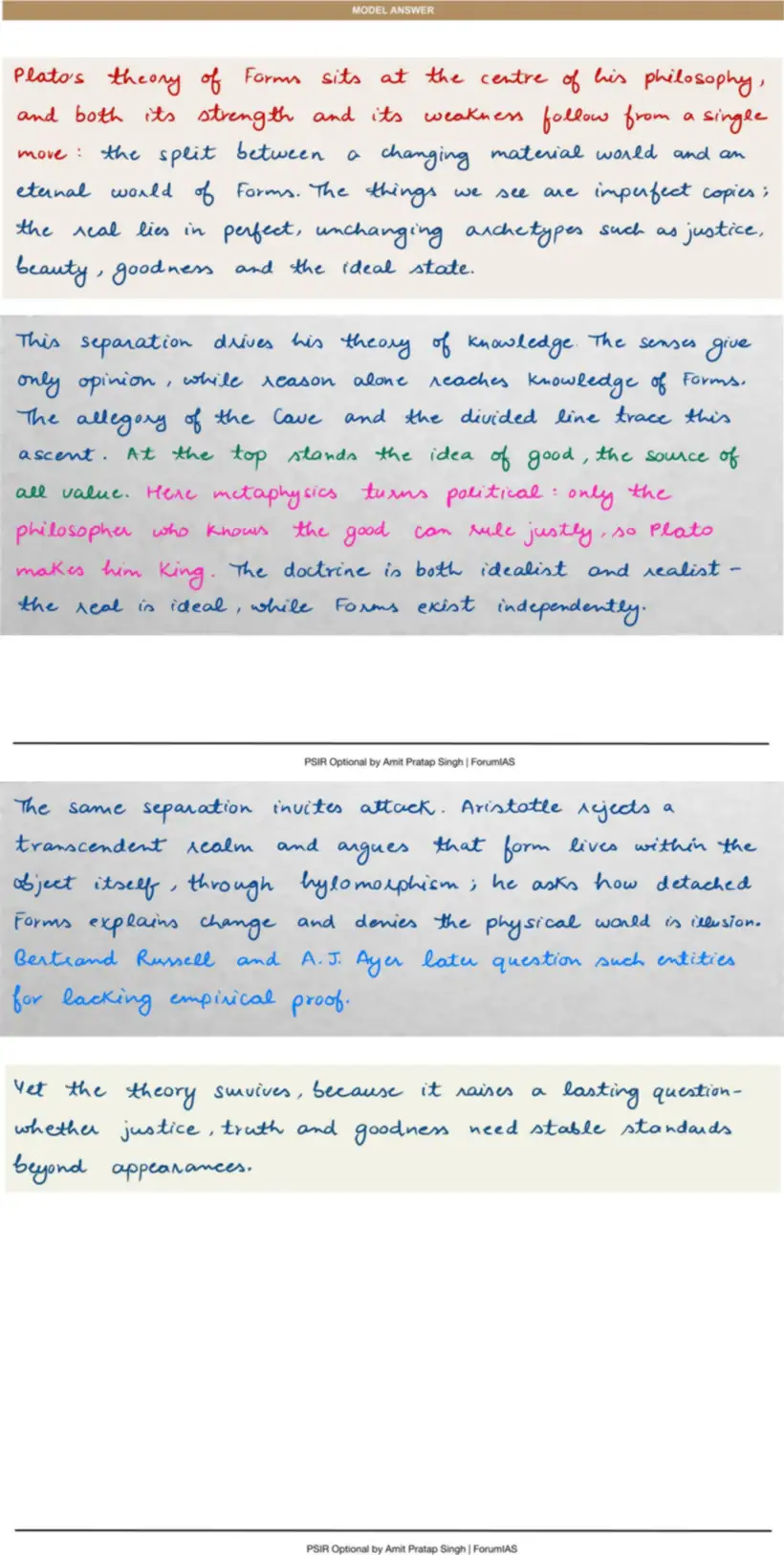
Model answer
Handwritten, in the form it would be written in the examination hall.
Also asked on this head
Western Political Thought — 29 questions in the Vault.
- Mill’s work was crucial to the development of liberalism, because it straddled the divide between classical and modern theories. Analyze.
- “Fortune favours the brave.” In the light of this statement, discuss Machiavelli’s concepts of ‘virtue’ and ‘fortune’.
- Hannah Arendt analysed a few categories of vita activa. Explain.
How this is taught
The same flow snapshot, built for every head of the syllabus, with the answer written in class.
The first session of Foundation 2027 is published in full.
Six programmes across three levels.