
Trace the evolution of western political thought from ancient to contemporary period.
How the answer moves
The flow snapshot — the routes in, the body, the counter-view and the routes out.
Route 1 tradition = one shifting question → what is politics for + where does authority rest → each age reworks the last
Route 2 read as a swing between ideal and power → Plato’s moral ideal → contemporary critique → continuity-in-change
Plato (ideal moral order, justice as harmony, rule of knowledge → philosopher king) → Aristotle (empirical turn, political animal, state natural & prior, rule of law → polity as best practicable) → Machiavelli (autonomy of politics, ethics/religion split, Dunning: medieval–modern borderline, power over good life) → Hobbes (first modern, authority from fearful self-preserving individuals → social contract → absolute sovereign) → Mill (order → its limits: liberty, individuality, self-development → women’s equality) → Gramsci (power beyond coercion → cultural hegemony → consent in civil society) → Arendt (against totalitarianism → politics as action → power as citizens acting together)
line not smooth → swings between ideal & real, authority & liberty → modern break (Machiavelli/Hobbes) disrupts the moral continuity Plato began
Route 1 one thread holds → from rule of knowledge → power as shared civic action → each age answers anew what politics is for
Route 2 evolution as continuity, not straight-line progress → same question (ends of politics, basis of authority) recast each age
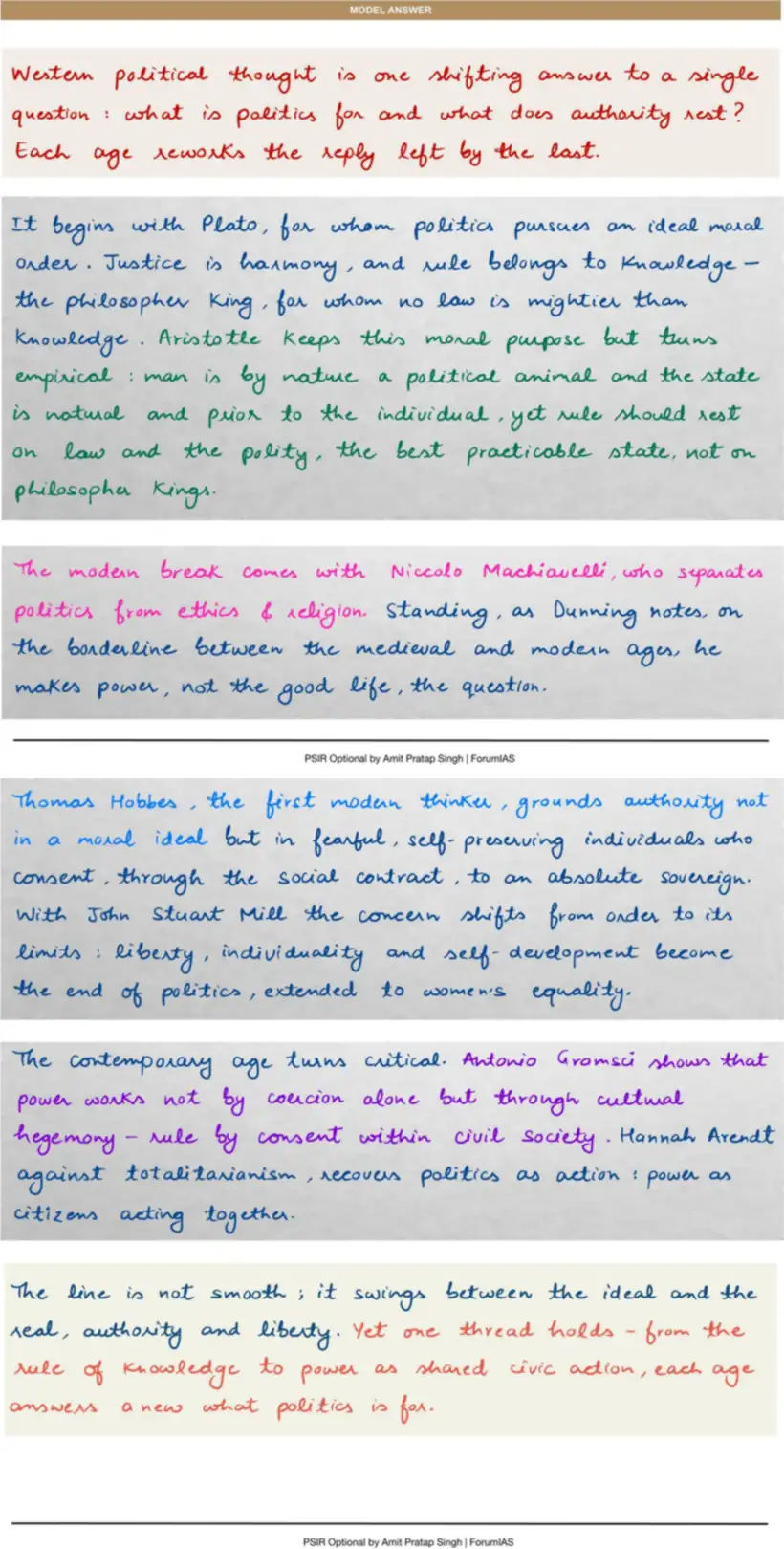
Model answer
Handwritten, in the form it would be written in the examination hall.
Also asked on this head
Western Political Thought — 29 questions in the Vault.
- Mill’s work was crucial to the development of liberalism, because it straddled the divide between classical and modern theories. Analyze.
- “Fortune favours the brave.” In the light of this statement, discuss Machiavelli’s concepts of ‘virtue’ and ‘fortune’.
- Hannah Arendt analysed a few categories of vita activa. Explain.
How this is taught
The same flow snapshot, built for every head of the syllabus, with the answer written in class.
The first session of Foundation 2027 is published in full.
Six programmes across three levels.