
“How would I and my fellow human beings behave if we were to find ourselves state of nature, and what does this behaviour tell us about our innate predispositions?” (Thomas Hobbes)
How the answer moves
The flow snapshot — the routes in, the body, the counter-view and the routes out.
Route 1 state of nature = hypothetical condition → remove common power → behaviour exposes innate nature
Route 2 start from man as matter in motion → self-preservation + fear → nature read off behaviour
appetite/aversion, self-preservation, fear → rough equality + scarcity → three causes of quarrel: competition, diffidence, glory → each a threat to all → war of every man against every man → “solitary, poor, nasty, brutish, and short” → not wickedness but restless desire for power “ceasing only in death” → against Aristotle’s natural sociability → guilt removed from selfishness, a fact of nature
Locke & Rousseau reject the pessimism → human nature not so bleak
Route 1 behaviour mirrors innate nature: fear + self-preservation, not depravity
Route 2 such a nature can be held in check only by a common power
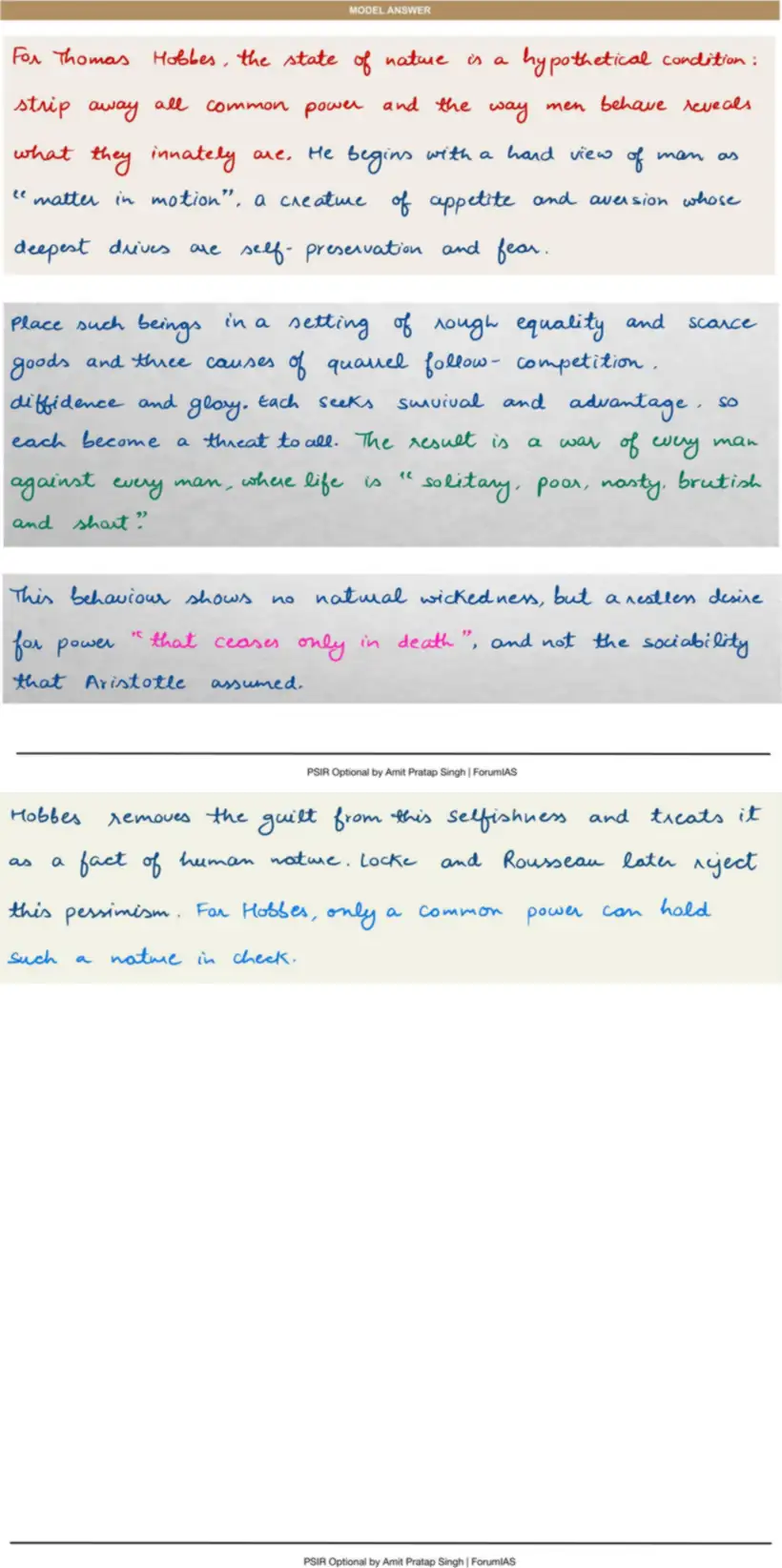
Model answer
Handwritten, in the form it would be written in the examination hall.
Also asked on this head
Western Political Thought — 29 questions in the Vault.
- Mill’s work was crucial to the development of liberalism, because it straddled the divide between classical and modern theories. Analyze.
- “Fortune favours the brave.” In the light of this statement, discuss Machiavelli’s concepts of ‘virtue’ and ‘fortune’.
- Hannah Arendt analysed a few categories of vita activa. Explain.
How this is taught
The same flow snapshot, built for every head of the syllabus, with the answer written in class.
The first session of Foundation 2027 is published in full.
Six programmes across three levels.