
Comment on the J. S. Mill’s ideas on women suffrage
How the answer moves
The flow snapshot — the routes in, the body, the counter-view and the routes out.
Route 1 Mill = earliest major male advocate of women’s vote → sex no basis for political rights
Route 2 restricted-franchise century → his stand = radical democratic intervention
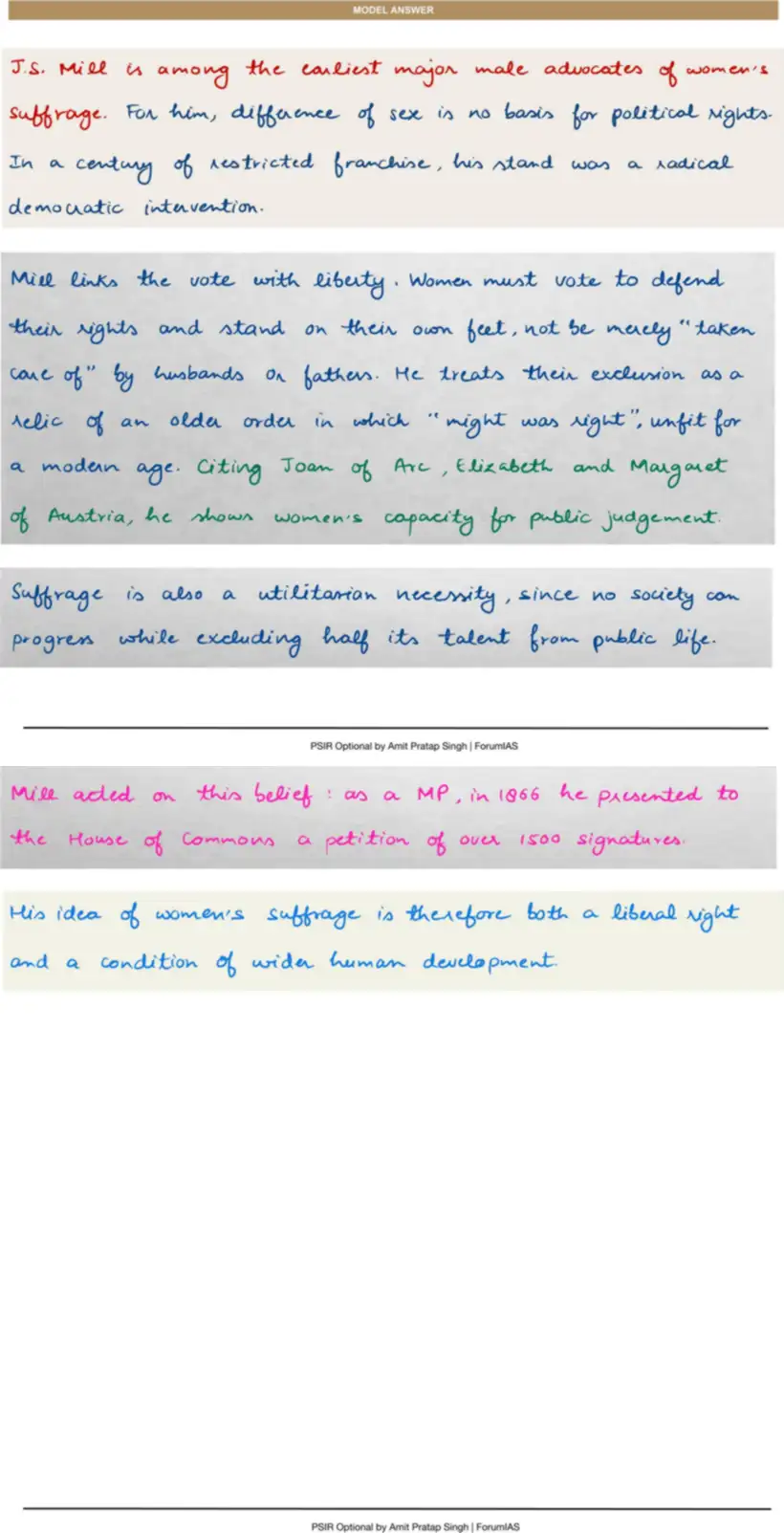
vote tied to liberty → defend own rights / stand on own feet / reject being “taken care of” → exclusion shown as relic of old “might was right” order, unfit for modern age → capability proven (Joan of Arc, Elizabeth, Margaret of Austria) → utilitarian necessity: no progress while half the talent is shut out → matched by practice (MP; 1866 petition, 1500+ signatures, House of Commons)
the older defence Mill overturns — sex as a ground for exclusion / women merely “taken care of” / “might was right” → set aside as pre-modern
Route 1 women’s vote = a liberal right + a condition of wider human development
Route 2 equal right joined to social progress → half of society’s talent freed for public life
Model answer
Handwritten, in the form it would be written in the examination hall.
Also asked on this head
Western Political Thought — 29 questions in the Vault.
- Mill’s work was crucial to the development of liberalism, because it straddled the divide between classical and modern theories. Analyze.
- “Fortune favours the brave.” In the light of this statement, discuss Machiavelli’s concepts of ‘virtue’ and ‘fortune’.
- Hannah Arendt analysed a few categories of vita activa. Explain.
How this is taught
The same flow snapshot, built for every head of the syllabus, with the answer written in class.
The first session of Foundation 2027 is published in full.
Six programmes across three levels.