
Comment on the Locke’s Social Contract in 150 words.
How the answer moves
The flow snapshot — the routes in, the body, the counter-view and the routes out.
Route 1 contract argues for limited, consent-based government, not absolute power
Route 2 men quit a moral state of nature (freedom/equality under natural law, not Hobbes’s war) only for its inconveniences
state of nature + inconveniences (no settled law / no impartial judge / weak enforcement) → chief end = life, liberty, property → distinctive two-stage split of society and government → unanimous community, then government as trustee → society prior to government, delegated power only → limited surrender (legislate / execute / judge) with natural rights retained → consent (express / tacit), unanimity then majority rule
Hobbes’s single-stage contract → absolute sovereignty, against Locke’s consent-based, revocable trust (Waldron: rights held as trust cannot pass to arbitrary power → absolutism ruled out)
Route 1 government a conditional fiduciary trust; breach dissolves the government, not society
Route 2 contract becomes the foundation of constitutional, accountable, limited rule
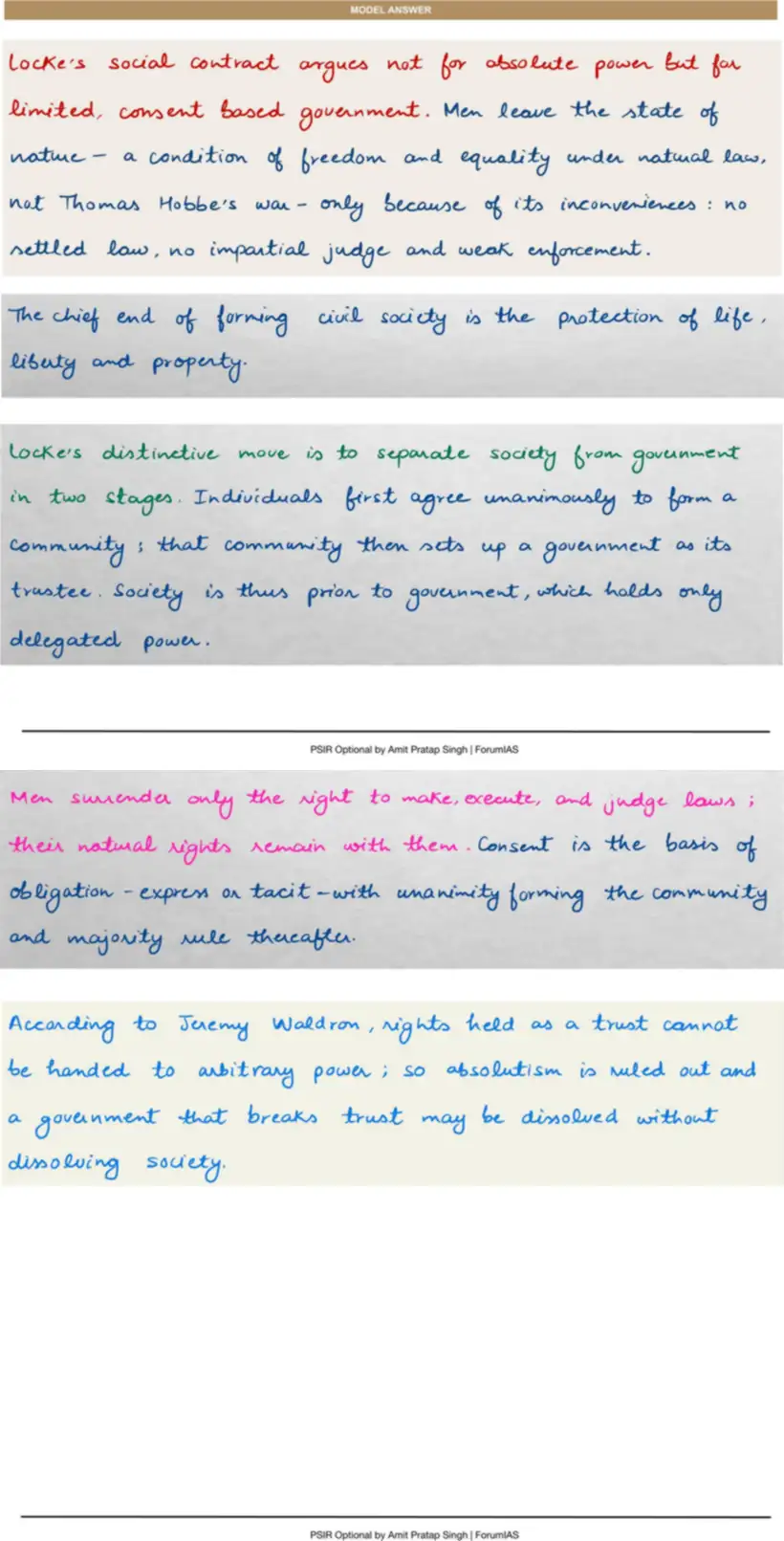
Model answer
Handwritten, in the form it would be written in the examination hall.
Also asked on this head
Western Political Thought — 29 questions in the Vault.
- Mill’s work was crucial to the development of liberalism, because it straddled the divide between classical and modern theories. Analyze.
- “Fortune favours the brave.” In the light of this statement, discuss Machiavelli’s concepts of ‘virtue’ and ‘fortune’.
- Hannah Arendt analysed a few categories of vita activa. Explain.
How this is taught
The same flow snapshot, built for every head of the syllabus, with the answer written in class.
The first session of Foundation 2027 is published in full.
Six programmes across three levels.