
John Stuart Mill is a ‘reluctant democrat’. – C. L. Wayper
How the answer moves
The flow snapshot — the routes in, the body, the counter-view and the routes out.
Route 1 defends representative government → but conditions democracy at every turn → Wayper’s ‘reluctant democrat’ → captures caution, not commitment
Route 2 representative government is his best practicable form → yet refuses unqualified majority rule → Wayper names this hesitation
best practicable form (society too complex for direct rule) → also educative (reason, judgement, political efficacy) → but democracy no free gift → fitness via civic culture + education → benevolent despotism for colonies (India, China) → Tocqueville’s fear: majority tyranny, mediocracy, mobocracy → safeguards: plural/weighted voting, educational filters, second chamber
radical-democratic strands pull back → women’s suffrage, minority representation, broad participation, open voting, state education → not anti-democratic
Route 1 reluctant only in scope, pace, institutional design → label fits hesitation, not faith
Route 2 champion of democracy, critic of crude majoritarianism → committed in principle, hesitant in form
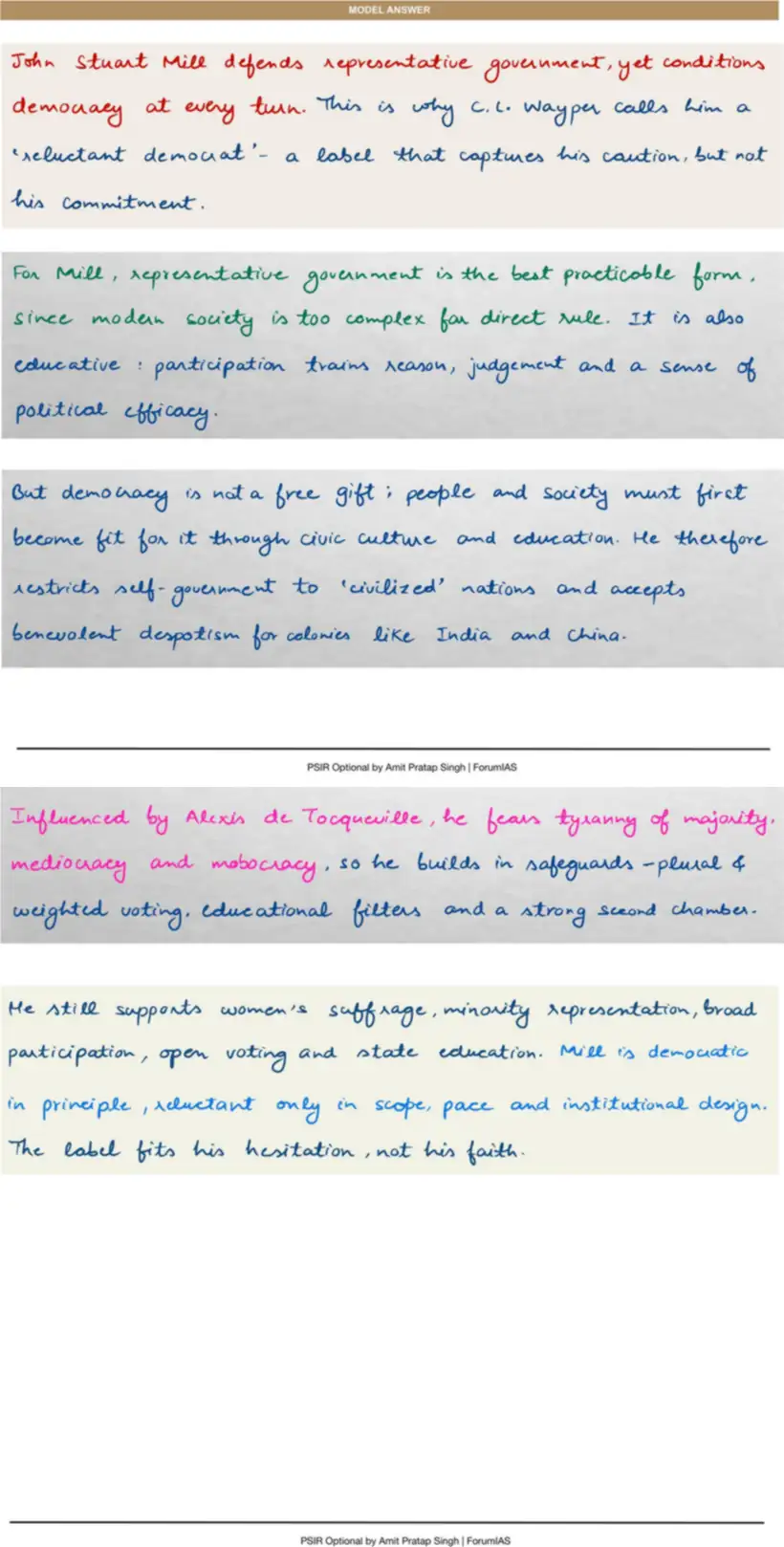
Model answer
Handwritten, in the form it would be written in the examination hall.
Also asked on this head
Western Political Thought — 29 questions in the Vault.
- Mill’s work was crucial to the development of liberalism, because it straddled the divide between classical and modern theories. Analyze.
- “Fortune favours the brave.” In the light of this statement, discuss Machiavelli’s concepts of ‘virtue’ and ‘fortune’.
- Hannah Arendt analysed a few categories of vita activa. Explain.
How this is taught
The same flow snapshot, built for every head of the syllabus, with the answer written in class.
The first session of Foundation 2027 is published in full.
Six programmes across three levels.