
John Locke is the father of liberalism. Explain.
How the answer moves
The flow snapshot — the routes in, the body, the counter-view and the routes out.
Route 1 Locke at centre of modern liberal thought → Seliger: first to elaborate liberalism as a complete system
Route 2 rights + consent + limited govt + property + toleration + resistance, bound into one frame → set against divine-right rule → title earned
reject Filmer / divine right → authority on consent, not inheritance → moral state of nature, not Hobbes’s war → natural rights (life, liberty, property) prior to state → government as fiduciary trust → society prior to government → only delegated power (make, execute, judge) under natural + standing law → liberty under law (“No law, no liberty”) → property as fruit of labour + toleration (conscience) + right to revolt → liberal frame complete
Macpherson: possessive individualism / Laski: negative state → yet Macpherson still locates Locke at the fountainhead of liberalism
Route 1 contract theory shifted from absolute sovereignty → constitutional rule → liberty under law, power under trust
Route 2 rights, consent, limited govt, toleration, resistance in a single system → why Locke remains the father of liberalism
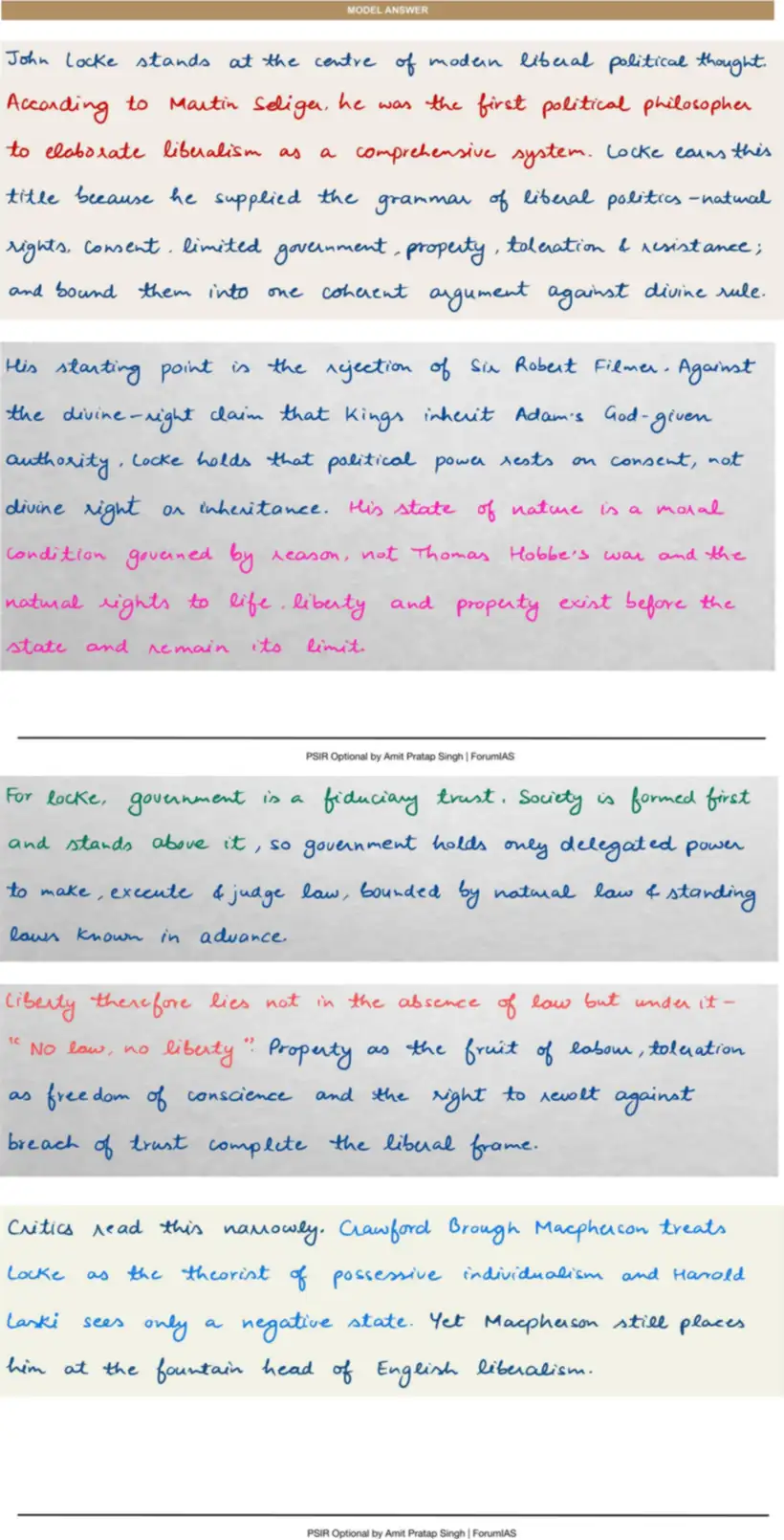
Model answer
Handwritten, in the form it would be written in the examination hall.
Also asked on this head
Western Political Thought — 29 questions in the Vault.
- Mill’s work was crucial to the development of liberalism, because it straddled the divide between classical and modern theories. Analyze.
- “Fortune favours the brave.” In the light of this statement, discuss Machiavelli’s concepts of ‘virtue’ and ‘fortune’.
- Hannah Arendt analysed a few categories of vita activa. Explain.
How this is taught
The same flow snapshot, built for every head of the syllabus, with the answer written in class.
The first session of Foundation 2027 is published in full.
Six programmes across three levels.