
National movement in India was anti-imperialist and increasingly radical in its socio-economic and political programmes. Discuss.
How the answer moves
The flow snapshot — the routes in, the body, the counter-view and the routes out.
Route 1 anti-imperialist from the start → British rule seen as exploitative and alien
Route 2 constant core, deepening trajectory → political demand and socio-economic content both hardened over time
Moderate drain critique (Naoroji) → Extremist rejection of colonial legitimacy + Swaraj (Tilak) → Swadeshi as mass economic anti-imperialism → Gandhian mass struggle (Non-Cooperation / Civil Disobedience / Quit India) → Lahore 1929 / Purna Swaraj (political radicalisation) → Russian Revolution → socialist turn (Nehru, Bose, Congress Socialist Party) → HSRA anti-capitalist / anti-feudal → Karachi Resolution 1931 (rights + economic programme) → Kisan Sabhas / trade unions (class enters nationalism)
radical in ideals, cautious in strategy → Congress hesitant before landlordism → class adjustment over class war
Route 1 anti-imperialism the constant; radicalism the trajectory, in both goal and programme
Route 2 revolutionary in social ambition → fuller social transformation deferred to the Constitution
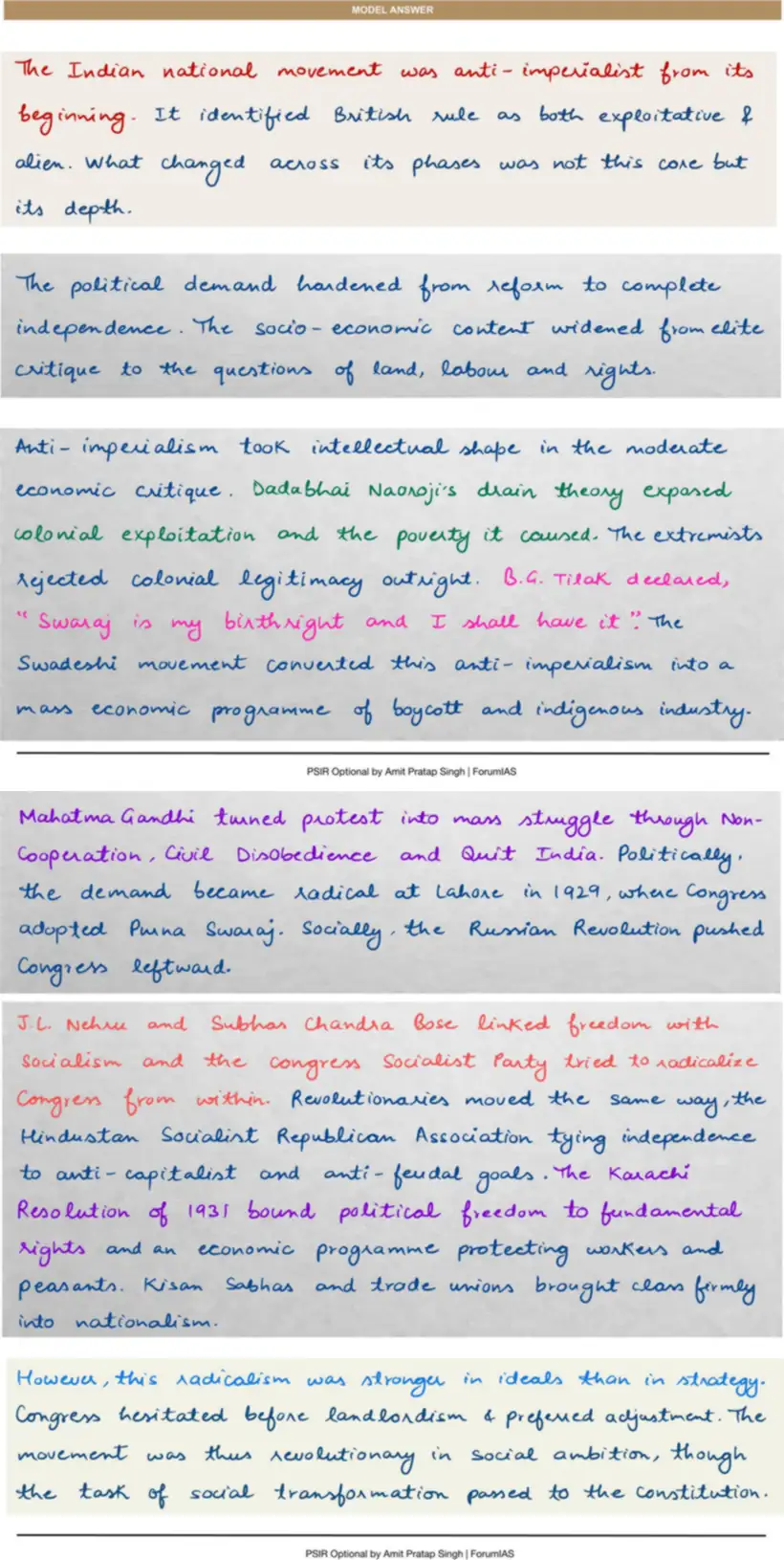
Model answer
Handwritten, in the form it would be written in the examination hall.
Also asked on this head
Indian Nationalism — 17 questions in the Vault.
- From passive resistors to armed revolutionaries, the Indian Freedom Struggle has a strong imprint of women freedom fighters. Elucidate.
- How did Swadeshi grow into a demand for Swaraj? (150 words)
- Analyse the workers’ movement in India in the pre-Independence period. (150 words)
How this is taught
The same flow snapshot, built for every head of the syllabus, with the answer written in class.
The first session of Foundation 2027 is published in full.
Six programmes across three levels.