
The success of Mahatma Gandhi lay in transforming both political and non-political movements into a unified nationalist movement.
How the answer moves
The flow snapshot — the routes in, the body, the counter-view and the routes out.
Route 1 pre-Gandhi nationalism = elite + constitutional debate → success = dissolving the political / social divide
Route 2 real achievement = fusing political and non-political into one movement → elite politics turned mass
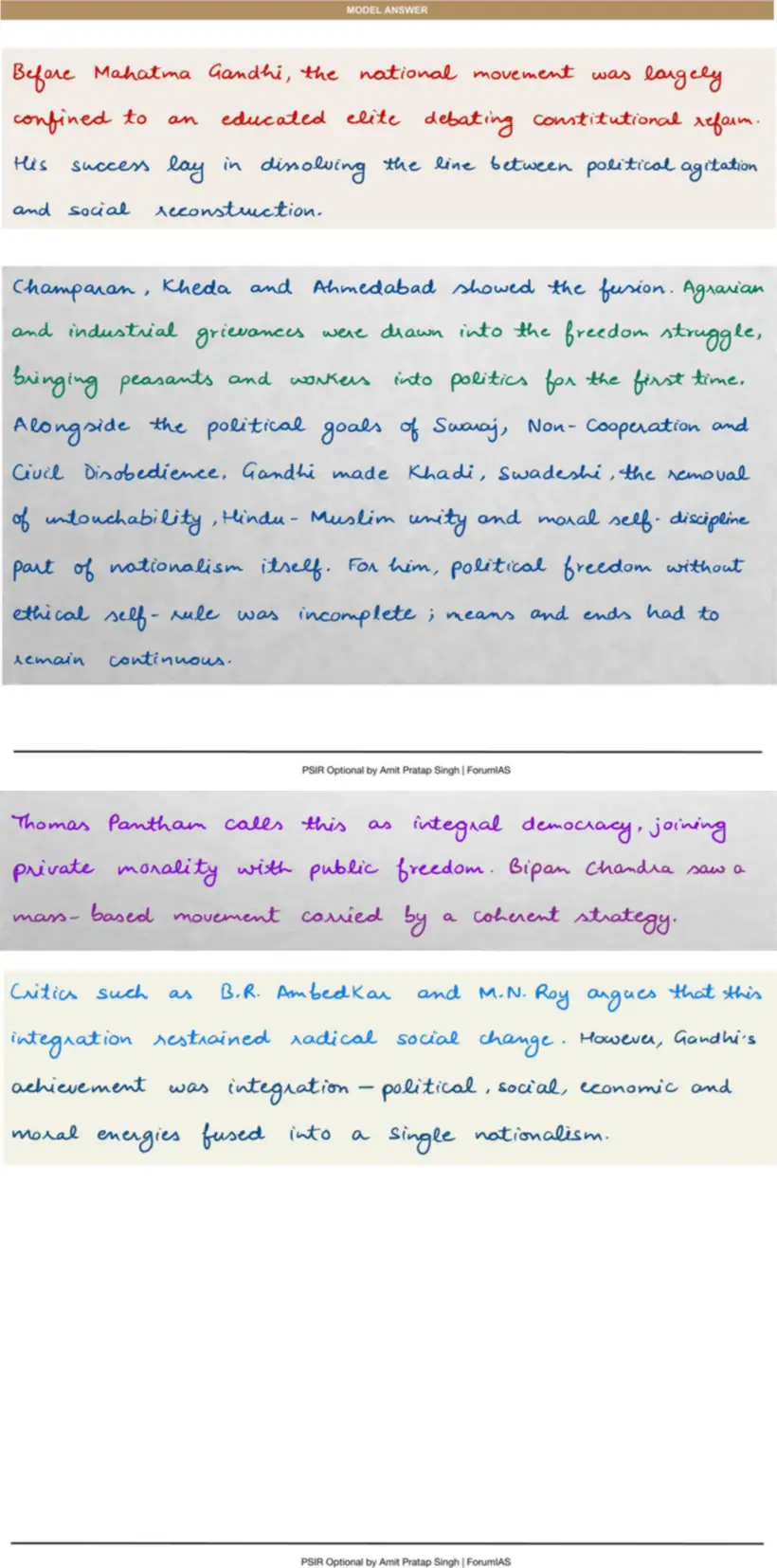
Champaran / Kheda / Ahmedabad fuse agrarian + industrial grievance with the freedom struggle → peasants & workers enter politics → political goals (Swaraj, Non-Cooperation, Civil Disobedience) joined with a non-political programme (khadi, Swadeshi, anti-untouchability, Hindu-Muslim unity, moral self-discipline) → continuity of means & ends; freedom without ethical self-rule incomplete → Pantham’s integral democracy (private morality + public freedom) → Bipan Chandra’s mass-based movement with a coherent strategy
Ambedkar & M.N. Roy: this very integration restrained radical social / caste-class transformation
Route 1 success lay in integration, not mere mobilization → political, social, economic, moral energies fused into a single nationalism
Route 2 unity of political and non-political = the distinctive Gandhian achievement → elite politics became a mass movement
Model answer
Handwritten, in the form it would be written in the examination hall.
Also asked on this head
Indian Nationalism — 17 questions in the Vault.
- From passive resistors to armed revolutionaries, the Indian Freedom Struggle has a strong imprint of women freedom fighters. Elucidate.
- How did Swadeshi grow into a demand for Swaraj? (150 words)
- Analyse the workers’ movement in India in the pre-Independence period. (150 words)
How this is taught
The same flow snapshot, built for every head of the syllabus, with the answer written in class.
The first session of Foundation 2027 is published in full.
Six programmes across three levels.