
Comment on the role of Socialists in Indian national movement in 150 words.
How the answer moves
The flow snapshot — the routes in, the body, the counter-view and the routes out.
Route 1 socialism enters in the 1920s–30s → Russian Revolution + post-war distress + post–Non-Cooperation disillusionment → freedom gains economic / class content
Route 2 nationalism so far mainly political → socialists add the class question → liberation tied to equality
origins (Russian Revolution, distress, disillusionment) → within Congress: Nehru + Bose → CSP 1934 (JP, Narendra Deva, Lohia) radicalize from within → Kisan Sabha + trade unions → freedom linked to workers + peasants + equality → social base widened → critique of Gandhi (class harmony, trusteeship, class contradiction) → underground role in Quit India
internal divisions + weak organization + doctrinal conflict → could not displace the Gandhian leadership
Route 1 limited in their own time, decisive in the long run → influence continued in planning, public sector, land reform, DPSP
Route 2 socialists made nationalism socially radical → freedom and equality joined as a lasting legacy
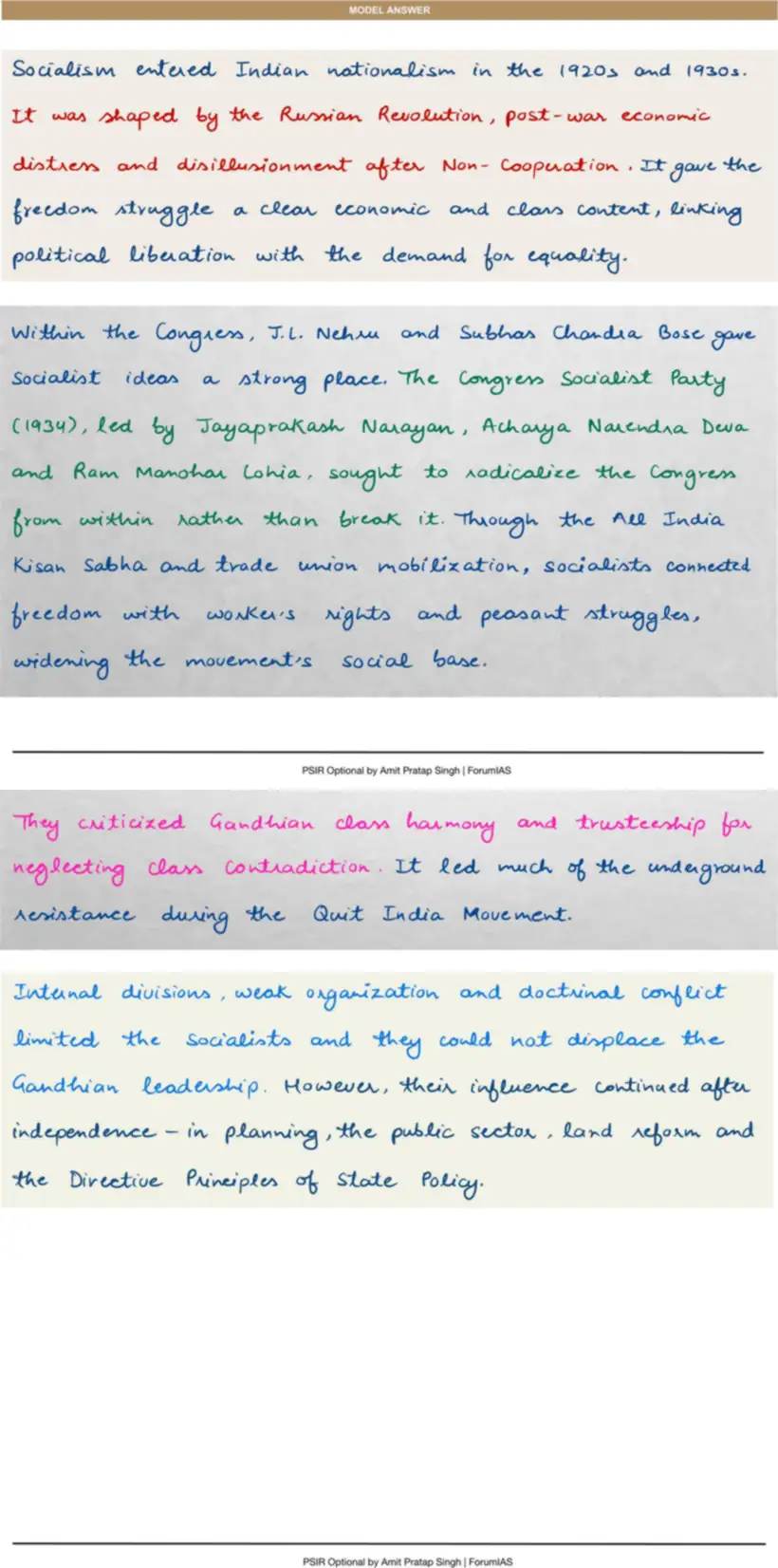
Model answer
Handwritten, in the form it would be written in the examination hall.
Also asked on this head
Indian Nationalism — 17 questions in the Vault.
- From passive resistors to armed revolutionaries, the Indian Freedom Struggle has a strong imprint of women freedom fighters. Elucidate.
- How did Swadeshi grow into a demand for Swaraj? (150 words)
- Analyse the workers’ movement in India in the pre-Independence period. (150 words)
How this is taught
The same flow snapshot, built for every head of the syllabus, with the answer written in class.
The first session of Foundation 2027 is published in full.
Six programmes across three levels.