
Critically examine the Radical Humanist perspective on Indian National Movement.
How the answer moves
The flow snapshot — the routes in, the body, the counter-view and the routes out.
Route 1 New Humanism → the individual is the end, society only the means → test = rational + ethical freedom, not independence alone
Route 2 Roy judges the movement incomplete → political independence ≠ real freedom → yardstick of reason, ethics, individual liberty
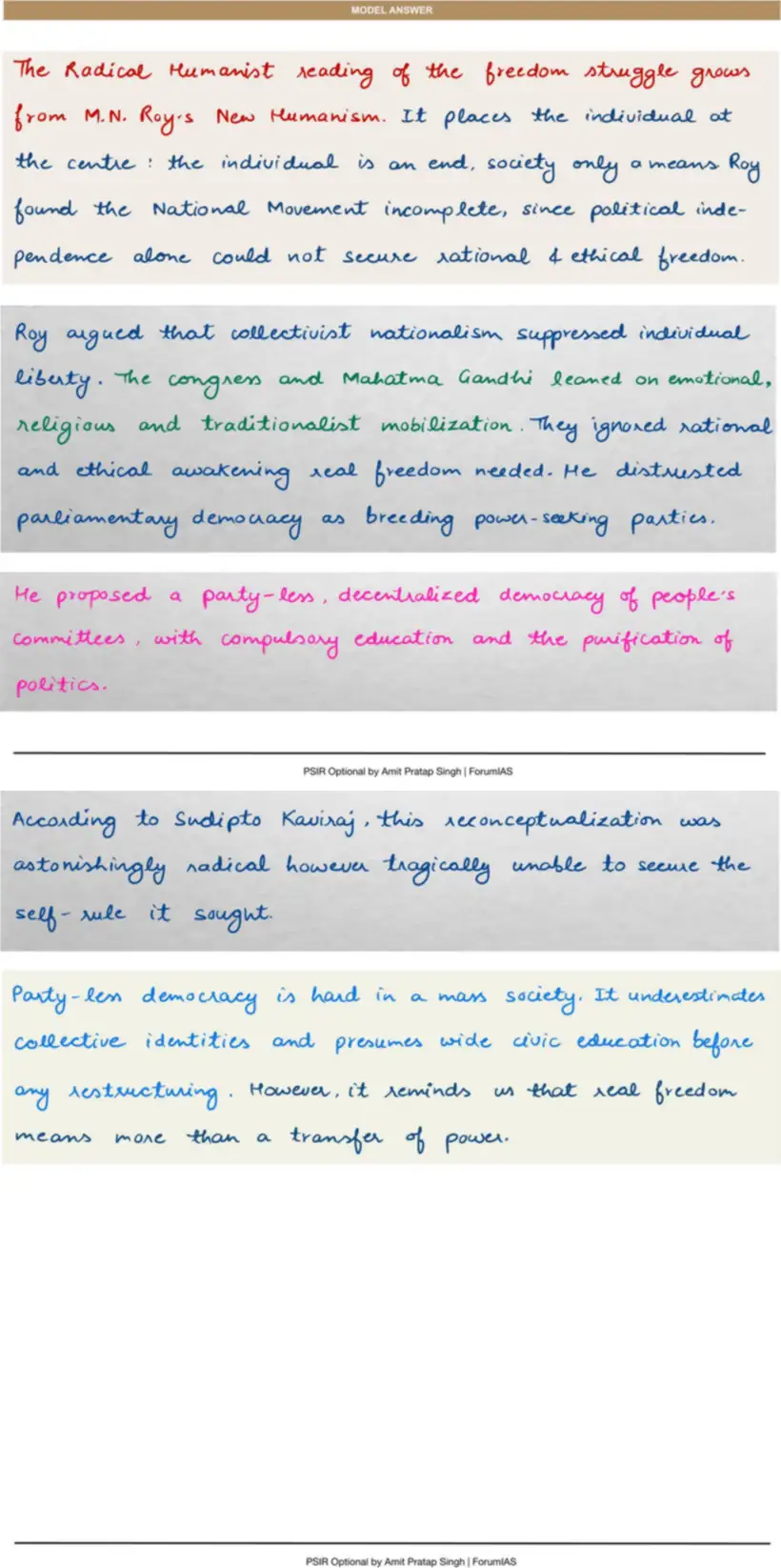
individual-centred premise → collectivist nationalism suppresses liberty → Congress / Gandhi: emotional, religious, traditionalist mobilization, no rational-ethical awakening → distrust of parliamentary democracy / power-seeking parties → alternative: party-less, decentralized people’s committees + compulsory education + purification of politics
Kaviraj: daring radicalism but a tragic loss of self-rule → party-less democracy impractical in a mass society → underestimates collective identities → presumes prior civic education
Route 1 freedom is more than a transfer of power → reason, ethics, individual liberty as its true content
Route 2 penetrating standard, impractical means → value lies in the yardstick, not the blueprint
Model answer
Handwritten, in the form it would be written in the examination hall.
Also asked on this head
Indian Nationalism — 17 questions in the Vault.
- From passive resistors to armed revolutionaries, the Indian Freedom Struggle has a strong imprint of women freedom fighters. Elucidate.
- How did Swadeshi grow into a demand for Swaraj? (150 words)
- Analyse the workers’ movement in India in the pre-Independence period. (150 words)
How this is taught
The same flow snapshot, built for every head of the syllabus, with the answer written in class.
The first session of Foundation 2027 is published in full.
Six programmes across three levels.