
Dalit perspective on Indian national movement. Discuss.
How the answer moves
The flow snapshot — the routes in, the body, the counter-view and the routes out.
Route 1 national movement not judged by anti-colonial unity alone → real test = social emancipation
Route 2 Dalit lens reframes ‘freedom’ → political Swaraj meaningless without social equality
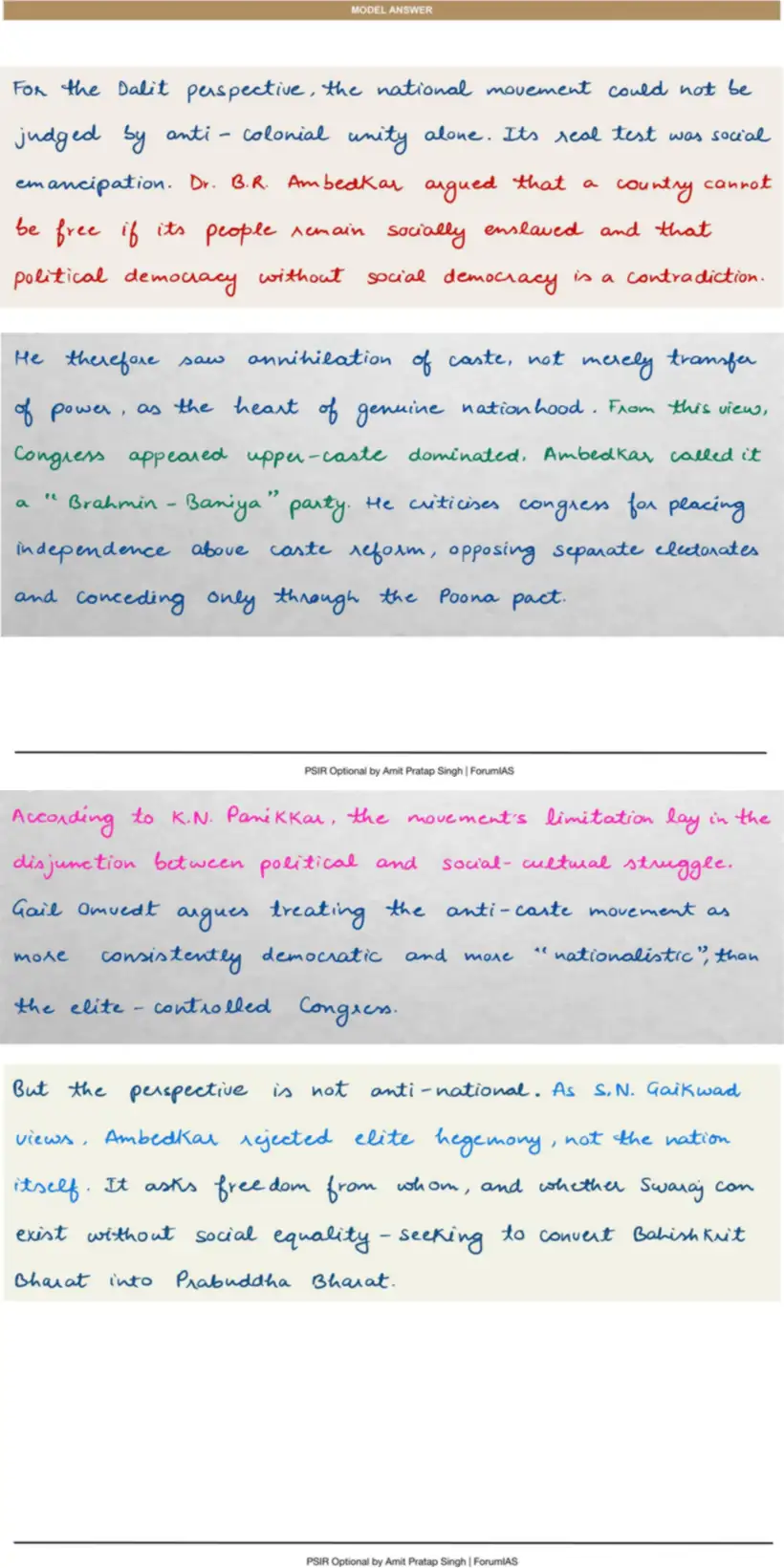
Ambedkar: no freedom while people remain socially enslaved → political democracy minus social democracy = contradiction → annihilation of caste as the core of nationhood → Congress upper-caste dominated / ‘Brahmin-Baniya’ → independence placed above caste reform → separate electorates opposed → Poona Pact compromise → Panikkar: disjunction between political and social-cultural struggle → Omvedt: anti-caste movement more democratic and ‘nationalistic’ than the elite Congress
perspective not anti-national → Gaikwad: a rejection of elite hegemony, not of the nation
Route 1 asks ‘freedom for whom?’ → no Swaraj without social equality
Route 2 Bahishkrit Bharat → Prabuddha Bharat → freedom complete only with social equality
Model answer
Handwritten, in the form it would be written in the examination hall.
Also asked on this head
Indian Nationalism — 17 questions in the Vault.
- From passive resistors to armed revolutionaries, the Indian Freedom Struggle has a strong imprint of women freedom fighters. Elucidate.
- How did Swadeshi grow into a demand for Swaraj? (150 words)
- Analyse the workers’ movement in India in the pre-Independence period. (150 words)
How this is taught
The same flow snapshot, built for every head of the syllabus, with the answer written in class.
The first session of Foundation 2027 is published in full.
Six programmes across three levels.