
Discuss the contribution of the Dalit struggle to establish egalitarianism in Indian society during freedom movement.
How the answer moves
The flow snapshot — the routes in, the body, the counter-view and the routes out.
Route 1 mainstream freedom = political independence → Dalit struggle widens it → social equality becomes the real test of freedom
Route 2 freedom hollow while caste enslaves → political Swaraj incomplete without social democracy → spine: egalitarianism as the meaning of freedom
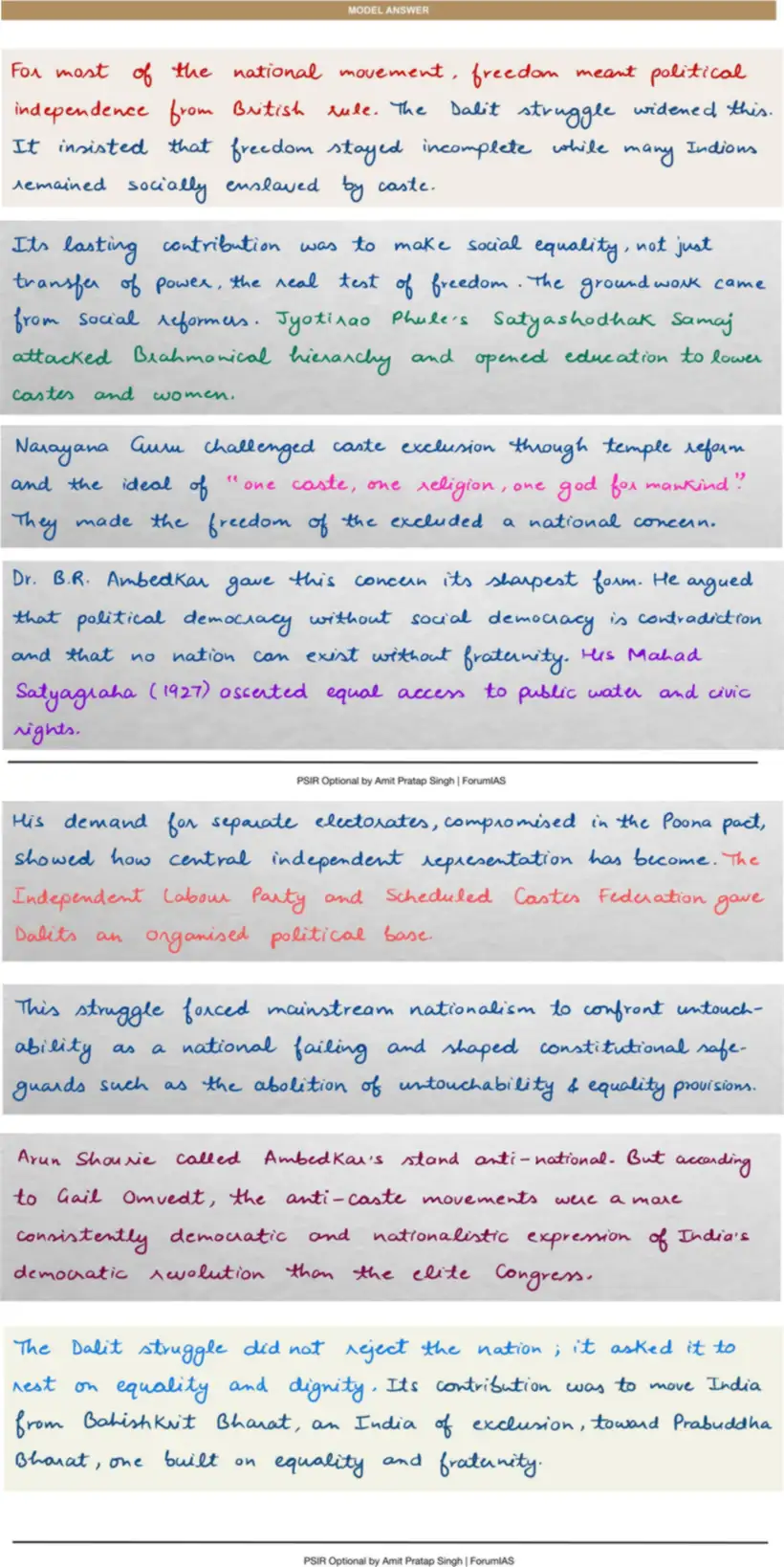
reformers (Phule – Satyashodhak Samaj – education for lower castes / women; Narayana Guru – temple reform – ‘one caste, one religion, one god’) → Ambedkar’s theory (political democracy without social democracy = contradiction; no nation without fraternity) → Ambedkar’s action (Mahad Satyagraha 1927 – public water / civic rights; separate electorates – Poona Pact compromise; ILP + Scheduled Castes Federation – organised base) → forces mainstream nationalism to confront untouchability → feeds constitutional safeguards (abolition of untouchability, equality provisions)
Arun Shourie: Ambedkar’s stand anti-national → rebutted by Omvedt: anti-caste movements more consistently democratic + nationalistic than the elite Congress
Route 1 the Dalit struggle did not reject the nation → it asked the nation to rest on equality + dignity
Route 2 moved India from Bahishkrit Bharat (exclusion) to Prabuddha Bharat (equality + fraternity)
Model answer
Handwritten, in the form it would be written in the examination hall.
Also asked on this head
Indian Nationalism — 17 questions in the Vault.
- From passive resistors to armed revolutionaries, the Indian Freedom Struggle has a strong imprint of women freedom fighters. Elucidate.
- How did Swadeshi grow into a demand for Swaraj? (150 words)
- Analyse the workers’ movement in India in the pre-Independence period. (150 words)
How this is taught
The same flow snapshot, built for every head of the syllabus, with the answer written in class.
The first session of Foundation 2027 is published in full.
Six programmes across three levels.