
The Comptroller and Auditor-General of India enhances the accountability of the Government and serves as the watchdog of the finances of the Government. Explain.
How the answer moves
The flow snapshot — the routes in, the body, the counter-view and the routes out.
Route 1 Art. 148 → independent CAG → Ambedkar: most important office → secures answerability for public money
Route 2 executive handles finance → needs an external check → CAG stakes that check
audit scope (Consolidated/Contingency/Public Account, receipts, govt companies, financed bodies, net proceeds of taxes) → reports to President/Governors → laid before legislatures → PAC (friend, philosopher, guide) tests authorised spending → Iyer: accountability = answerability → performance audit (economy/efficiency/effectiveness) → Vinod Rai (2G, coal, CWG) → watchdog made visible
Basu: no control over release of funds → audits after spending → watchdog, not comptroller → delayed reports, weak PPP coverage
Route 1 within limits, CAG converts financial power into answerability → enhances accountability
Route 2 strength rests on independence + reporting to legislature, not executive → watchdog is real only when Parliament acts on its reports
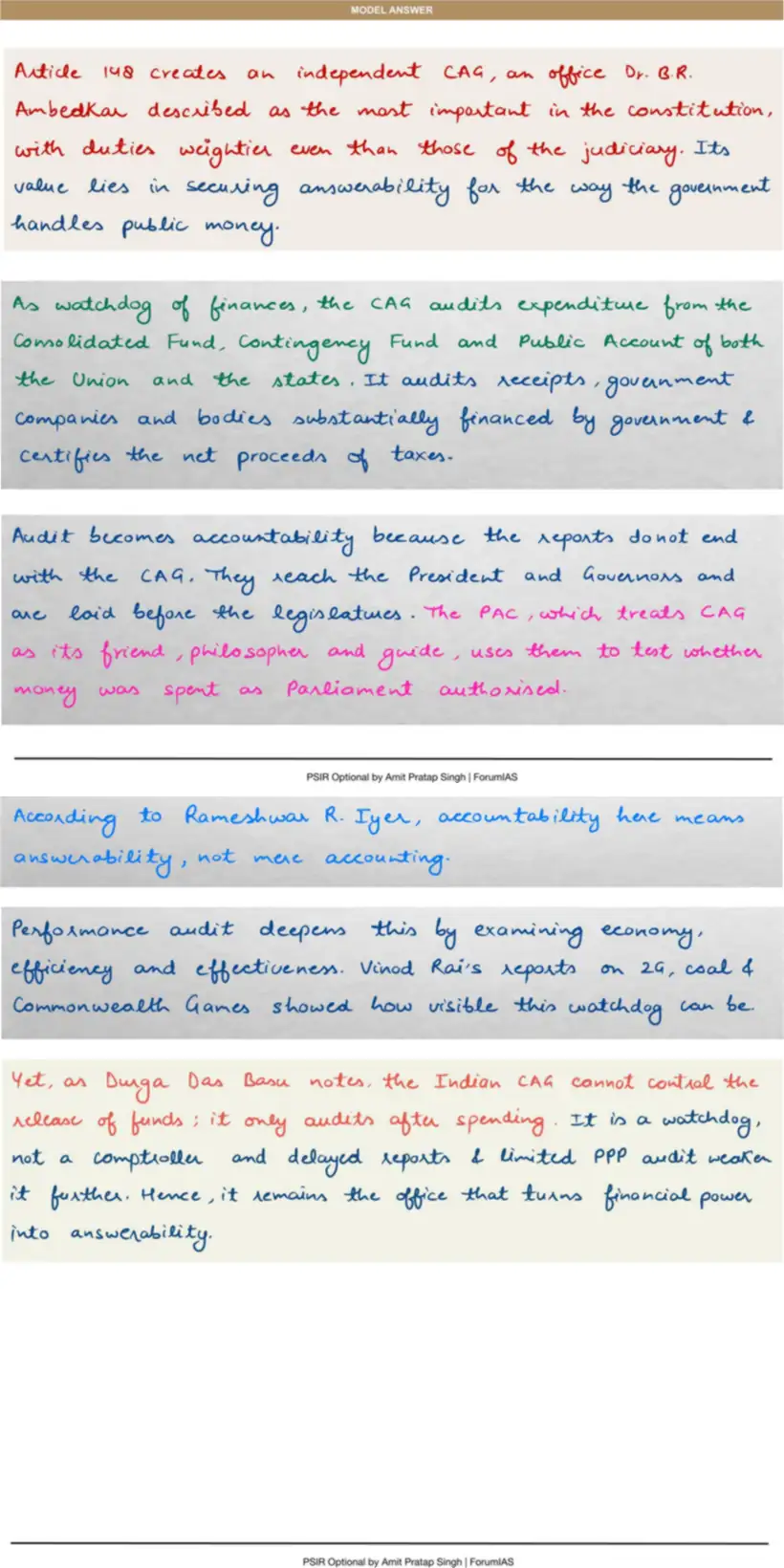
Model answer
Handwritten, in the form it would be written in the examination hall.
Also asked on this head
Statutory Institutions / Commissions — 12 questions in the Vault.
- There is a debate on the procedure for appointment of the Chief Election Commissioner and Election Commissioners to the Election Commission of India. Analyse its various...
- Discuss the policy initiatives of the Fourteenth Finance Commission aimed towards promoting and strengthening agricultural development in India.
- How far has been the National Human Rights Commission successful in achieving its objectives? Comment.
How this is taught
The same flow snapshot, built for every head of the syllabus, with the answer written in class.
The first session of Foundation 2027 is published in full.
Six programmes across three levels.