
Discuss, in brief, the role of the National Commission for women. Do you think it is a toothless organization?
How the answer moves
The flow snapshot — the routes in, the body, the counter-view and the routes out.
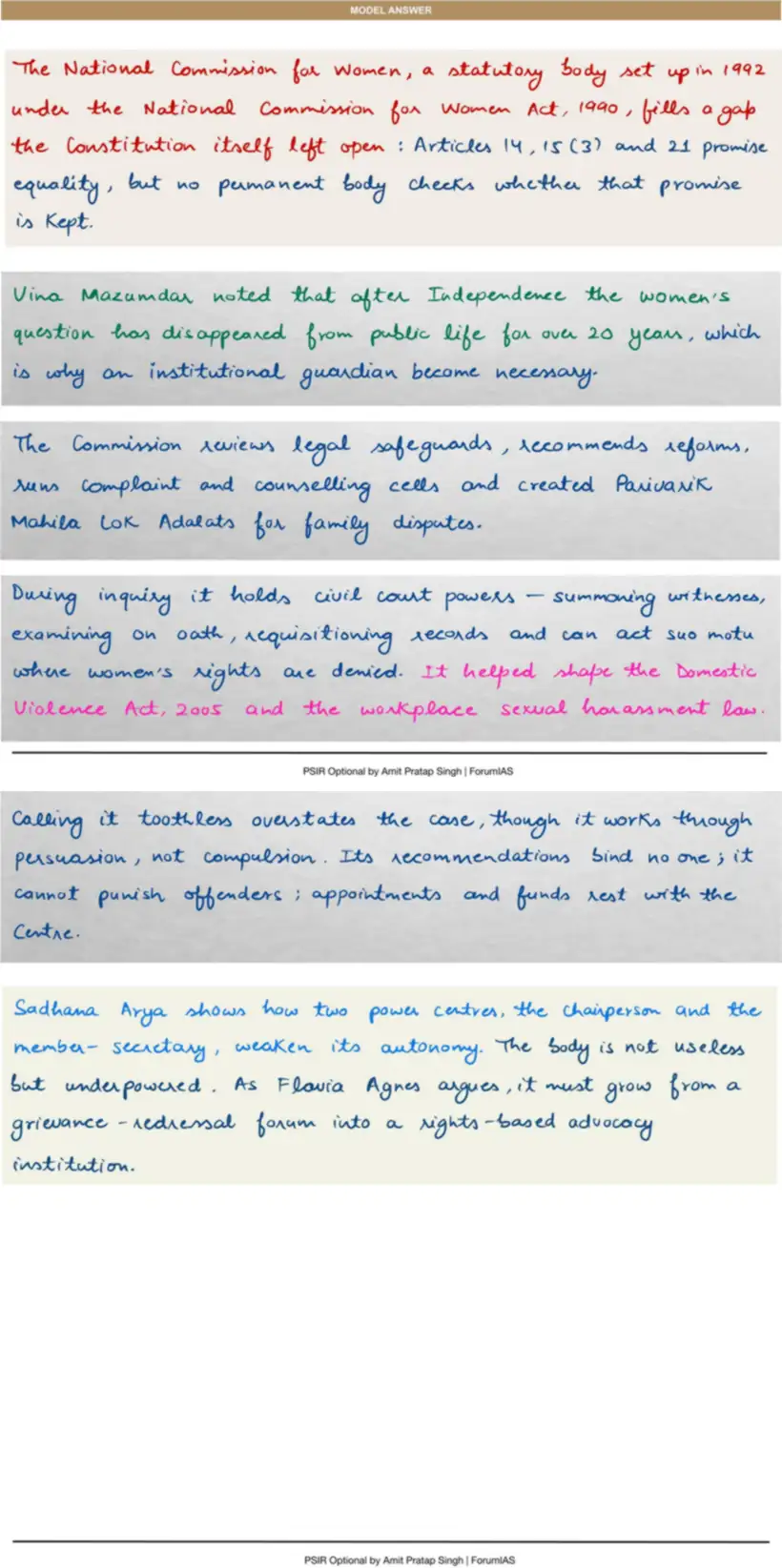
Route 1 constitutional gap → Arts 14, 15(3), 21 promise equality, no permanent monitor → NCW fills it (statutory, 1990 Act, est. 1992)
Route 2 women’s question vanished post-Independence (Mazumdar) → institutional guardian needed
reviews safeguards + recommends reforms → complaint/counselling cells + Parivarik Mahila Lok Adalats → civil court powers + suo motu → shaped DV Act 2005 / workplace harassment law
“toothless” charge → recommendations non-binding → no power to punish → appointments + funds with Centre → Arya: two power centres (Chairperson / Member-Secretary) weaken autonomy
Route 1 not toothless but underpowered → persuasion, not compulsion
Route 2 reform direction (Agnes) → grievance redressal → rights-based advocacy institution
Model answer
Handwritten, in the form it would be written in the examination hall.
Also asked on this head
Statutory Institutions / Commissions — 12 questions in the Vault.
- There is a debate on the procedure for appointment of the Chief Election Commissioner and Election Commissioners to the Election Commission of India. Analyse its various...
- Discuss the policy initiatives of the Fourteenth Finance Commission aimed towards promoting and strengthening agricultural development in India.
- How far has been the National Human Rights Commission successful in achieving its objectives? Comment.
How this is taught
The same flow snapshot, built for every head of the syllabus, with the answer written in class.
The first session of Foundation 2027 is published in full.
Six programmes across three levels.