
Examine the objective and role of the National Human Rights Commission.
How the answer moves
The flow snapshot — the routes in, the body, the counter-view and the routes out.
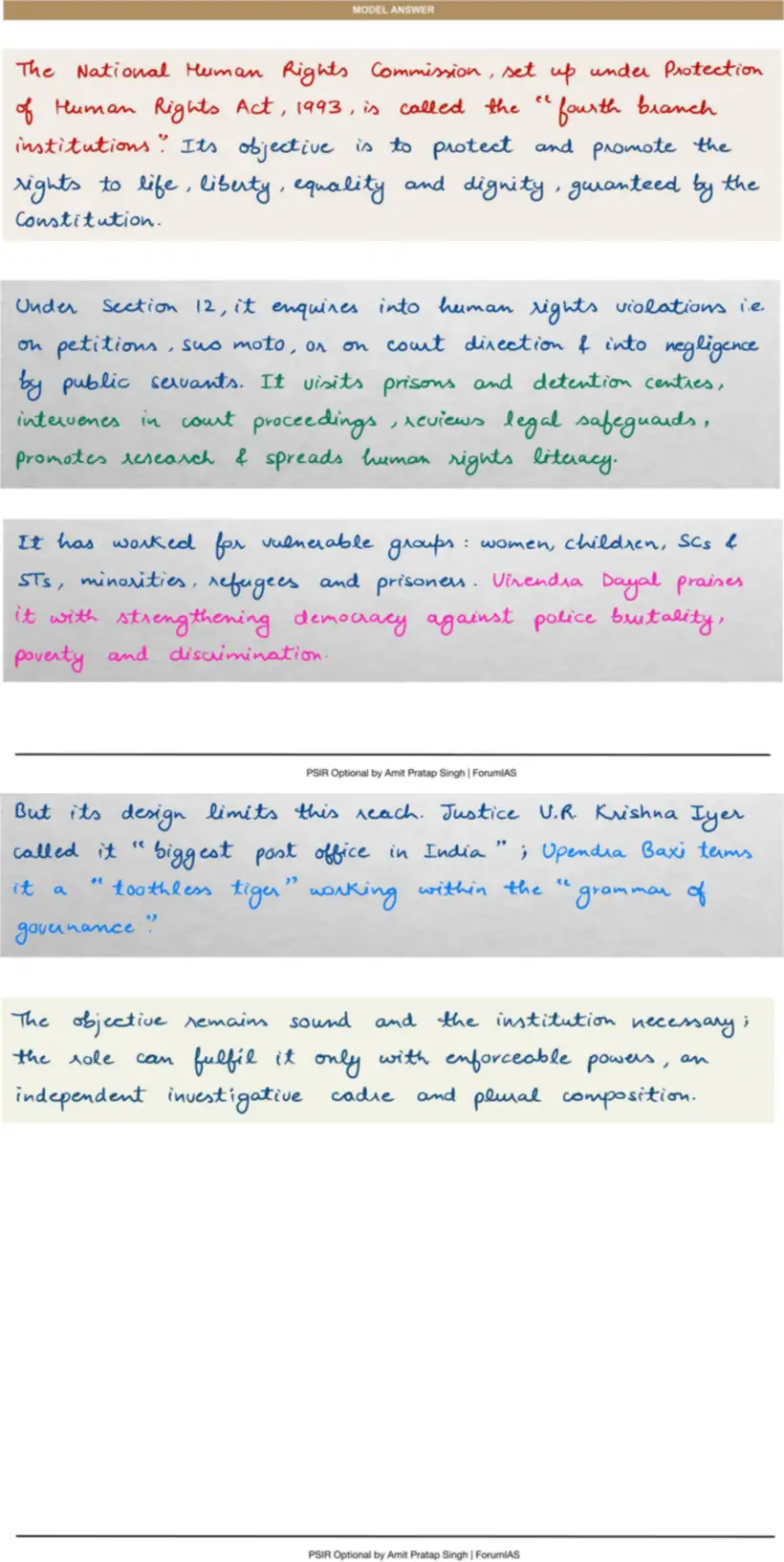
Route 1 NHRC under PHRA 1993 → Bhatia’s “fourth branch institution” (makes democracy workable) → objective = protect/promote life, liberty, equality, dignity (Constitution + covenants, enforceable in courts)
Route 2 Mandela’s moral framing on denying rights → rights as life/liberty/equality/dignity → NHRC as their statutory guardian under PHRA 1993
objective shapes role → Section 12 inquiry (petitions / suo motu / court direction) + negligence of public servants → prison visits, court intervention, review of safeguards, research, rights literacy → reach to vulnerable groups (women, children, SC/ST, minorities, refugees, prisoners) → Dayal: strengthened democracy
recommendatory design caps reach → non-binding, govt dependence, one-year bar, armed-forces restriction → Krishna Iyer “biggest post office” / Baxi “toothless tiger”, “grammar of governance”
Route 1 objective sound, institution necessary → role serves it fully only with enforceable powers + independent cadre + plural composition
Route 2 move from “post office”/critique to Verma’s “conscience keeper of the nation” → empowerment, not abolition, is the corrective
Model answer
Handwritten, in the form it would be written in the examination hall.
Also asked on this head
Statutory Institutions / Commissions — 12 questions in the Vault.
- There is a debate on the procedure for appointment of the Chief Election Commissioner and Election Commissioners to the Election Commission of India. Analyse its various...
- Discuss the policy initiatives of the Fourteenth Finance Commission aimed towards promoting and strengthening agricultural development in India.
- How far has been the National Human Rights Commission successful in achieving its objectives? Comment.
How this is taught
The same flow snapshot, built for every head of the syllabus, with the answer written in class.
The first session of Foundation 2027 is published in full.
Six programmes across three levels.